

Your Land Rover just started knocking, smoking, or losing power on the motorway. Now you're staring down a repair bill that might cost more than the car is worth, wondering if a new engine is even worth it.
Here's the good news: you don't need a brand-new engine to get your Land Rover back on the road properly. A used Land Rover engine, sourced correctly and tested properly, can save you thousands over a main dealer replacement while getting you the exact same performance you had before the fault.
At RR Engine Works, we supply used Land Rover engines for every major model, from the Defender through to the Range Rover Vogue, all tested, matched to your vehicle, and backed by a genuine warranty. This guide walks you through exactly what to look for, what to avoid, and how to buy the right engine the first time.
Used Land Rover Engines for Every Model
Not every Land Rover engine is interchangeable, even within the same model line. A 2.2 TD4 Freelander engine won't slot into a 2.4 TDCi Defender, and a Discovery 3's 2.7 TDV6 differs mechanically from the Discovery 4's 3.0 TDV6, despite looking similar on paper. Getting the right engine for your exact vehicle starts with knowing your model, engine code, and year.
Used Defender Engines
The Defender has run on several distinct engine families over the years, and each one has its own reputation. Early Defenders used the Td5, a five-cylinder diesel known for being relatively simple to work on but prone to head gasket issues if overheated. Later models moved to the 2.2 and 2.4 Puma diesel engines, which are more refined but more sensitive to poor maintenance, particularly around the timing belt and injectors.
If you're replacing a Defender engine, we stock used units across the Td5, 2.2 Puma, and 2.4 Puma ranges, all pulled from verified donor vehicles and checked against your registration or engine code before dispatch.
Used Discovery Engines
The Discovery range spans multiple generations, and the engine differences between them matter a lot when you're sourcing a replacement.
Used Discovery 3, Discovery 4 & Discovery 5 Engines
- Discovery 3 typically runs the 2.7 TDV6, a capable diesel but one known for timing chain wear if service intervals slip.
- Discovery 4 upgraded to the 3.0 TDV6 and later the 3.0 SDV6, both stronger performers with better fuel injection systems.
- Discovery 5 moved onto the Ingenium engine family, a more modern, electronically complex diesel that requires careful ECU matching when replaced.
Because these generations look similar but use very different internals, we always confirm the exact engine code against your V5C or registration before quoting, rather than assuming based on the model year alone.
Used Range Rover Engines
Range Rover owners are usually dealing with either the TDV6, SDV6, TDV8, or in the case of the L405 and L494, increasingly the Ingenium diesel or the 5.0 V8 petrol. These are premium vehicles, and the engines reflect that in complexity, so donor engine quality and full ancillary compatibility matter more here than almost anywhere else in the range.
We supply used engines across the Range Rover Sport, Range Rover Vogue, and older L322 platforms, each tested and documented before it leaves our workshop.
Used Freelander Engines
The Freelander and Freelander 2 mostly ran the 2.2 TD4 diesel, alongside some earlier petrol variants. These are among the more affordable Land Rover engines to source used, and demand for them stays consistently high because the Freelander was such a common daily-driver choice across the UK.
Land Rover Engines by Code – Td5, Puma, TDV6, SDV6 & Ingenium
If you already know your engine code, sourcing the right replacement becomes far more straightforward. Here's a quick reference for the engine families we work with most often:
Engine Code | Common Models | Fuel Type | Known For |
| Td5 | Defender, Discovery 2 | Diesel | Simple, robust, head gasket sensitivity |
| Puma (2.2/2.4) | Defender | Diesel | Refined but timing belt sensitive |
| TDV6 | Discovery 3/4, Range Rover Sport | Diesel | Strong but chain wear if neglected |
| SDV6 | Discovery 4, Range Rover Sport | Diesel | Improved injection, better economy |
| TDV8 | Range Rover L322/L405 | Diesel | Powerful, premium application |
| Ingenium | Discovery 5, Range Rover L405/L494 | Diesel/Petrol | Modern, ECU-dependent |
Not sure which code your Land Rover runs? Send us your registration and we'll confirm the exact engine code, no guesswork involved.
How to Choose the Right Used Land Rover Engine
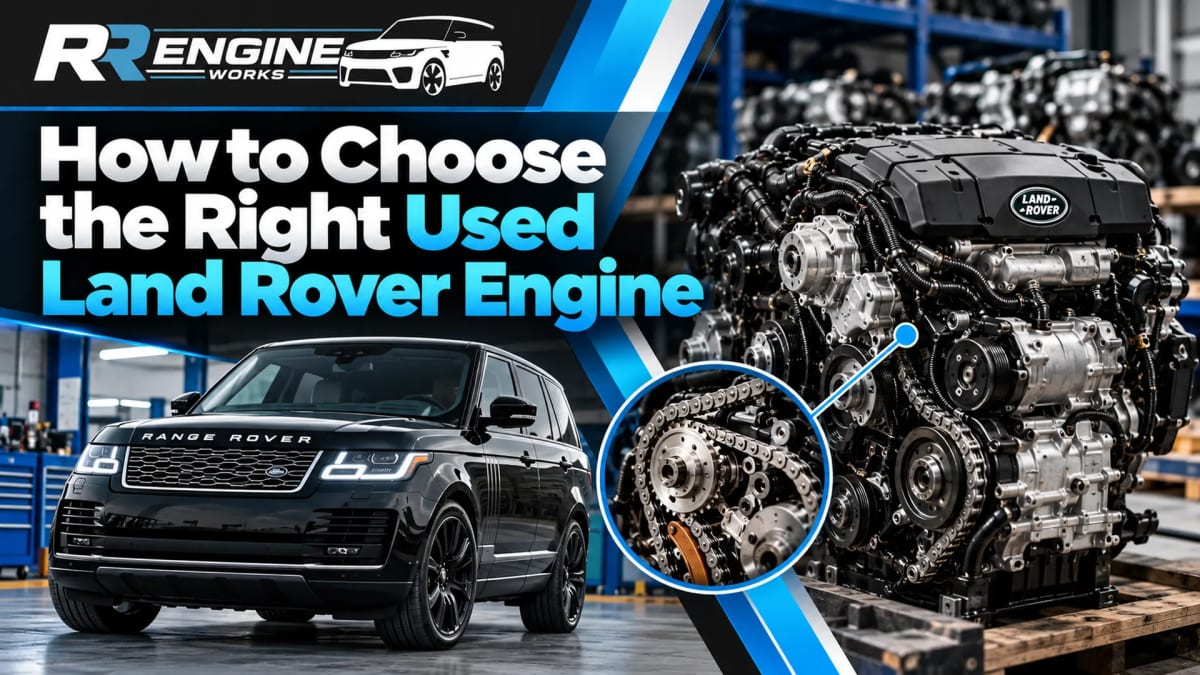
Picking a used engine isn't just about finding one that fits the model name. Getting this wrong means paying for a second removal and refit, so it's worth spending five minutes checking these details properly before you commit.
How to Check Your Land Rover Engine Code and VIN Match
Every Land Rover engine has a stamped engine code, usually found on the engine block itself, and this code should match what's listed on your V5C logbook. Two Discoveries from the same year can carry different engines depending on trim level and market, so relying on the model name alone is a common and costly mistake.
The safest approach is to give your supplier either your full registration number or your VIN. A reputable supplier will cross-check this against their stock before confirming compatibility, rather than just taking your word for the model.
Why Mileage and Donor Vehicle History Matter
A used engine's mileage tells you roughly where it sits in its wear cycle, but mileage alone doesn't tell the whole story. An engine with 90,000 miles that's had regular oil changes and gentle use can outperform a 60,000-mile engine that's been neglected or driven hard.
That's why we always look at:
- Service history of the donor vehicle – regular maintenance is a strong reliability indicator
- Reason for donor vehicle removal – accident-damaged vehicles often have perfectly healthy engines
- Mileage relative to engine type – some engines, like the Td5, tend to run well past 150,000 miles with proper care, while others are more mileage-sensitive
- Storage conditions – an engine that's sat outdoors for months needs closer inspection for corrosion
Low mileage is a good sign, but it's one data point among several, not a replacement for proper testing.
Used vs Reconditioned vs Rebuilt Land Rover Engines
This is probably the single most common question we get, and the honest answer is: it depends on your budget, your timeline, and how long you plan to keep the vehicle.
Engine Type | Condition | Typical Cost | Testing Level | Best For |
| Used | Complete unit from a donor vehicle | Lower | Varies by supplier | Budget-conscious replacement, older vehicles |
| Reconditioned | Key components inspected and replaced | Medium | Extensive | Vehicles you plan to keep long-term |
| Rebuilt | Engine stripped and rebuilt after failure | Medium-high | Extensive | Repairing a specific failure rather than full replacement |
| Remanufactured | Rebuilt to factory/OE specification | Higher | Extensive, often certified | Buyers wanting near-new reliability |
Which Option Is Right for You?
If your Land Rover is worth £3,000 to £6,000 and you plan to keep it for another two to three years, a well-tested used engine is usually the sensible choice financially. If you're planning to keep the vehicle for the long haul, or it's a higher-value model like a Range Rover, a reconditioned or remanufactured engine can be worth the extra spend for the added peace of mind.
We're happy to talk through which option makes sense for your specific situation rather than just pushing whatever's in stock.
How Every Used Engine Is Tested and Guaranteed

This is where a lot of used engine suppliers cut corners, and it's exactly where we don't. An engine that looks fine sitting on a pallet can still have internal problems that only show up once it's running under load, which is why proper testing before dispatch matters more than almost anything else in this process.
Compression and Oil Pressure Testing
Before any engine leaves our workshop, we run a compression test across all cylinders. Uneven compression readings usually point to worn piston rings, a damaged head gasket, or valve problems, any of which would cause trouble down the line if missed.
We also check oil pressure at idle and under load. Low oil pressure is one of the earliest warning signs of bearing wear or oil pump failure, and it's something you genuinely cannot see just by looking at an engine.
Visual Inspection, Leak Checks and Turbo Testing
Alongside the mechanical tests, every engine gets a full visual inspection covering:
- Cylinder head condition – checking for cracks, warping, or previous gasket failure
- Timing chain or belt wear – confirming there's no excessive slack or stretch
- Turbocharger inspection – checking for shaft play, oil leaks, and boost seal integrity
- Cooling system checks – looking for corrosion, coolant leaks, or blocked passages
- Injector and fuel system condition – particularly important on TDV6, SDV6, and Ingenium units where injector faults are common and expensive to fix separately
Any engine that doesn't pass these checks doesn't go on sale. It's a straightforward standard, but it's one that makes a real difference to how long your replacement engine actually lasts.
Warranty Cover on Every Engine We Supply
Every used Land Rover engine we sell comes with a warranty as standard. If something goes wrong that's covered under the terms, you're not left carrying the cost of our mistake. We'll always explain exactly what's covered, what isn't, and for how long, before you buy, so there are no surprises later.
Prices, Delivery & Common Questions
What Affects the Price of a Used Land Rover Engine?
Prices for used Land Rover engines vary more than people expect, and it usually comes down to a handful of factors:
- Model and engine code – rarer engines, like certain Range Rover V8 petrol units, command higher prices simply due to supply
- Mileage and condition – lower mileage, well-maintained donor engines cost more
- Availability – some engine codes are harder to source than others at any given time
- Diesel vs petrol – diesel units are typically in higher demand across the range
- Warranty length – longer warranty periods generally reflect more thorough testing and cost slightly more
- Supply-only vs supply and fit – having us fit the engine adds labour cost but removes the risk of a poor DIY installation
As a rough guide, a used Freelander 2.2 TD4 engine will usually cost significantly less than a Range Rover TDV8 or Ingenium unit, purely because of parts complexity and demand.
Supply-Only vs Supply and Fit
If you've got a trusted local garage, supply-only might suit you better, and we're happy to work that way. If you'd rather not deal with the logistics of removal and refitting, our supply and fit service covers the whole job, including ECU matching where the engine requires it, so the vehicle comes back to you ready to drive.
UK-Wide Delivery from Our Grays, Essex Workshop
We operate from Unit 1 Hedley Ave, Grays, RM20 4EL, and deliver used Land Rover engines across the UK. Being based in Essex, close to London and the M25 corridor, means quick turnaround times for customers across the South East, but our delivery network covers customers nationwide, whether you're arranging supply-only or supply and fit.
Frequently Asked Questions
How much is a used Land Rover engine?
Prices typically range from around £800 for a common engine like the Freelander 2.2 TD4 up to £4,000 or more for a rarer unit such as a Range Rover 5.0 V8 or an Ingenium diesel. The exact price depends on mileage, condition, and warranty length.
Are used Land Rover engines reliable?
Yes, provided they've been properly tested before sale. A used engine from a well-maintained donor vehicle, checked for compression, oil pressure, and visible wear, can be just as reliable as a reconditioned unit at a fraction of the cost. The key is buying from a supplier who actually tests before dispatch rather than just cleaning the outside and shipping it.
Do your used engines come with a warranty?
Yes, every engine we supply includes a warranty as standard. We'll confirm the exact terms and duration before you buy, based on the specific engine and application.
How do I know which engine my Land Rover needs?
The most reliable way is to give us your registration number or VIN. We'll check it against your logbook details and confirm the exact engine code needed, rather than relying on model year alone, which can be misleading.
Can you fit the engine as well as supply it?
Yes, we offer both supply-only and supply and fit services, including ECU matching on newer models where it's required.
Is a used engine better than a reconditioned one?
It depends on your budget and how long you're keeping the vehicle. A used engine is usually the more cost-effective choice for shorter-term ownership, while a reconditioned or remanufactured engine suits those planning to keep the car for several more years. We can talk you through the trade-offs based on your specific vehicle and situation.
Getting Your Land Rover Back on the Road
A failed engine doesn't have to mean the end of the road for your Land Rover, and it definitely doesn't have to mean paying main dealer prices for a replacement. The right used engine, properly tested and correctly matched to your vehicle, gets you back to full performance without the premium price tag.
If you're not sure which engine your Land Rover needs, or you just want a straight answer on price and availability, get in touch with RR Engine Works today. Send us your registration number and we'll confirm the exact engine code, check our stock, and give you a clear, no-obligation quote, whether you need supply-only or a full supply and fit service.