
The Velar looks like a £100,000 car and drives like one. Then a warning light appears on the dash, the touchscreen freezes, or the garage quotes you for a timing chain, and the sums start to look different.
Here is the direct verdict. Range Rover Velar reliability is average at best. It is not a write-off, but it is not a Toyota either. Plenty of Velars cover big mileages without drama. Others spend months in the workshop. What separates the two comes down to model year, engine, service history and how the car is used.
At RR Engine Works in Grays, Essex, we diagnose and repair Land Rover and Range Rover engines every week. This guide covers what tends to go wrong, which versions are safer, what repairs cost, and how to buy or run a Velar with your eyes open.
Is the Range Rover Velar Reliable? A Straight Answer by Year and Engine
Owner surveys and used-car reviews place the Velar in the lower half of the premium SUV class. The complaints are rarely about the basic mechanical design. They usually involve electrics, software, sensors, air suspension and a handful of engine-specific issues.
Reliability varies a lot from car to car. A Velar with a full specialist service history and sensible use is a very different proposition from one that has done short urban trips with missed oil changes.
How reliable is a used Range Rover Velar compared with rivals like the Sport and F-Pace?
The Velar shares its platform and many components with the Jaguar F-Pace, and it shares electronics and some engines with the wider Land Rover and Jaguar Land Rover (JLR) range. Here is how it compares in practice:
Model | Typical strengths | Typical weak spots |
| Range Rover Velar | Refined, great cabin, strong used value | Electrics, infotainment, air suspension, Ingenium diesel issues |
| Range Rover Sport | Capable, strong engines, big presence | Higher running costs, complex air suspension, heavier wear |
| Jaguar F-Pace | Sharp handling, shared engines | Similar electrical and engine concerns |
| Range Rover Evoque | Cheaper to run, compact | Smaller engines under strain, gearbox complaints |
None of these cars is bulletproof. If long-term dependability is your top priority, you have to look at each car's history rather than rely on the badge.
Which Velar model years are safest to buy, and which should you avoid?
Early cars (2017 to around 2019) tend to attract more fault reports. That is typical of any new model in its first years. Later cars benefit from running updates, software fixes and revised parts.
- 2017 to 2019 (early L560): Early software bugs, infotainment glitches and some engine concerns on the 2.0 diesel. Buy only with strong paperwork.
- 2020 onwards (later cars): Mild hybrid engines arrived, along with the newer Pivi Pro infotainment, which many owners find faster and less temperamental than the earlier Touch Pro Duo screens.
- Any year: A car with missing service history is a risk, whatever the badge year.
Do not buy on model year alone. Check the vehicle history, run a recall check using the registration on the GOV.UK recall service, and ask for MOT history and invoices.
What Goes Wrong With a Range Rover Velar? Common Faults and Warning Signs
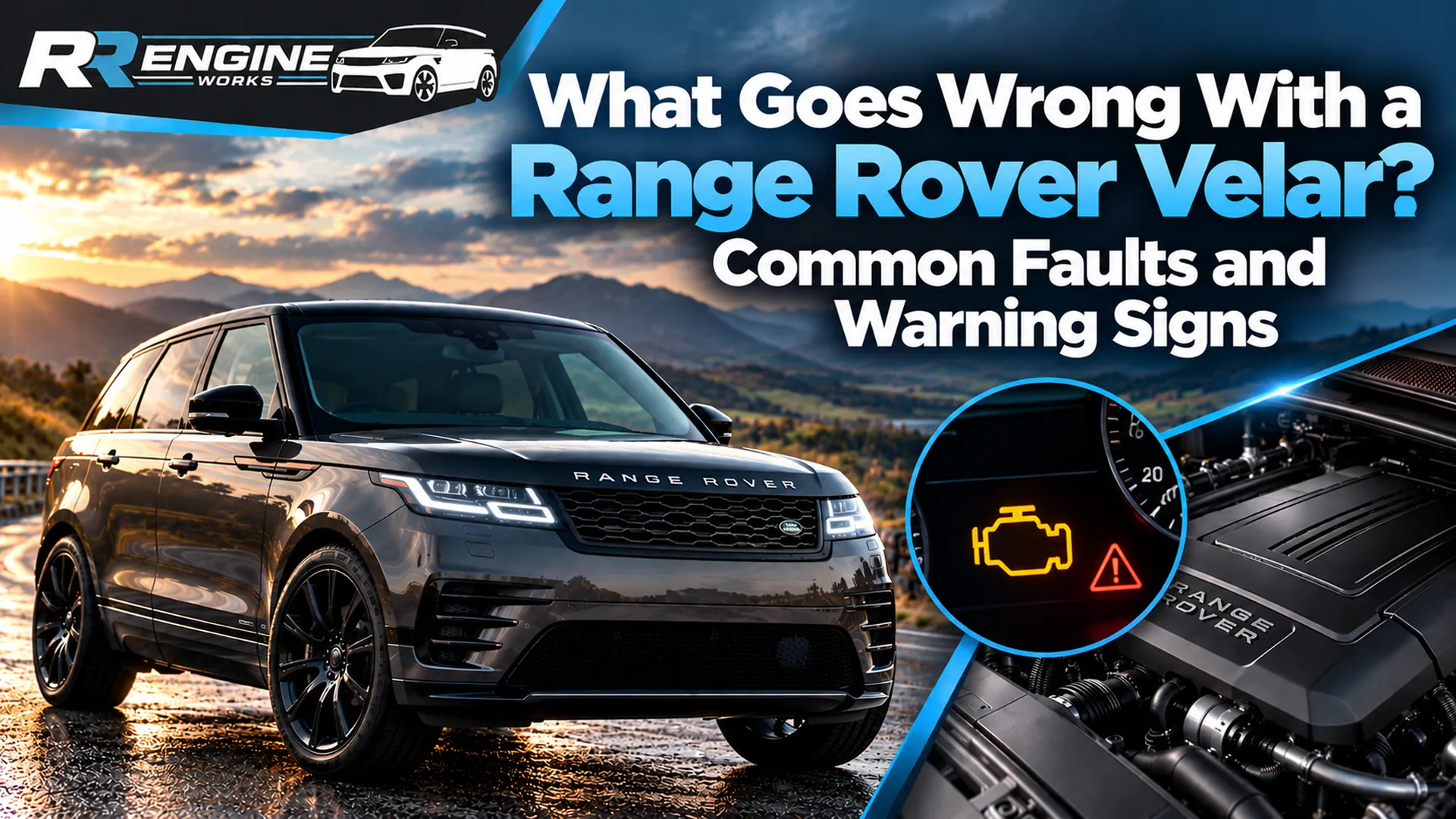
Most Velar problems fall into three groups: engine, electrical and suspension. Knowing the early signs can save you thousands. A small fault caught early is often a cheap fix. The same fault ignored can turn into an engine job.
Does the 2.0 Ingenium diesel have timing chain, oil dilution or DPF problems?
The 2.0 Ingenium diesel (D180, D200 and D240 depending on year) is the engine most owners ask us about. Three issues come up repeatedly.
1. Timing chain wear. On some Ingenium engines the chain can stretch or its components can wear prematurely. Warning signs include:
- A rattle or chatter on cold start
- An engine warning light or fault codes relating to cam and crank correlation
- Rough running or reduced performance
Left alone, a worn chain can lead to serious engine damage. Do not keep driving a car with a suspected timing chain fault.
2. Oil dilution. Diesel engines inject extra fuel during DPF (diesel particulate filter) regeneration. On cars that do mostly short trips, some of that fuel ends up in the sump and thins the oil. A thinner oil protects the engine less well, so the engine wears faster. Check the oil level regularly. If it rises over time without you topping it up, take the car to a specialist.
3. DPF blockages. Short journeys prevent the filter from burning off soot. You may see a DPF warning light, restricted performance or the car going into limp mode. A good motorway run can sometimes clear it, but repeated warnings need a proper diagnostic. Related faults often involve the EGR valve, turbocharger or fuel injection system, which is why a quick scan is never the full story.
Is the 3.0 D300 more dependable than the 2.0 D240?
Many owners find it is. The 3.0 diesel has more power in reserve, so it works less hard in the same car. Earlier cars used a 3.0 V6 diesel, and later cars moved to a 3.0 Ingenium six-cylinder with mild hybrid assistance.
Factor | 2.0 Ingenium diesel (D240) | 3.0 diesel (D300) |
| Strain in a heavy SUV | Higher | Lower |
| Timing chain concerns | More frequently reported | Less commonly reported |
| DPF and short-trip sensitivity | High | High |
| Fuel economy | Better | Slightly lower |
| Purchase and servicing cost | Lower | Often higher |
The 3.0 D300 is not immune. It still has a DPF, and it still needs on-time servicing. But for buyers covering high mileage, it is often the safer bet.
What electrical, infotainment and air suspension faults do Velar owners report?
This is where the Velar earns most of its reputation. Common complaints include:
- Infotainment glitches: Freezing, slow response or random reboots, particularly on early InControl Touch Pro Duo systems
- Reversing camera and parking sensor faults: Blank screens or false warnings
- Warning lights: A dashboard warning with no obvious cause is often a sensor or software issue rather than a mechanical failure
- Battery drain: Often linked to software or a failing battery, which matters on cars with start-stop systems
- Air suspension faults: Sagging corners, compressor noise or a "suspension fault" warning
- Pop-out door handles: These can stick or fail to deploy
- Steering warnings: Faults in the electronic power-assisted steering (EPAS) system
Many of these are fixable without major cost. A proper diagnostic is the key. Replacing parts by guesswork is how repair bills grow.
How Much Does It Cost to Keep a Range Rover Velar Reliable, and Who Can Help?
A Velar is not a cheap car to run. Parts and labour cost more than on a mainstream SUV, and complex systems like air suspension and the diesel emissions hardware add to the bill. That said, good maintenance keeps costs far more predictable.
How much do Velar repairs, servicing and engine work cost in the UK?
Costs vary widely by garage, parts choice and the fault itself. As a rough guide:
Job | Typical cost pattern |
| Routine service | Moderate, and lower at an independent specialist than at a main dealer |
| Fault diagnosis | Usually a fixed fee, worth paying before any repair |
| Air suspension component | Can run to several hundred pounds or more per corner |
| DPF cleaning or repair | Often a fraction of a replacement unit |
| Timing chain replacement | Typically runs into the low thousands |
| Reconditioned engine or engine replacement | A significant sum, depending on engine and condition |
These figures are guidance only. Ask for a written quote that separates parts from labour.
Ways to keep costs down:
- Service on time, using the correct oil specification
- Avoid constant short trips in a diesel
- Deal with warning lights early
- Keep a service history folder, since it protects resale value
- Consider an extended warranty if the car is out of manufacturer cover, but read the exclusions carefully
What should you check in a pre-purchase inspection on a used Velar?
A pre-purchase inspection costs little compared with a bad purchase. Here is what a thorough check should include:
- Full diagnostic scan for stored and pending fault codes
- Cold start check to listen for timing chain rattle
- Oil condition and level, looking for signs of dilution
- Air suspension operation, raising and lowering the car and checking for leaks or compressor noise
- Infotainment, cameras and sensors, tested properly rather than glanced at
- Door handles, steering and brakes
- Tyres, since uneven wear can point to suspension or alignment problems
- Service records, MOT history and recall status
Never rely on a seller saying "it just needs a software update." Ask for proof.
When should you repair, rebuild or replace a Velar engine?
This is a decision we help owners with often. A rough guide:
- Repair when the fault is isolated, such as a sensor, injector or DPF issue, and the engine has no internal damage.
- Rebuild when the engine has known wear, such as timing chain damage, but the block and major components are sound.
- Replace when there is serious damage, for example after a failed chain or a lubrication problem, and a reconditioned engine gives better value than a long repair.
The right choice depends on the car's value, mileage and how long you plan to keep it. A proper inspection should come before any recommendation.
Need a Velar specialist in Essex?
RR Engine Works offers diagnostics, engine health checks, timing chain work, DPF repair, engine rebuilds and replacements for Range Rover Velar and other Land Rover models.
📍 Unit 1 Hedley Ave, Grays RM20 4EL
Book a diagnostic or engine health check before a small fault becomes a big bill. You can also ask us to carry out a pre-purchase inspection before you buy.
Range Rover Velar Reliability: Frequently Asked Questions
Is the Range Rover Velar reliable?
It is average. Many Velars run well with good maintenance, but the model is known for electrical, software and some diesel engine issues. Later cars and well-serviced examples are the safer buys.
How long does a Range Rover Velar last?
With regular servicing, a Velar can pass 100,000 miles and beyond. Longevity depends heavily on maintenance, use and whether known faults were dealt with early.
Which Range Rover Velar year is best?
Later cars, from around 2020 onwards, usually have the benefit of updates and the newer Pivi Pro system. Always judge the individual car's history over the badge year.
Which Range Rover Velar year should I avoid?
Early 2017 to 2019 cars have attracted more fault reports. They are not all bad, but inspect them carefully and avoid any without full history.
Which Velar engine is most reliable?
The 3.0 diesel is often seen as less stressed than the 2.0 Ingenium diesel, though neither is fault-free. Petrol engines avoid DPF issues but cost more to run.
Is the Range Rover Velar expensive to maintain?
Yes, compared with mainstream SUVs. Using an independent specialist rather than a main dealer can lower the cost of servicing and repairs.
Does the Velar have timing chain problems?
Some 2.0 Ingenium diesels have shown timing chain wear. Listen for cold start rattle and have any engine warning light checked promptly.
Does the Velar have air suspension problems?
It can. Air springs and compressors wear over time. Early signs include a sagging corner and a suspension warning on the dash.
What should I check when buying a used Velar?
Check service history, run a full diagnostic scan, test electronics and suspension, and review MOT and recall records. A specialist pre-purchase inspection is the safest route.
Final Verdict: Should You Buy or Keep a Range Rover Velar?
The Velar is a beautiful, comfortable and desirable SUV. Its reliability record is mixed, but most of the common faults are well understood and manageable if you catch them early.
If you are buying, choose a later car with strong paperwork, think hard about the 3.0 diesel if you cover big mileage, and pay for an independent inspection. If you already own one, stay ahead of servicing, take warning lights seriously and avoid letting small faults linger.
Either way, a specialist who knows these engines is worth having on your side.
Talk to RR Engine Works today. Whether you need a diagnostic, an engine health check or a pre-purchase inspection, our team in Grays, Essex will give you a clear, honest answer before any work begins.