

If your Range Rover has started making a rattling noise on a cold start, or you've noticed the engine management light flickering alongside a "Restricted Performance" warning, there's a good chance your timing chain is trying to tell you something. And when a Range Rover speaks, it's worth listening.
Timing chain problems are among the most serious and unfortunately most common, mechanical issues affecting Land Rover and Range Rover vehicles across multiple engine families. Left unaddressed, a worn or stretched timing chain doesn't just affect performance. It can destroy an engine entirely.
This guide covers everything you need to know: the symptoms, the causes, the replacement cost, and why getting it fixed by a genuine Land Rover specialist in Essex makes all the difference.
What Is a Timing Chain and Why It Matters in a Range Rover Engine
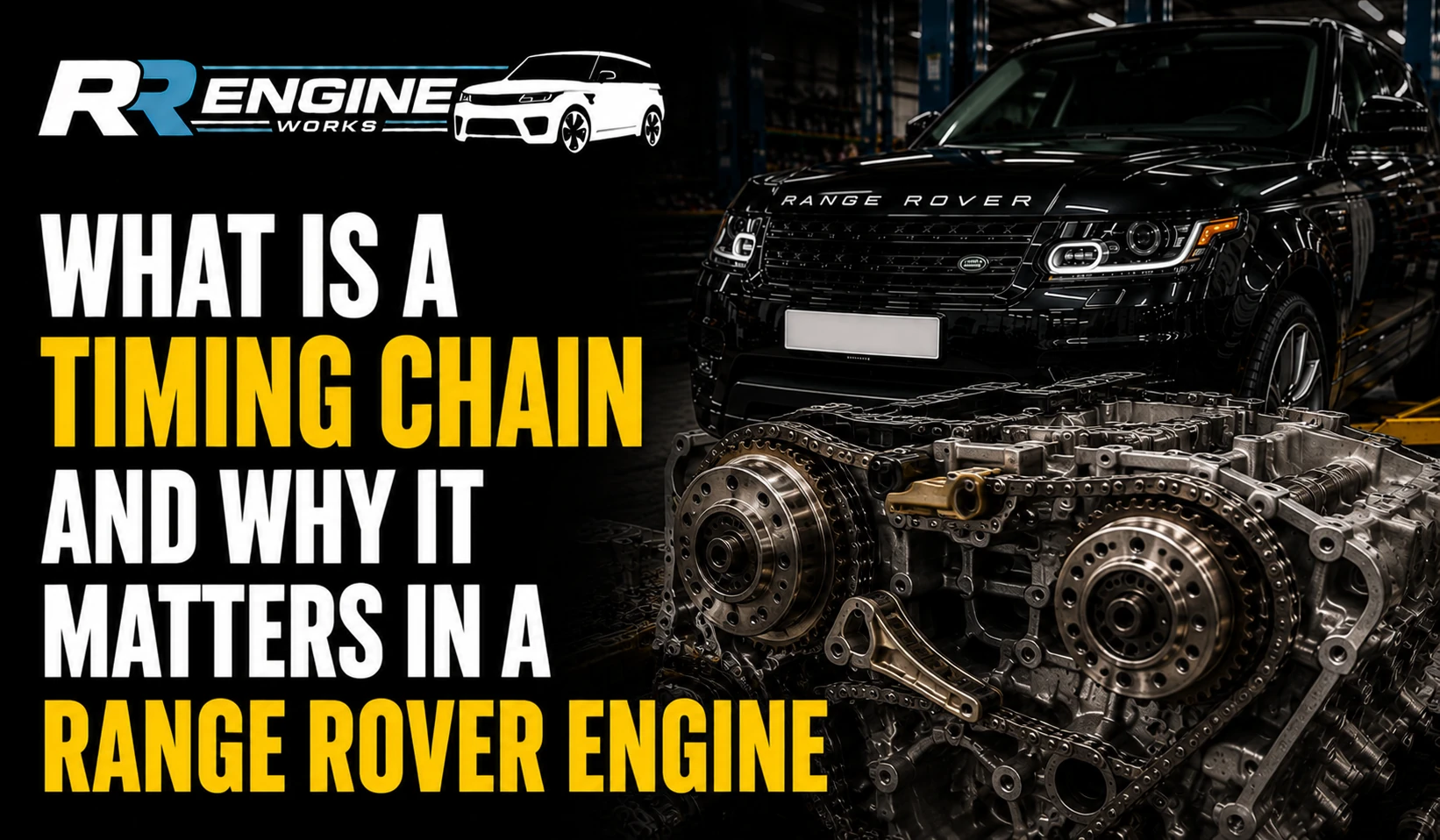
Before diving into problems and costs, it helps to understand what the timing chain actually does and why it's so critical to your Range Rover's health.
How the Timing Chain Controls Your Range Rover's Engine Performance
The timing chain is a precision-engineered metal chain that connects the crankshaft to the camshaft inside your engine. Its job is to synchronise the opening and closing of the intake and exhaust valves with the movement of the pistons, a process that must happen with extraordinary accuracy, thousands of times per minute.
When the timing chain is functioning correctly, your engine runs smoothly, efficiently, and powerfully. When it begins to stretch, wear, or fail, that synchronisation breaks down. The valve timing falls out of alignment, the engine management system detects the fault, and things deteriorate rapidly from there.
Unlike a timing belt, which is a scheduled replacement item, a timing chain is designed to last the life of the engine. In reality, however, several Range Rover engine families have proven that this expectation doesn't always hold up.
Which Range Rover Models and Engines Are Most Affected by Timing Chain Problems?
Timing chain issues are not isolated to one engine variant. They span multiple generations and powertrains across the Range Rover lineup. Understanding which engines carry the greatest risk helps owners stay ahead of potential failure.
Ingenium 2.0L Engine Timing Chain Issues
The Ingenium engine, Land Rover's in-house developed 2.0L four-cylinder unit, has been widely reported to suffer from timing chain stretch at relatively low mileage. Vehicles fitted with this engine, including the Range Rover Evoque and Range Rover Velar, have shown symptoms from as early as 40,000 to 60,000 miles in some cases.
Oil dilution, where petrol contaminates the engine oil and reduces its viscosity and lubricating properties, is considered a major contributing factor to premature timing chain wear in Ingenium-equipped vehicles. Thin or contaminated oil starves the chain guides and tensioners, accelerating wear significantly.
3.0L V6 and 5.0L V8 Supercharged Timing Chain Concerns
The 3.0L V6 and the 5.0L V8 Supercharged engines both mainstays of the Range Rover Sport and full-size Range Rover lineup, carry their own timing chain vulnerabilities. On the 5.0L V8, multiple timing chains, guides, tensioners, and cam phasers work in coordination. When one component wears, it places additional stress on the entire timing system.
Cold start rattle is particularly prevalent on these larger engines, especially in vehicles where oil service intervals have been stretched or low-quality synthetic oil has been used. The chain tensioners rely on immediate oil pressure at startup to maintain correct chain tension. Any delay or weakness in oil pressure delivery accelerates wear.
AJ-V8 and BMW-Sourced 4.4L Engine Variants
Older Range Rover Full Size models, particularly the L322 generation fitted with either the AJ-V8 petrol or the BMW-sourced 4.4L engine, have a well-documented history of timing chain guide failure. The plastic guides responsible for keeping the chain aligned deteriorate over time, and once they begin to break down, metal fragments can circulate through the engine oil, causing damage well beyond the timing system itself.
Common Range Rover Timing Chain Symptoms You Should Never Ignore
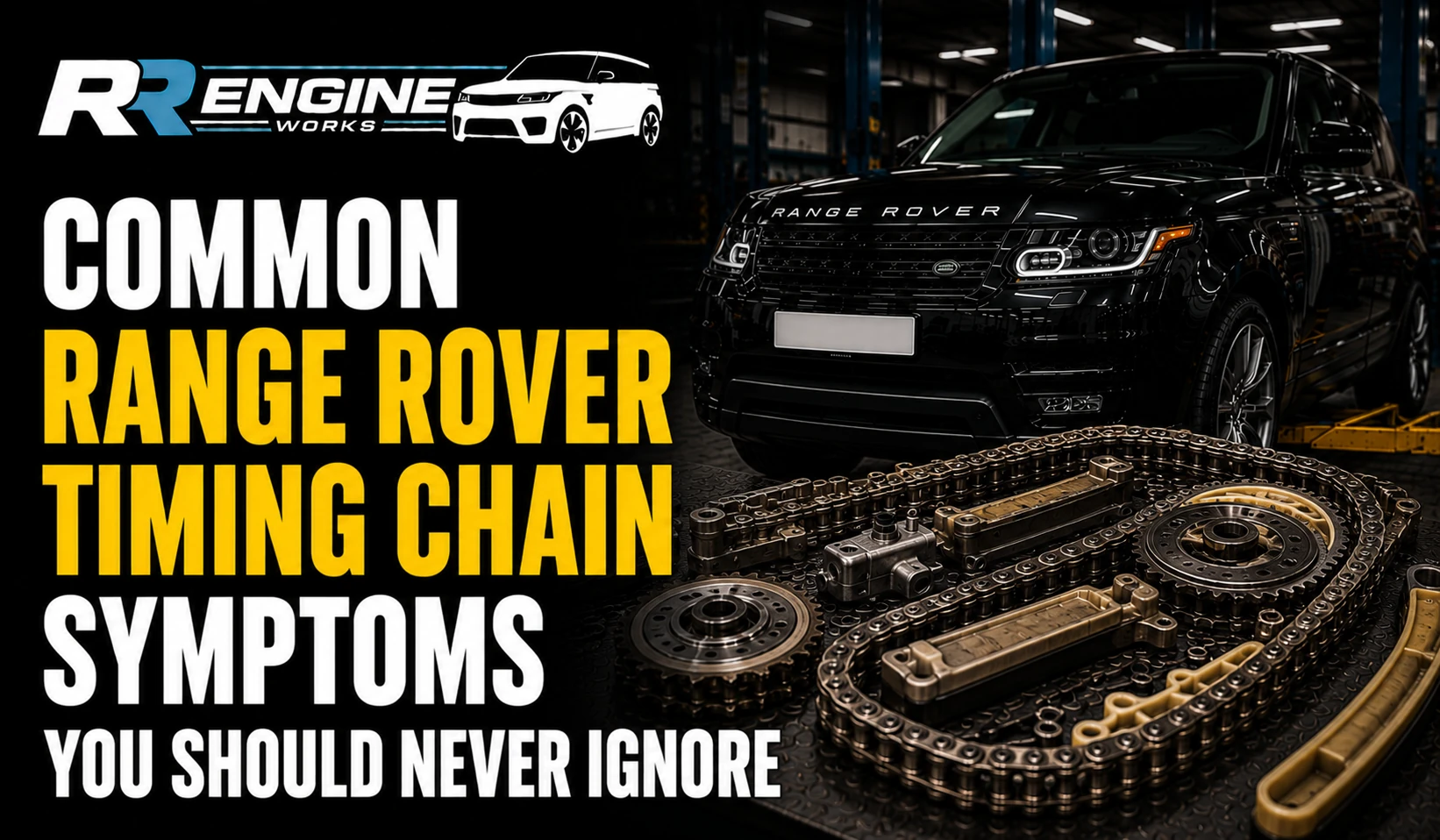
Catching timing chain problems early is the difference between a manageable repair and a catastrophic engine rebuild. These are the warning signs that demand immediate attention.
Cold Start Rattle — The Earliest Warning Sign of Timing Chain Wear
A rattling or chattering noise from the engine in the first few seconds after a cold start is the most recognisable symptom of timing chain wear. It typically originates from the front of the engine and fades once oil pressure builds up and the tensioners compensate for chain slack.
Many owners dismiss this noise as "just how it sounds", particularly in colder months. That's a costly mistake. That rattle is the sound of a chain with insufficient tension, knocking against its guides before oil reaches the tensioner. Over time, each cold start worsens the wear until the tensioner can no longer compensate at all.
If your Range Rover rattles on a cold start, book a timing chain inspection as soon as possible. Do not wait for the noise to worsen.
Fault Codes Related to Timing Chain Failure
Modern Range Rover engines are monitored by a sophisticated engine management system and engine control module. When timing goes out of synchronisation, fault codes are logged — often before the driver notices any physical symptoms.
What Does a P0016 or P0017 Code Mean on a Range Rover?
The fault codes P0016 and P0017 are among the most common timing-related diagnostic codes seen on Range Rover and Land Rover vehicles. They indicate a correlation problem between the crankshaft position sensor and the camshaft position sensor, in plain terms, the engine management system has detected that the camshaft and crankshaft are no longer in correct alignment.
These codes point directly to timing chain stretch or, in some cases, a failing cam phaser or VVT (Variable Valve Timing) system. Neither should be ignored. A P0016 or P0017 code on a Range Rover warrants immediate professional diagnosis from a Land Rover specialist.
P0008 is another code worth noting, indicating engine position system performance, often triggered by worn chain guides or a stretched lower chain.
Other Warning Signs That Point to a Stretched or Failing Timing Chain
Beyond the cold start rattle and fault codes, a deteriorating timing chain can manifest in several other ways. Being aware of these symptoms ensures nothing slips past unnoticed.
Rough Idle and Reduced Engine Performance
A stretched timing chain causes the valve timing to drift out of specification. This disrupts the combustion cycle, resulting in a rough, uneven idle, particularly noticeable when the engine is under light load or sitting stationary. You may also notice a reduction in throttle response, hesitation during acceleration, or an overall sense that the engine feels flat and unresponsive.
This isn't a performance inconvenience. It's a sign that internal engine timing is compromised and the situation is progressing.
Engine Management Light and Restricted Performance Warning
Range Rovers equipped with Terrain Response and advanced engine management systems are quick to flag timing-related issues. If your dashboard shows the engine management light alongside a "Restricted Performance" message, the vehicle's ECU has actively limited engine output to prevent further damage.
While this is a protective measure, it is not a solution. The underlying cause, almost always a timing chain, tensioner, or guide issue at this stage, requires physical repair, not a warning light reset.
Can You Still Drive a Range Rover With a Stretched Timing Chain?
Technically, yes — but you absolutely should not. Continuing to drive with a stretched or worn timing chain risks catastrophic engine damage. In a worst-case scenario, the chain can skip a tooth on the sprocket, causing the valves and pistons to collide. This results in bent valves, damaged cylinder heads, scored pistons, and in severe cases, a complete engine write-off.
The repair cost difference between catching a stretched timing chain early and dealing with the aftermath of a jumped chain is significant, often the difference between a few thousand pounds and a full engine rebuild.
Range Rover Timing Chain Replacement — Cost, Process & What's Included
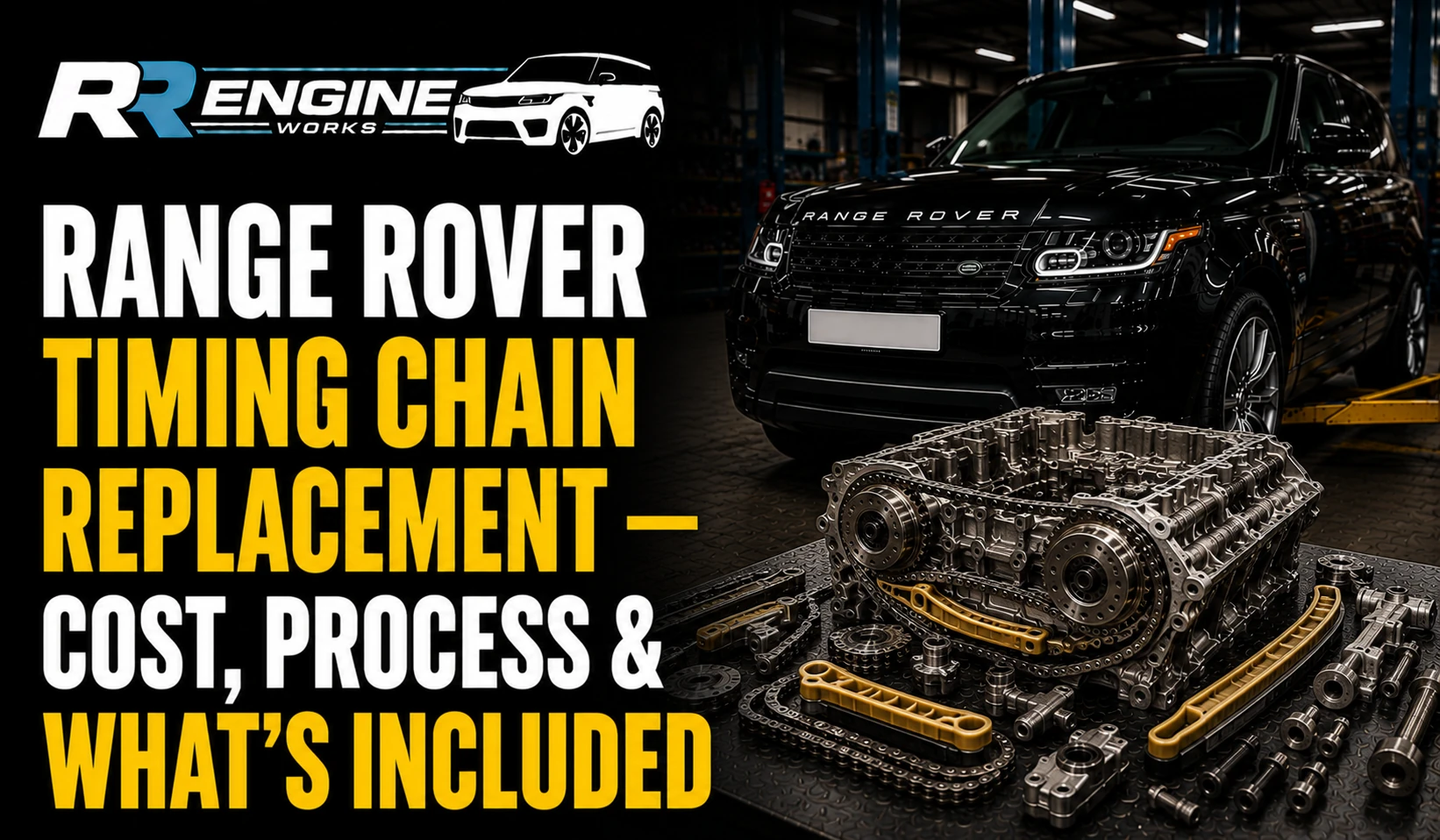
Understanding what goes into a timing chain replacement helps you make an informed decision and ensures you're not caught off guard by the scope of the work involved.
How Much Does a Range Rover Timing Chain Replacement Cost in the UK?
Timing chain replacement on a Range Rover is a labour-intensive job. It requires substantial engine disassembly, specialist tools, and a thorough understanding of the specific engine variant involved. As a result, it is not an inexpensive repair but it is far more affordable than the alternative.
In the UK, Range Rover timing chain replacement costs typically range as follows:
Engine | Estimated Replacement Cost (UK) |
| Ingenium 2.0L (Evoque / Velar) | £1,200 — £2,000 |
| 3.0L V6 (Sport / Discovery) | £1,800 — £2,800 |
| 5.0L V8 Supercharged | £2,500 — £4,000+ |
| AJ-V8 / BMW 4.4L (L322) | £1,500 — £2,500 |
These figures are estimates and vary based on parts specification, labour rates, and the extent of additional damage found during disassembly. At rrengineworks.co.uk, we provide transparent, itemised quotes before any work begins.
What Affects the Total Timing Chain Replacement Cost?
Several factors influence the final cost of a timing chain repair on a Range Rover:
- Engine variant: More complex engines with multiple chains (such as the 5.0L V8) require significantly more labour hours
- Parts quality: OEM (Original Equipment Manufacturer) parts carry a premium over aftermarket alternatives, but offer superior fit, durability, and compatibility
- Condition of associated components: If the chain guides, tensioners, or cam phasers show wear, replacing them at the same time avoids returning to the same job in short order
- Engine oil condition: Contaminated oil or evidence of oil dilution may indicate additional investigation is required
- Any secondary damage: Metal shavings in the oil, damaged valve timing components, or worn bearings may add to the scope of work
Should Guides and Tensioners Be Replaced at the Same Time?
Yes, without exception. This is one of the most important points of advice any experienced Land Rover specialist will give you.
The timing chain, guides, and tensioners are interdependent components. The guides keep the chain aligned; the tensioners maintain correct chain tension. If your chain has worn prematurely, the guides and tensioners have been under the same stress. Replacing the chain alone and leaving worn guides in place is a false economy, the new chain will wear at an accelerated rate almost immediately.
A proper timing chain kit replacement includes the chain, all guides, tensioners, relevant seals, and hardware. Anything less is a shortcut that will cost more in the long run.
What to Expect During a Timing Chain Replacement at rrengineworks.co.uk
When your Range Rover comes into our workshop in Grays, Essex, we begin with a thorough diagnostic assessment, not just of the timing chain, but of the entire timing system and any fault codes stored in the engine management system.
Once we've confirmed the scope of work and provided you with a clear, written quote, our Land Rover-trained technicians carry out the replacement using the correct specialist tools for your specific engine. Every timing chain replacement we carry out includes:
- Full timing system inspection prior to parts ordering
- Replacement of chain, guides, tensioners, and seals as a complete kit
- Camshaft and crankshaft timing verification post-installation
- Engine oil and filter change as standard (contaminated oil must not be reintroduced to a new timing system)
- Post-repair road test and diagnostic scan to confirm fault code clearance
OEM vs Aftermarket Timing Chain Kits — Which Is Right for Your Range Rover?
This is a question we're asked regularly, and the answer depends on your priorities, though we always lean towards OEM or OEM-equivalent quality for timing system components.
OEM Parts | Aftermarket Parts | |
| Fit & Compatibility | Exact match to original specification | Variable — quality differs by brand |
| Durability | Engineered for engine lifespan | Can be shorter-lived in some cases |
| Warranty | Manufacturer-backed | Varies by supplier |
| Cost | Higher upfront cost | Lower upfront cost |
| Risk | Minimal | Higher if low-quality parts used |
For a component as critical as the timing chain, where failure means potential engine destruction, we strongly recommend OEM or Genuine Land Rover parts. The cost difference over the life of the repair is negligible compared to the risk of a repeat failure.
How Long Does a Timing Chain Replacement Take?
On most Range Rover engines, a full timing chain kit replacement takes between 1.5 to 3 days in the workshop, depending on engine complexity and parts availability. The 5.0L V8 Supercharged, with its multiple chain runs, typically takes longer than the Ingenium 2.0L. We'll always give you an accurate timeframe when booking.
Why Choose RR Engine Works for Range Rover Timing Chain Repair in Essex
Range Rovers are not ordinary vehicles, and they should not be treated as such. Taking your Land Rover to a general garage for a timing chain repair is a risk that simply isn't worth taking. These engines require specialist knowledge, dedicated tooling, and genuine familiarity with the quirks of each engine variant.
Land Rover Specialist Experience You Can Trust in Grays, Essex
At rrengineworks.co.uk, based in Grays, Essex, we specialise exclusively in Land Rover and Range Rover engines. That focus matters. When our technicians open a Range Rover bonnet, they're not consulting a generic repair guide, they're drawing on hands-on experience with these specific engines, across multiple generations and variants.
We work with clients across Essex and the surrounding areas, providing dealership-level expertise at independent specialist prices. Whether your vehicle needs a full timing chain kit replacement, a diagnostic assessment, or a second opinion after a dealer quote, we're here to give you an honest, expert answer.
Our commitment is straightforward: transparent pricing, quality parts, and repairs done right the first time.
Frequently Asked Questions About Range Rover Timing Chains
How Long Does a Range Rover Timing Chain Last?
A timing chain is designed to last the life of the engine, theoretically 150,000 miles or more. In practice, several Range Rover engines, particularly the Ingenium 2.0L and older AJ-V8 variants, have shown premature wear between 40,000 and 100,000 miles. Regular oil servicing with the correct specification of synthetic oil is the single most important factor in maximising timing chain longevity.
Does Regular Oil Service Affect Timing Chain Longevity?
Absolutely — and this cannot be overstated. The timing chain, guides, and tensioners are lubricated entirely by engine oil. Using the correct oil specification, maintaining clean oil, and adhering to service intervals directly impacts how long the timing system lasts. Oil dilution — a known issue in some Ingenium engines, reduces oil viscosity and compromises lubrication, which accelerates chain wear dramatically. Keeping on top of oil services is the most effective preventative maintenance step a Range Rover owner can take.
Can Timing Chain Failure Cause Serious Engine Damage?
Yes, and it can happen quickly. A jumped or broken timing chain causes immediate valve timing loss. Valves and pistons occupy the same space in the combustion chamber at different moments; when timing is lost, they collide. The result is bent valves, cracked pistons, damaged cylinder heads, and in severe cases, complete engine destruction. What begins as a £2,000 repair can become a £10,000+ engine rebuild if the chain is allowed to fail completely.
What Fault Codes Indicate Timing Chain Problems on a Range Rover?
The most common fault codes associated with timing chain issues on Range Rover and Land Rover vehicles are:
- P0016: Crankshaft/Camshaft Position Correlation (Bank 1)
- P0017: Crankshaft/Camshaft Position Correlation (Bank 2)
- P0008: Engine Position System Performance
These codes alone do not confirm a timing chain fault, they can also be triggered by a faulty camshaft or crankshaft position sensor, or a cam phaser issue. Professional diagnosis using Land Rover-specific diagnostic equipment is essential to pinpoint the exact cause.
What Is the Best Oil for Range Rover Timing Chain Longevity?
Always use the oil specification recommended by Land Rover for your specific engine variant. For most modern Range Rovers, this is a low-viscosity fully synthetic oil meeting the relevant ACEA or manufacturer specification. Using the wrong grade, or extending oil change intervals beyond the manufacturer's recommendation, significantly increases the risk of premature timing chain wear.
Book Your Range Rover Timing Chain Inspection Today
If your Range Rover is showing any of the symptoms described in this guide cold start rattle, fault codes, rough idle, or a restricted performance warning, don't wait. Early intervention is the difference between a straightforward repair and a major engine rebuild.
Contact rrengineworks.co.uk today to book a timing chain inspection or request a quote. Our Land Rover specialists in Grays, Essex are ready to give your vehicle the expert attention it deserves.
Call us, use our online booking form, or visit us directly and drive away with the confidence that your Range Rover's engine is in the right hands.