
If your Range Rover Sport has started knocking on cold mornings, losing power on the motorway, or throwing up warning lights you've never seen before, you're not imagining things, and you're not alone. The 3.0 SDV6 engine is a genuinely capable piece of engineering, but it has a well-documented set of failure points that catch owners out, often without much warning. Crankshafts snap. Bearings spin. Timing chains rattle themselves loose. And by the time the dashboard lights up, the damage is frequently already done.
This guide walks through exactly what goes wrong with the Range Rover Sport SDV6 engine, why it happens, how to spot it early, and what your realistic options are once a problem shows up, repair, rebuild, or replacement. We've worked on enough of these engines at our workshop to know the difference between a noise that's cosmetic and a noise that means your engine is dying, and we've laid that knowledge out here so you don't have to learn it the expensive way.
What Are the Most Common Range Rover Sport SDV6 Engine Issues?
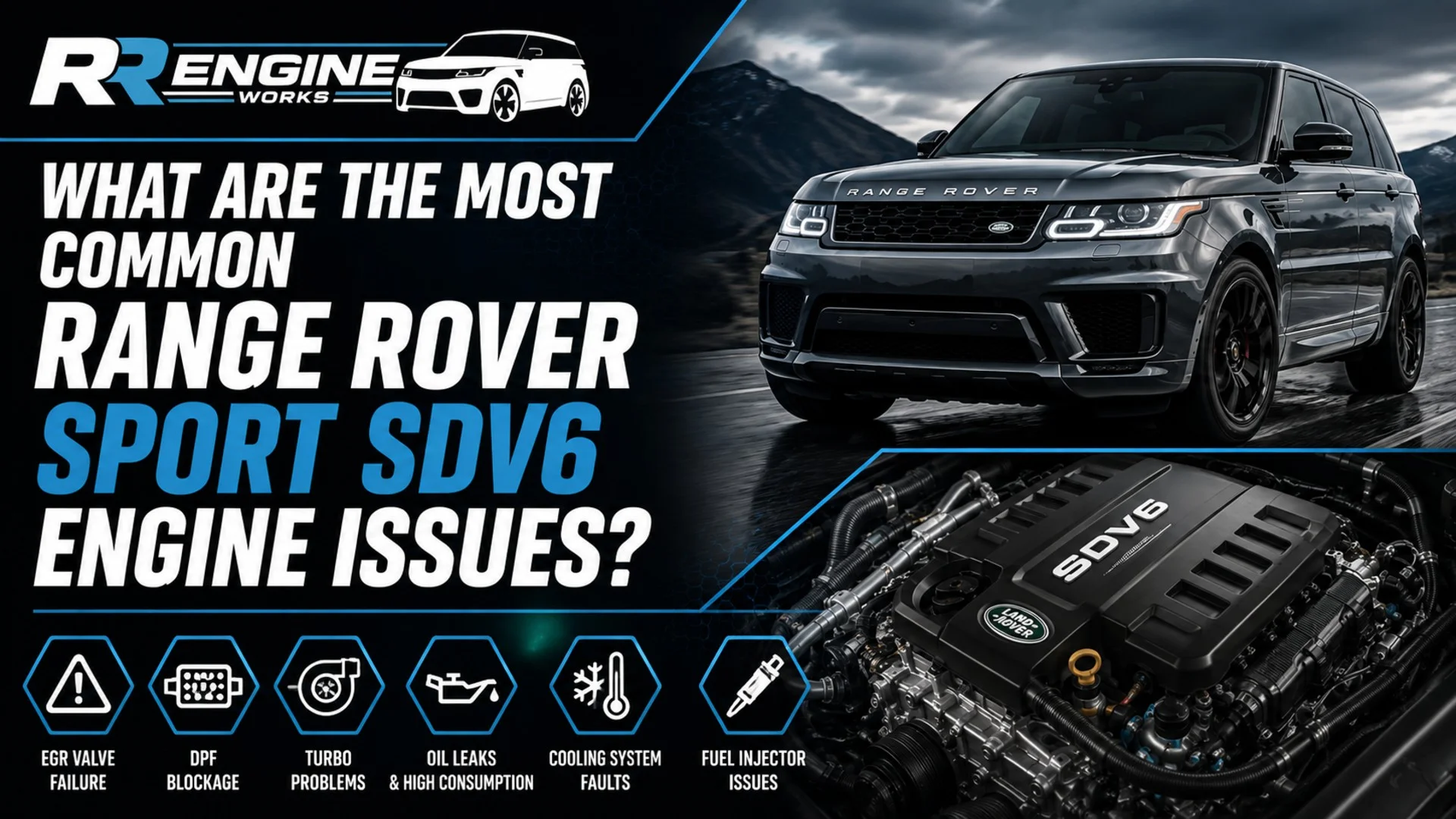
The 3.0-litre SDV6 (engine codes 306DT and related 306D1 variants) is part of the AJD-V6 "Lion" engine family shared across Land Rover and Jaguar's diesel line-up, including the Discovery 4, Discovery 5, and various Jaguar XF and XJ models. Fitted across both the L320 (pre-2013) and L494 (2013 onward) generations of Range Rover Sport, it's a twin-turbo diesel V6 with a reputation for strong performance, and, unfortunately, some serious internal weaknesses that surface as the miles rack up.
Here's what tends to go wrong, roughly in order of severity:
- Crankshaft and bearing failure, the single most feared fault in the SDV6, and often terminal for the engine
- Timing chain and tensioner wear, leads to that unmistakable cold-start rattle
- Turbocharger failure, loss of boost, smoke, and reduced performance
- EGR valve and cooler faults, carbon build-up and coolant leaks into the intake
- DPF blockages, restricted performance and failed regenerations
- Injector seal leaks, rough running and, in some cases, fire risk
- Coolant leaks and overheating, often traced back to the EGR cooler or water pump
Each of these has its own warning signs, but they're rarely isolated. A failing oil pump starves the bearings. Worn bearings put stress on the crankshaft. A neglected EGR system chokes the turbo and clogs the DPF. Understanding the SDV6 means understanding how these systems talk to each other, not just memorising a list of parts that break.
Crankshaft and Bearing Failure in the SDV6 Engine
This is the fault that gives the SDV6 its reputation, and for good reason. A number of these engines, particularly certain early production batches, suffer from crankshaft failure caused by weak bearing shells that wear prematurely. Once a bearing starts to spin or degrade, oil pressure drops, the crank journal loses proper lubrication, and in the worst cases the crankshaft itself snaps.
This isn't a slow, gentle decline. Owners often describe it as sudden, a metallic knocking noise that appears from nowhere and gets rapidly worse over a matter of days or even hours of driving. By the time you hear it, metal-on-metal contact has usually already started.
Real-world scenario: A common pattern we see is an owner who's had the vehicle serviced on schedule, oil levels always topped up, no obvious neglect, and the crankshaft still fails around the 90,000–130,000 mile mark. This is why crankshaft failure is treated as a known design weakness rather than purely a maintenance issue, even though poor servicing dramatically increases the risk.
Timing Chain and Tensioner Problems
The SDV6's timing chain and tensioner assembly is another well-known weak point, particularly on higher-mileage examples. As the chain stretches and the tensioner loses its ability to keep it taut, you'll typically hear a rattle on cold start that fades once oil pressure builds and the tensioner takes up the slack.
The problem is that this rattle isn't just annoying, it's a warning. A worn timing chain that's allowed to run too long can jump timing, and on an interference engine like the SDV6, that means bent valves or worse. Left unaddressed, what starts as a cold-start rattle can escalate into a five-figure repair bill.
Turbocharger Failure Symptoms
The SDV6 runs a twin-turbo setup, and turbo failure typically shows up as one or more of the following:
- Noticeable loss of power or sluggish acceleration
- Whining or whistling noises under acceleration
- Blue or grey smoke from the exhaust (often a sign of turbo oil seals failing)
- Boost-related fault codes and the engine dropping into limp mode
Turbo failure on the SDV6 is frequently linked back to oil quality and oil pressure, the same lubrication issues that damage bearings also starve the turbo bearings of clean, pressurised oil. It's rarely a fault that exists entirely on its own.
EGR and DPF Related Issues
Like most modern diesels, the SDV6 relies on its EGR (exhaust gas recirculation) and DPF (diesel particulate filter) systems to control emissions, and both are common sources of trouble.
The EGR cooler is particularly prone to internal cracking, which allows coolant to leak into the intake system or exhaust gas to contaminate the cooling system. This shows up as unexplained coolant loss, white smoke, or overheating. The EGR valve itself can also stick or clog with carbon, causing rough idling, poor throttle response, and fault codes.
The DPF, meanwhile, tends to block up on vehicles used mainly for short journeys, since it needs sustained higher-speed driving to regenerate properly. A blocked DPF triggers restricted performance, warning lights, and, if ignored, a costly filter replacement.
Why These Failures Happen (The Oil Starvation → Bearing Wear → Crankshaft Damage Chain)
It's worth understanding the mechanism behind the SDV6's most serious failure, because it explains why "just keep the oil topped up" isn't always enough.
The sequence typically runs like this:
- Oil pump weakness or degraded oil quality reduces the pressure and volume of oil reaching the crankshaft's main and big-end bearings
- Bearing shells wear prematurely, sometimes due to a factory tolerance issue, sometimes accelerated by extended oil-change intervals
- Reduced bearing clearance control allows metal-on-metal contact under load
- Metal particles contaminate the oil, which then circulates and accelerates wear elsewhere in the engine
- The crankshaft itself becomes damaged, either through scoring of the journals or, in severe cases, outright fracture
This is precisely why oil pressure warnings and metallic knocking should never be driven through. Once bearing damage starts, it doesn't heal, it compounds, fast.
How Do I Know If My Range Rover Sport SDV6 Engine Is Failing?
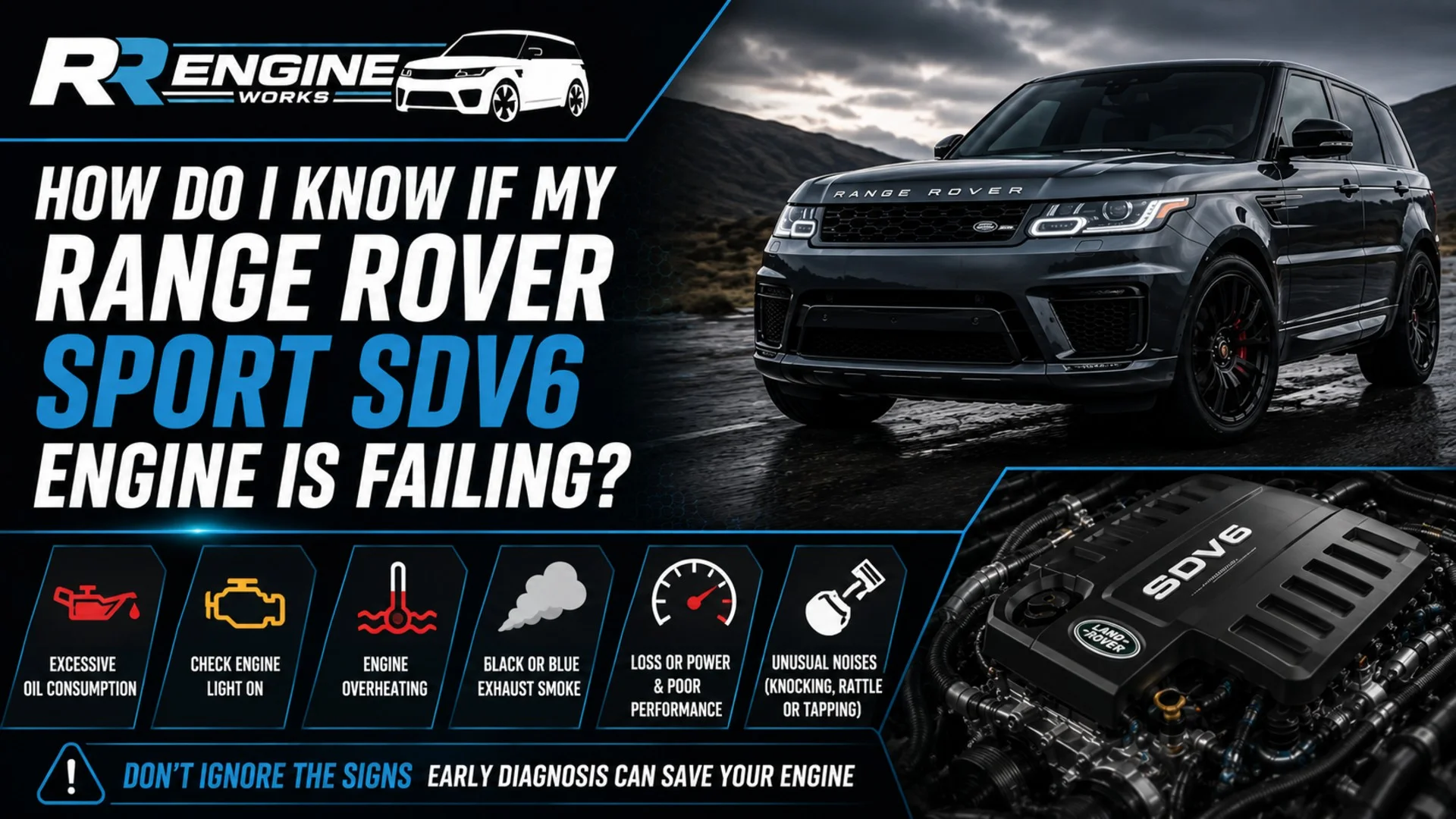
Catching an SDV6 engine problem early is the single biggest factor in whether you're looking at a modest repair bill or a full engine replacement. Most owners describe a moment where, looking back, there was a symptom they brushed off for a few weeks before things got serious. Here's what to watch for.
Warning Signs and Symptoms Checklist
Unusual Noises, Knocking, Rattling & Cold-Start Tapping
Noise is usually the earliest and most reliable indicator that something's wrong internally. Different noises point to different problems:
- A rhythmic metallic knock that changes pitch with engine speed, strongly suggests bearing or crankshaft wear
- A rattle on cold start that disappears after a few seconds, classic timing chain tensioner behaviour
- A persistent rattle that doesn't fade, suggests the timing chain has stretched beyond what the tensioner can compensate for
- A whining or whistling under acceleration, often turbo-related
- A tapping noise from the top of the engine, can point to injector or valvetrain wear
If you're ever unsure which of these you're hearing, it's worth getting it checked rather than guessing, the cost difference between "caught it early" and "waited too long" on this engine is enormous.
Warning Lights, Fault Codes & Limp Mode
The SDV6's ECU is generally good at flagging problems before they become catastrophic, provided you don't ignore the lights. Common triggers include:
- Engine management light accompanied by reduced power (limp mode)
- Oil pressure warning, this one should never be ignored or driven through
- EGR and DPF-related fault codes, often linked to codes such as P0401, P0402, and P2463
- Turbo boost pressure codes, including P0234 and P0299
- Coolant temperature warnings tied to overheating or EGR cooler leaks
A proper diagnostic scan will pull the specific fault code and narrow down which system is affected, which is far more reliable than guessing from symptoms alone.
How to Properly Diagnose SDV6 Engine Problems
A thorough diagnosis on a suspected SDV6 engine issue should go well beyond a quick code read. At a minimum, it should include:
- Checking oil level and inspecting the oil itself for metallic particles or contamination
- Running a diagnostic scan to pull current and stored fault codes
- A mechanical oil pressure test, rather than relying solely on the dashboard gauge or warning light
- Inspecting the oil filter for debris
- Where bearing or crankshaft failure is suspected, a physical inspection of the oil pickup, oil pump, and, where necessary, the bottom end itself
Oil Pressure Test & Diagnostic Scan Explained
An oil pressure test involves fitting a mechanical gauge directly to the engine's oil galleries rather than trusting the in-cabin sensor, which can occasionally give a falsely reassuring reading. This is combined with a full diagnostic scan to check for stored codes relating to oil pressure, EGR flow, turbo boost, and DPF status.
If oil pressure reads low and there's evidence of metallic contamination in the oil or on the filter, that's a strong indicator of bearing wear, and at that point, further driving genuinely risks turning a repairable fault into a written-off engine.
Repair, Rebuild or Replace, What's Right for Your SDV6 Engine?
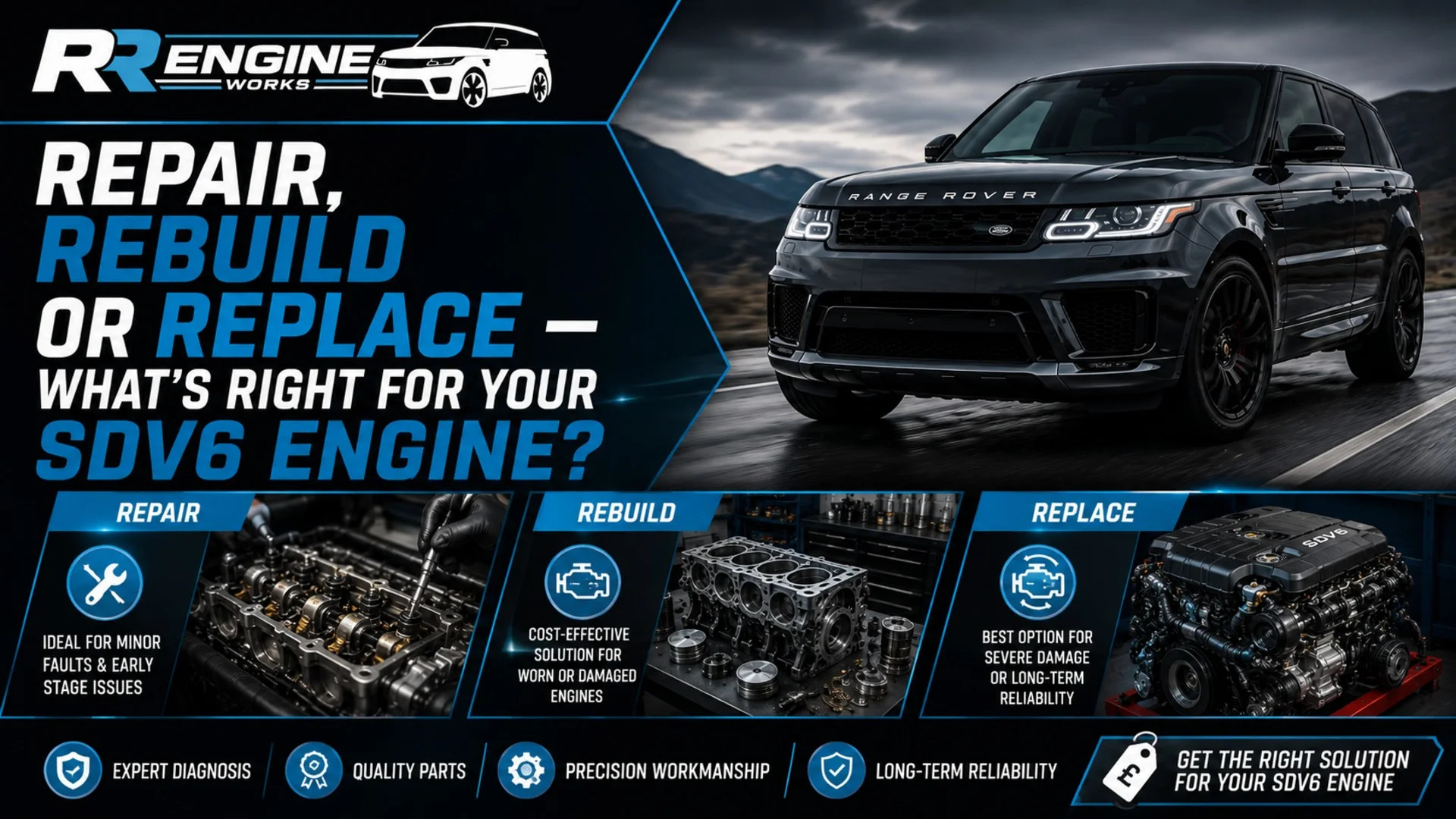
Once you've confirmed there's a genuine internal problem, the next question is what to actually do about it. This decision depends heavily on the specific fault, the engine's mileage and condition, and, realistically, your budget. Here's how the options compare.
SDV6 Engine Repair Costs in the UK
Costs vary significantly depending on what's failed, but as a general guide:
Repair Type | Typical Cost Range | Notes |
| Timing chain & tensioner replacement | Moderate | Cost-effective if caught before major wear occurs |
| Turbocharger replacement | Moderate to high | Varies by whether one or both turbos need replacing |
| EGR valve or cooler replacement | Low to moderate | Often resolves coolant loss and rough running |
| Injector replacement | Moderate | Per-injector cost adds up on multi-cylinder failures |
| Crankshaft/bearing repair | High | Requires significant engine strip-down |
| Full engine rebuild | High | Addresses internal wear comprehensively |
| Full engine replacement | Highest | Reconditioned or replacement unit plus labour |
These figures are indicative rather than fixed, the only way to get an accurate number is a proper inspection, since two engines showing the same symptom can have very different underlying causes.
Engine Rebuild vs Engine Replacement: Which Is Better?
This is the question we get asked most often once a customer knows their SDV6 has a serious internal fault, and there's no single right answer, it depends on the extent of the damage and what you want from the vehicle going forward.
When a Rebuild Makes Sense
A rebuild is usually the sensible route when:
- The block, cylinder head, and major castings are undamaged
- The fault is isolated to bearings, crankshaft, or timing components rather than being catastrophic
- You want to retain the original engine (useful for provenance or warranty reasons)
- You're planning to keep the vehicle long-term and want a comprehensive, known-quality repair
When Replacement Is the Smarter Choice
Replacement tends to make more sense when:
- There's been a genuine catastrophic failure, a snapped crankshaft with block or head damage, for example
- The cost difference between rebuild and replacement is marginal once labour is factored in
- You want a faster turnaround, since a reconditioned unit can often be fitted more quickly than a full rebuild can be completed
- The vehicle's overall condition and mileage suggest a fresh engine offers better long-term value than restoring the old one
Why Choose RR Engine Works for Your SDV6 Engine Repair
We're RR Engine Works, based at Unit 1 Hedley Ave, Grays RM20 4EL, and the SDV6 is one of the engines we deal with the most. We've seen the crankshaft failures that happen despite full service history, the timing chain rattles that get ignored until they're expensive, and the EGR coolers that quietly leak for months before anyone notices the coolant loss.
What that means for you as a customer:
- We diagnose properly before quoting, no guessing, no unnecessary parts
- We can advise honestly on rebuild versus replacement based on what we actually find, not what's easiest to sell
- We work specifically with Land Rover and Range Rover diesel engines, so we're not learning the SDV6's quirks on your vehicle
- We're a physical workshop you can visit, inspect, and talk to directly, not a call centre
If your SDV6 is showing any of the symptoms covered above, getting it looked at properly now is almost always cheaper than waiting for it to get worse.
Preventing SDV6 Engine Failure & Frequently Asked Questions
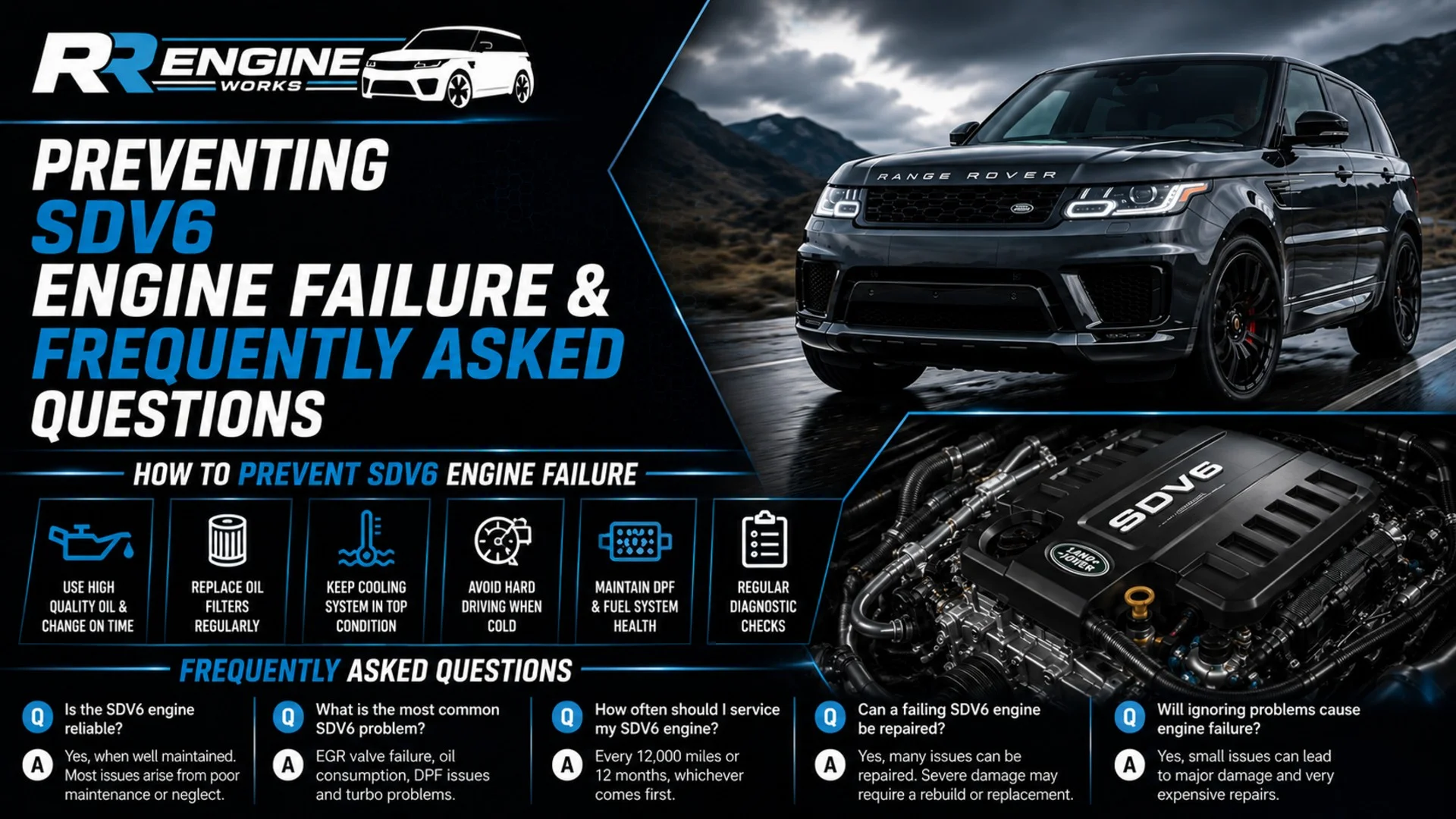
Not every SDV6 problem is preventable, some are down to known design weaknesses in specific production batches. But good maintenance habits significantly reduce your risk and, just as importantly, help catch problems while they're still cheap to fix.
How to Extend the Life of Your Range Rover Sport SDV6 Engine
- Stick to shorter oil change intervals than the manufacturer's maximum, especially if the vehicle does mostly short journeys, fresh, clean oil is your best defence against bearing wear
- Use the correct oil specification every time, not just "close enough", the SDV6 is sensitive to oil quality
- Don't ignore cold-start rattles, get the timing chain and tensioner checked at the first sign of noise
- Take the vehicle on a longer, higher-speed run periodically to allow proper DPF regeneration if most of your driving is short trips
- Address EGR and coolant issues immediately rather than topping up coolant and hoping it holds
- Get an oil pressure test done at any service if the vehicle has covered significant miles, even without obvious symptoms
- Keep a full service history, not just for resale value, but because it genuinely correlates with fewer catastrophic failures
None of these guarantee you'll never have a problem. But they meaningfully shift the odds, and they mean that if something does start to go wrong, you're far more likely to catch it while it's still a repair rather than a replacement.
Frequently Asked Questions
Is the Range Rover Sport SDV6 Engine Reliable?
The SDV6 delivers strong performance and, when well maintained, plenty of owners cover well over 100,000 miles without major issues. However, it does carry known weaknesses, particularly around crankshaft and bearing wear, that mean reliability varies more by individual engine history than by the model as a whole. Full service history and prompt attention to early symptoms make a significant difference.
How Much Does an SDV6 Engine Replacement Cost?
Costs depend on whether you're fitting a reconditioned, rebuilt, or used replacement engine, along with labour for removal and refitting. It's a significant expense, which is exactly why catching issues early, before they escalate into full engine failure, is worth prioritising. Getting a specific quote based on your vehicle and the cause of failure will give you an accurate figure rather than a generic estimate.
Can a Seized SDV6 Engine Be Repaired?
Sometimes. It depends entirely on what caused the seizure and how much internal damage resulted. If it's isolated bearing or crankshaft failure without damage to the block or head, a rebuild is often possible. If the seizure caused broader internal damage, replacement is usually more practical and cost-effective. This is exactly the kind of judgment call that needs a physical inspection rather than a guess over the phone.
Which Range Rover Sport SDV6 Engine Year Is Most Reliable?
There's no single "safe" year that's entirely free of these issues, since failures relate more to specific production batches and individual maintenance history than to model year alone. What matters more when buying used is checking full service history, asking about any prior engine work, and, ideally, getting a pre-purchase inspection that includes an oil pressure check.
Final Thoughts
The Range Rover Sport SDV6 is a strong engine when it's healthy, but it's not one to take chances with once something sounds, smells, or feels off. Crankshaft and bearing failure, timing chain wear, turbo problems, and EGR or DPF faults are all well-documented issues, and in almost every case, the outcome comes down to how quickly the problem gets addressed.
If your SDV6 is knocking, rattling, losing power, or throwing warning lights, don't wait to see if it gets worse, it usually does. Get in touch with RR Engine Works at Unit 1 Hedley Ave, Grays RM20 4EL for an honest diagnosis and a clear, straightforward assessment of your repair, rebuild, or replacement options.