
That orange engine light staring back at you from the dashboard has a way of ruining your day. Maybe your Range Rover's idling rougher than usual. Maybe there's a faint knock you're pretending not to hear, or a puff of smoke in the rearview mirror that definitely wasn't there last week. Whatever brought you here, one thing's certain: guessing isn't a strategy, and neither is hoping it fixes itself.
Range Rover engine diagnostics exist for exactly this moment , to turn a vague, worrying symptom into a clear answer. At RR Engine Works in Grays, we spend our days doing precisely that: reading the fault codes, pulling the live data, and telling you exactly what's going on under the bonnet before a small problem turns into an engine rebuild.
This guide walks through everything you need to know , the warning signs worth acting on, how proper diagnostics actually work, what it costs, and why the right specialist makes all the difference.
What's Actually Wrong With Your Range Rover? Common Symptoms That Need Engine Diagnostics
Range Rovers are sophisticated vehicles, and that sophistication cuts both ways. When everything's working, the ride is superb. When something's off, the engine management system usually knows before you do , it just needs someone to ask it the right questions.
Here's the thing about symptoms: they rarely tell the whole story on their own. A misfire could be a worn spark plug or a failing injector. A warning light could mean something trivial or something expensive. That's exactly why diagnostics matter , they replace guesswork with evidence.
Engine warning light on? Here's what your Range Rover is trying to tell you
The engine management light isn't a single-purpose indicator , it's a catch-all for dozens of possible issues, from a loose fuel cap to a genuine ECU fault. Common triggers we see on Ingenium petrol and diesel engines, TDV6, SDV6, and AJ133 V8 units include:
- Oxygen sensor faults , often linked to fuel trim irregularities and reduced fuel efficiency
- EGR valve problems , common on diesel Ingenium engines, usually flagged alongside rough running
- MAF or MAP sensor issues , these confuse the engine's air-fuel calculations, leading to hesitation or poor throttle response
- Catalytic converter or DPF concerns , frequently picked up during a routine diagnostic scan before the driver notices anything
The light itself won't tell you which of these it is. A proper diagnostic scan reads the actual stored fault code and cross-references it with live sensor data, which is the only reliable way to know what you're dealing with.
Misfires, rough idle, and loss of power , what these symptoms usually mean
A misfire feels like a stumble under acceleration, or a rough, uneven idle at a standstill. It's one of the most common reasons Range Rover owners in Essex bring their car to us. Misfires typically trace back to:
- Worn or fouled fuel injectors
- Ignition coil failure (more common on petrol variants)
- Vacuum leaks affecting the air-fuel ratio
- Timing chain wear, particularly on higher-mileage Ingenium and AJ133 engines
Loss of power , sometimes described as the car going into "limp mode" , is the engine management system protecting itself from further damage. It's not something to drive through; it's something to diagnose immediately.
Smoke, knocking, or overheating , when it's time to stop driving and get checked
Some symptoms move beyond "book it in this week" territory and into "pull over now." Persistent engine knocking, visible exhaust smoke, or a rising temperature gauge are signs of active mechanical stress , continuing to drive risks turning a repairable fault into a full engine failure.
- Blue smoke typically points to oil consumption or worn piston rings
- White smoke often signals coolant entering the combustion chamber , a possible head gasket issue
- Black smoke usually means the fuel mixture is running rich, often linked to injector or sensor faults
- Knocking can indicate anything from worn bearings to timing chain stretch , and timing chain issues on Range Rover engines are notoriously expensive to leave unresolved
If you're seeing any of these, engine diagnostics aren't optional , they're the fastest way to find out whether you're looking at a minor repair or something more serious.
How Our Range Rover Engine Diagnostics Process Works
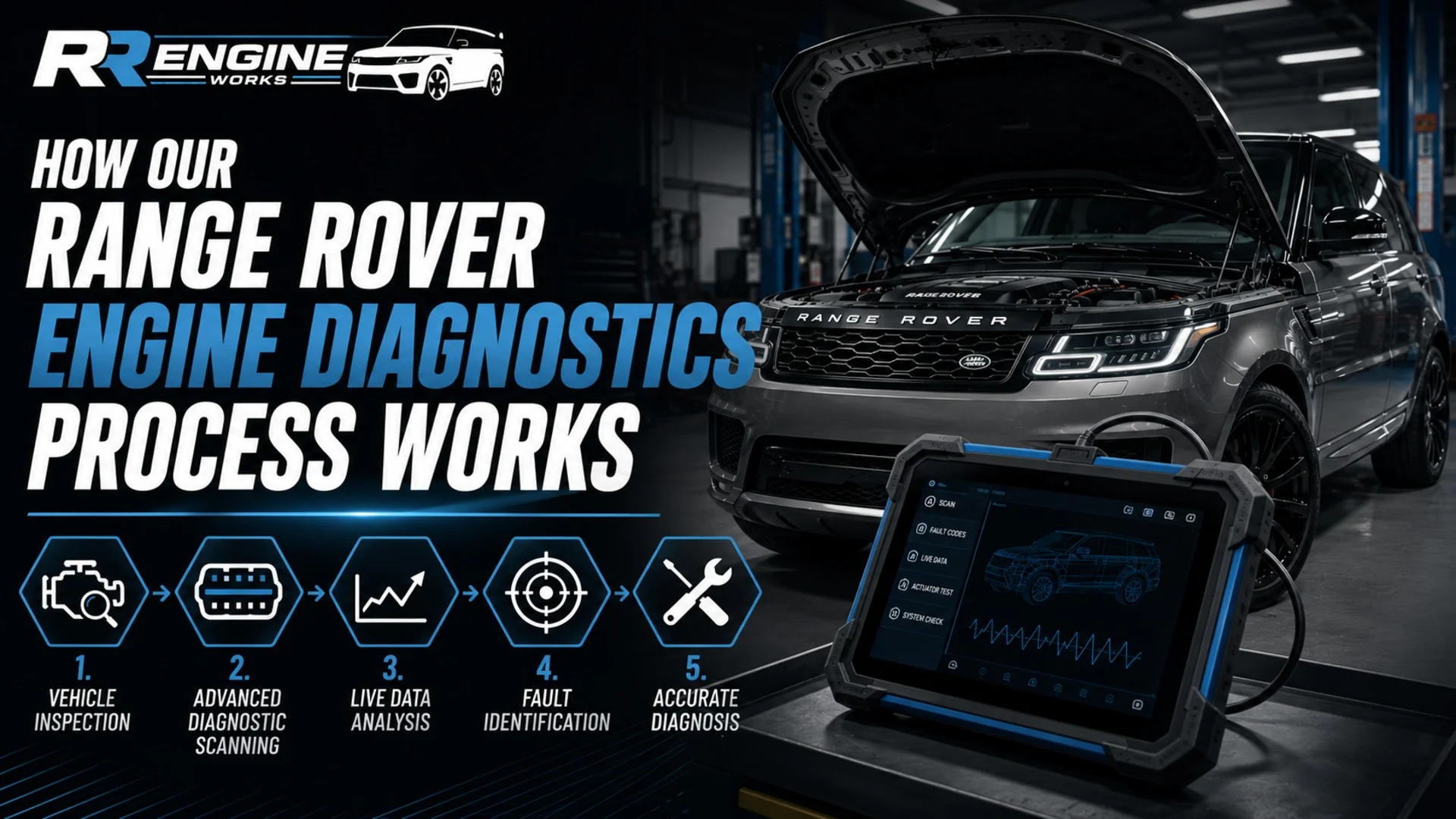
This is where a lot of garages fall short. Plugging in a generic OBD2 scanner and reading a fault code isn't diagnostics , it's the first step of diagnostics. The real value comes from what happens after the code appears.
Step-by-step: from fault code scan to full diagnostic report
Our process is built around getting to the actual root cause, not just clearing a code and hoping it doesn't come back.
- Initial fault code retrieval , we connect specialist-grade diagnostic equipment to read stored and pending DTCs (diagnostic trouble codes) directly from the ECM and ECU
- Live data analysis , we monitor real-time sensor readings while the engine runs, watching for irregularities a static code won't reveal
- Fuel trim and freeze-frame review , we examine the exact conditions present when the fault was logged, which often points straight to the cause
- Component-specific testing , depending on what the data shows, this might mean injector balance testing, compression testing, or a leak-down test
- Full diagnostic report , you get a clear, written explanation of what's wrong, why it's happening, and what it'll take to fix it
Live data and fuel trim analysis , going beyond a basic OBD scan
A fault code tells you that something's wrong. Live data tells you why. When we pull live data from a Range Rover's engine control module, we're watching fuel trims, oxygen sensor readings, MAF and MAP values, and NOx sensor output in real time. If short-term and long-term fuel trims are drifting outside normal range, that's often the real story behind a vague misfire code , long before it becomes an expensive repair.
Freeze-frame data adds another layer, capturing exactly what the engine was doing the moment the fault triggered , engine speed, load, temperature, and sensor values all frozen at that instant. It's one of the most underused diagnostic tools in general garages, and one we lean on heavily.
Model-specific diagnostics for L322, L405, L460, Velar, Evoque and Sport
Not every Range Rover behaves the same way under the bonnet. The diagnostic approach for an older L322 with a TDV6 engine differs from what you'd apply to a newer L460 with a hybrid powertrain. We tailor our diagnostic process to the specific model and engine variant, including:
- L322 and L405 , common legacy fault patterns, particularly around timing chains and EGR systems
- L460 , modern electronics, including MHEV and plug-in hybrid diagnostic considerations
- Range Rover Sport , performance-oriented faults, often related to turbo and supercharged V8 units
- Velar and Evoque , smaller Ingenium engines with their own known sensor and injector patterns
The tools we use , TOPIx, Pathfinder and specialist-grade diagnostic equipment
Dealer-level diagnostics rely on manufacturer software like TOPIx and Pathfinder, which give access to the full depth of Jaguar Land Rover's diagnostic library , not just generic OBD-II codes, but manufacturer-specific fault data, software update histories, and module coding information. We use this same level of equipment, combined with specialist scan tools built specifically for Range Rover and Land Rover platforms, rather than relying on generic aftermarket scanners that only scratch the surface.
This matters because a basic scanner might read a code but miss the underlying CAN bus communication issue, transmission control module conflict, or ECU coding mismatch that's actually driving the fault.
Range Rover Engine Diagnostics , Cost, Turnaround and What's Included
Understandably, cost and time are usually the first questions on every owner's mind. Here's a straightforward breakdown.
How much does a Range Rover engine diagnostic check cost?
Diagnostic pricing depends on the depth of investigation required. A straightforward fault code read and basic live data check costs less than a full multi-system diagnostic involving compression testing, injector balance testing, or oscilloscope waveform analysis. As a general guide:
Diagnostic Level | What's Involved | Typical Suitability |
| Basic scan | Fault code read + clear | Simple warning light checks |
| Standard diagnostic | Fault codes + live data + fuel trim review | Most warning lights, misfires, rough running |
| Advanced diagnostic | Component testing, compression/leak-down, waveform analysis | Persistent or intermittent faults, pre-purchase checks |
We always confirm pricing upfront before starting any work, so there are no surprises once you're in the workshop.
How long does a full diagnostic scan take?
A standard diagnostic , fault code retrieval plus live data review , typically takes 45 minutes to an hour. If the fault is intermittent or requires component-level testing (like an injector balance test or a leak-down test), it can take longer, since some issues only reveal themselves under specific driving conditions. We'll always give you a realistic timeframe once we've seen the initial results.
What's included in our diagnostic report (and what dealer diagnostics often skip)
A proper diagnostic report should leave you with clarity, not more questions. Ours includes:
- The exact fault code(s) found, explained in plain English
- Live data readings relevant to the fault
- A clear explanation of the likely root cause
- A straightforward recommendation , repair options, urgency level, and estimated cost
What we don't do is hand you a print-out of a code number and send you on your way. That's the gap we consistently see with quick dealer visits and generic diagnostic checks , the code gets read, but the actual explanation gets lost.
Why Choose RR Engine Works for Range Rover Engine Diagnostics in Grays
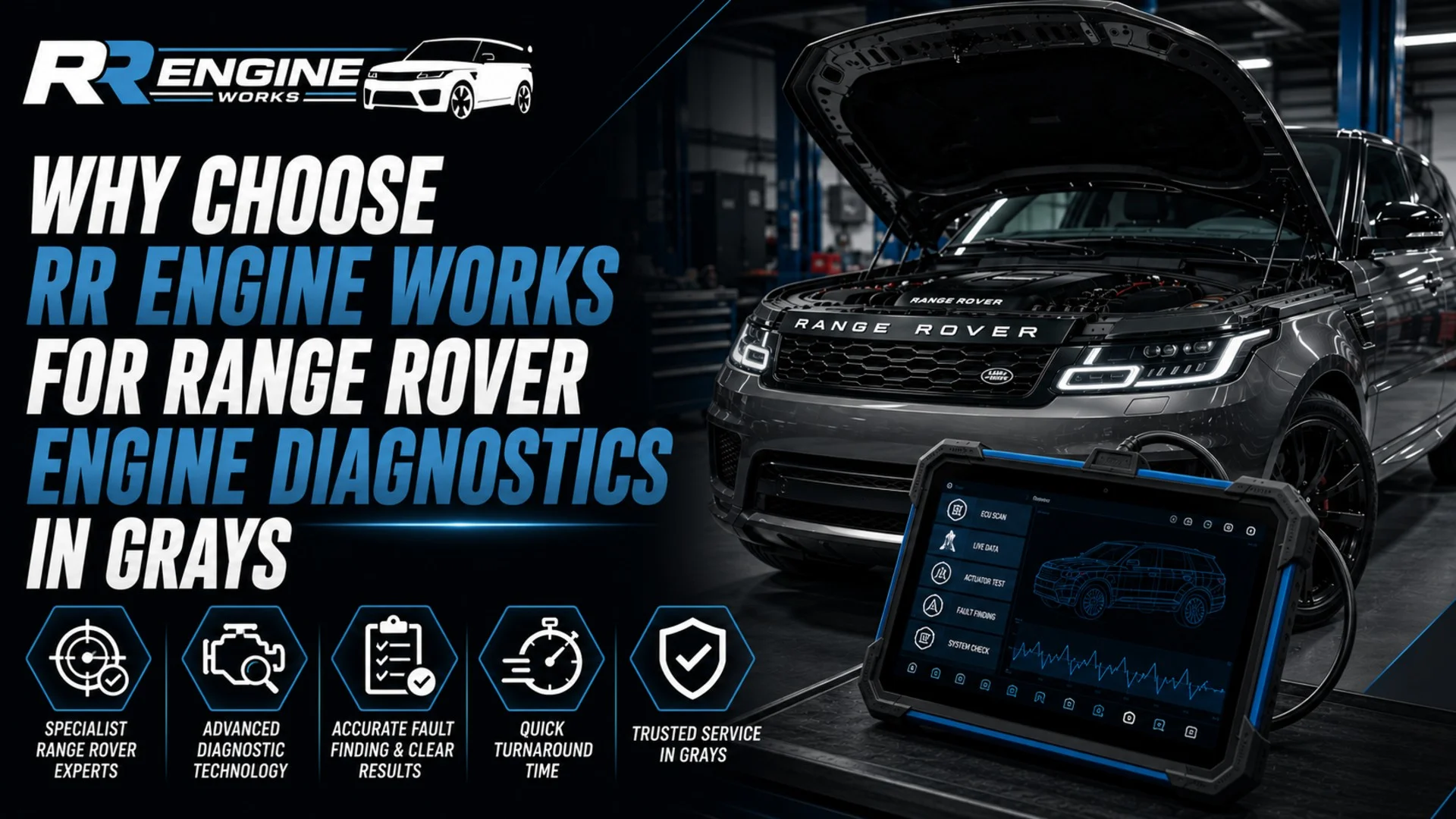
There's a real difference between a garage that can plug in a scanner and a specialist that actually understands Range Rover engines inside and out. That difference shows up in how accurately the fault gets diagnosed the first time.
Independent Range Rover specialists vs. dealer diagnostics , what's the difference?
Factor | Dealer Diagnostics | RR Engine Works (Independent Specialist) |
| Turnaround time | Often booked weeks in advance | Quicker appointment availability |
| Cost | Typically higher labour rates | Competitive, transparent pricing |
| Focus | General service centre, wide vehicle range | Range Rover and Land Rover specialist focus |
| Diagnostic depth | Standard manufacturer software | Same manufacturer-grade tools, applied with specialist model knowledge |
| Communication | Can be process-heavy | Direct, plain-English explanations |
Choosing an independent specialist doesn't mean compromising on diagnostic quality , it often means getting faster, more focused attention from people who work on these engines every single day.
Visit our Grays workshop or book your diagnostic appointment today
If your Range Rover's throwing up a warning light, running rough, or just not feeling right, don't wait for it to get worse. We're based at Unit 1, Hedley Ave, Grays, RM20 4EL, and we'd rather catch a fault early than see you back with a bigger bill later.
Call us or book online to get your Range Rover engine diagnostics sorted by people who actually specialise in these vehicles , not just service them in passing.
Frequently Asked Questions
Why is my Range Rover engine warning light on? It could be anything from a minor sensor fault to a more serious issue with the fuel system, EGR valve, or catalytic converter. The only way to know for certain is a proper diagnostic scan that reads the actual fault code and live data.
What causes Range Rover engine failure? Most engine failures don't happen overnight , they're usually the end result of an ignored warning sign, whether that's a persistent misfire, low oil pressure, overheating, or a timing chain fault left unaddressed for too long.
How much does engine diagnostics cost? It depends on the depth of testing required. A basic fault code check costs less than an advanced diagnostic involving compression testing or live data analysis. We confirm exact pricing before any work begins.
Can OBD scanners read Range Rover codes? Generic OBD-II scanners can read basic codes, but they often miss manufacturer-specific fault data available through specialist tools like TOPIx and Pathfinder, which we use for a more complete picture.
Can diagnostics detect timing chain issues? Yes , timing chain wear often shows up through live data irregularities, unusual engine noise correlation, and in some cases specific fault codes, especially on higher-mileage Ingenium and AJ133 V8 engines.
What causes a rough idle? Rough idle is commonly linked to worn spark plugs, faulty injectors, vacuum leaks, or EGR valve issues. Live data analysis usually narrows this down quickly.
How long does engine diagnostics take? A standard diagnostic typically takes 45 minutes to an hour, though intermittent faults requiring component testing can take longer.
If your Range Rover's been giving you signs something's not right, don't let it sit. A proper diagnostic check today could save you from a far more expensive repair down the line. Get in touch with RR Engine Works in Grays and let's find out exactly what your engine's trying to tell you.