
The main Range Rover 5.0 V8 supercharged engine problems are timing chain tensioner and guide wear, supercharger isolator rattle, coolant leaks from plastic pipes and the water pump, carbon build-up on the inlet valves and oil leaks on older engines. Timing chain wear was most serious on early engines from around 2010. Jaguar Land Rover revised the tensioners and guides, and its own technical bulletin covers the repair. Later engines are generally better, but cooling and supercharger faults affect every generation. This guide sets out which models use the engine, what goes wrong and how faults differ between early and later cars.
Which Range Rovers Use the 5.0 Supercharged V8?
The 5.0-litre supercharged V8 belongs to JLR's AJ133 engine family. It arrived for the 2010 model year and has been used across the Range Rover line-up for more than a decade, so the same faults appear in several models.
Models and Years
Model | Approx. years with 5.0 SC V8 | Notes |
| Range Rover L322 (Mk3) | 2009–2012 | Last years of the L322 |
| Range Rover Sport L320 | 2009–2013 | First-generation Sport, late models |
| Range Rover L405 (Mk4) | 2013–2021 | Includes SVAutobiography versions |
| Range Rover Sport L494 | 2013–2022 | Includes the SVR |
| Range Rover Velar | Late models only | SVAutobiography Dynamic Edition |
| Defender L663 | 2021 onwards | V8 versions |
Use your engine code, not the badge, to confirm what you have. The L322 also had a naturally aspirated 5.0 V8, and our L322 engine page lists both versions. For the later flagship, see our L405 engine page. SVR owners can find a model-specific guide on our Range Rover Sport SVR engine page.
The Main 5.0 V8 Supercharged Problems
Timing Chain Tensioners and Guides
Timing chain wear is the best-known fault on the early 5.0 V8. The engine uses chains with hydraulic tensioners and plastic-faced guides, or "blades". On early engines, the guides could wear and the tensioners lose control of the chain, which caused a rattle.
JLR addressed this in technical bulletin LTB00474, which covers the AJ133 engine in the Range Rover (L322), Range Rover Sport (L320) and LR4/Discovery 4. Version 2 of the bulletin specifies replacing both pairs of tensioners and blades. The revised blades have a steel insert to resist wear, and the tensioner design was changed to match. The bulletin also warns that an engine "must not have a mix of old level and new level parts fitted". Partial repairs that replaced only some parts led to repeat noise.
What it means for you: on an early car, ask whether the timing chain work was done and whether both sides were fully updated. The typical symptom is a rattle for a few seconds after a cold start. Camshaft timing fault codes can follow. The engine is an interference design, so a chain that jumps can cause major internal damage. Our timing chain replacement service covers the 5.0 V8 supercharged.
Later engines use the updated parts and are less prone to the problem, but they still depend on regular oil changes. Old or degraded oil speeds up wear on any chain-driven engine.
Supercharger, Cooling, Carbon and Leaks
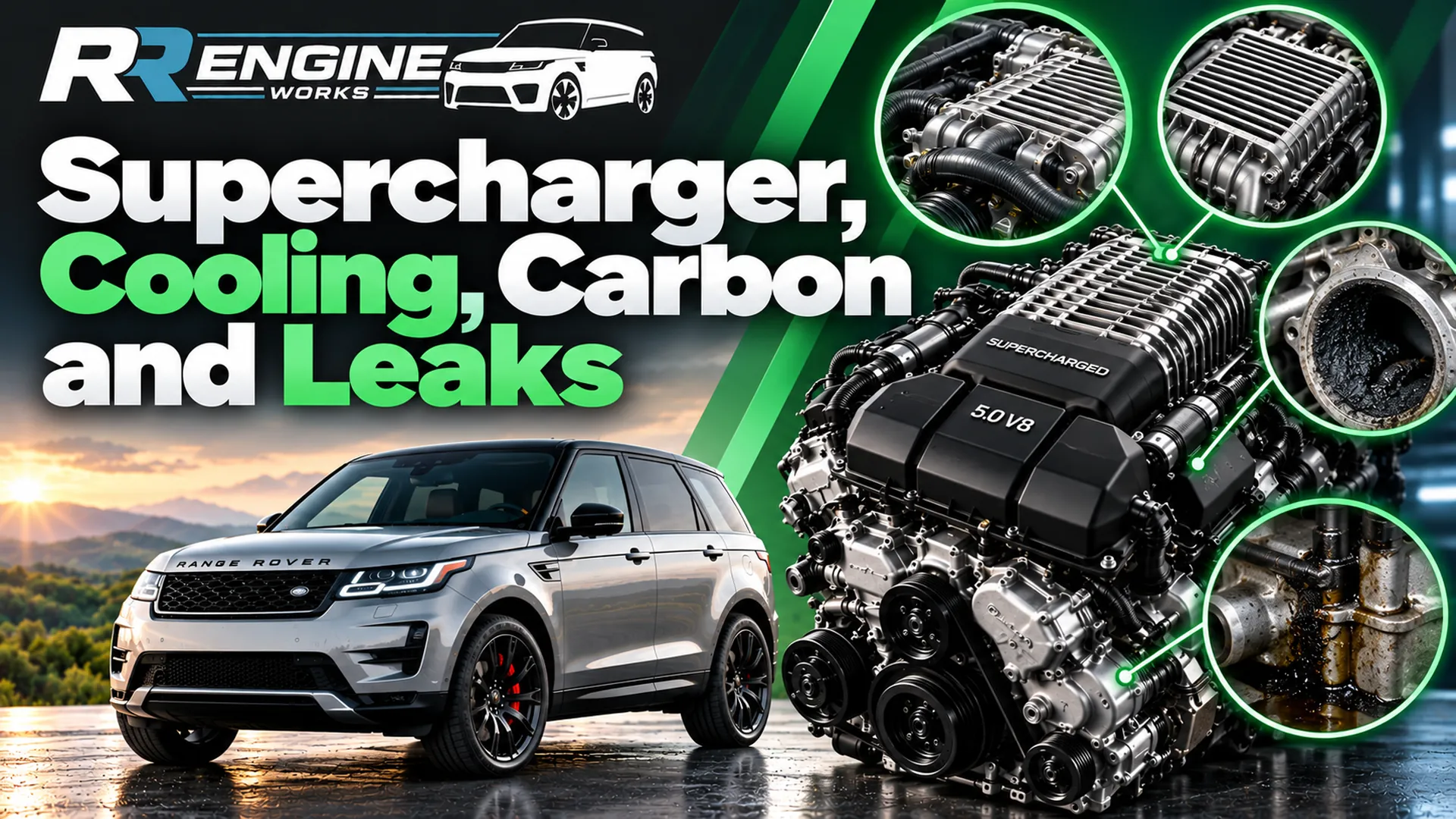
Supercharger isolator rattle. JLR bulletin LTB00482NAS6 describes a "clattering, knock or rattle" from the 5.0 supercharged engine. The cause is wear in the supercharger's torsional isolator or its spring support shaft. The bulletin covers the Range Rover and Range Rover Sport from 2010 through to the L405 and L494 generations. Its check is to turn the pulley by hand with the belt removed. Free play or a clunk points to the isolator. Roughness, sticking or a loud whine points to the supercharger itself. Because the isolator knock can sound like a much more serious fault, a proper diagnosis matters.
Cooling system leaks. Coolant pipes, the crossover pipe and the thermostat housing sit under the supercharger in the vee of the engine. They are partly plastic and endure repeated heat cycles, so they can become brittle and leak. Water pumps can also weep or fail. Coolant loss leading to overheating is the most damaging thing that can happen to this engine, so any unexplained drop in coolant level deserves attention.
Carbon build-up. The 5.0 V8 uses direct injection, so fuel does not wash the inlet valves. Over time, deposits can form there and cause rough running, misfires and lost power, especially on cars used for short trips. Walnut blasting is a common cleaning method.
Oil leaks and wear items. Higher-mileage engines can leak from valve cover gaskets, the vacuum pump seal or the front crankshaft seal. Drive belts, idlers and tensioners are routine wear parts.
Fuel smell on early Range Rover Sports. NHTSA recall 21V635 covers a cracked fuel outlet flange in the fuel tank on 2010–2013 Range Rover Sports with the 5.0 V8, among other models. Symptoms include a fuel smell, the engine warning light and sometimes fuel under the rear of the car. This is a US recall record, so UK owners should check their car on the GOV.UK recall checker.
Early vs Later Engines: What to Check
As a broad guide, early engines (roughly 2010–2013, in the L322 and L320) carry the greatest timing chain risk if the bulletin update has not been done. They also have the oldest cooling plastics. Later engines in the L405 and L494 share the cooling, supercharger and carbon issues, while their timing chain risk mostly comes down to oil condition and servicing. The 5.0 V8 engine page covers rebuild options for every generation.
Symptom Guide
Symptom | Likely cause | What to do |
| Rattle for a few seconds on cold start | Timing chain tensioners or guides | Check the history for the LTB00474 update and inspect |
| Rhythmic knock or clatter at idle | Supercharger isolator | Pulley free-play check before condemning anything |
| Whine that rises with revs | Supercharger bearing or drive parts | Inspect the supercharger and belt drive |
| Coolant level dropping | Crossover pipe, housing or water pump | Pressure test; don't keep topping up |
| Rough idle or misfire | Carbon build-up, coils or plugs | Diagnose before cleaning or replacing |
| Fuel smell, especially at the rear | Fuel flange or lines (21V635 on some cars) | Stop driving and check recall status |
| Oil spots under the engine | Gaskets or seals | Locate the leak before it reaches the exhaust |
If any of these appear, get a proper diagnosis first. Our engine diagnostics and repair service uses fault codes and live data to confirm the actual fault. To book an inspection, contact the team or call 01708 592377.
FAQs
5.0 V8 Supercharged Engine FAQs
Is the Range Rover 5.0 supercharged V8 reliable?
It can be, with good maintenance. Its known weak points are early timing chain tensioners, cooling system plastics, the supercharger isolator and carbon build-up. Most can be managed if they are caught early.
Which years of the 5.0 V8 had timing chain problems?
Timing chain issues are most associated with early AJ133 engines in the L322, L320 and LR4. JLR's bulletin LTB00474 introduced revised tensioners and steel-insert guides. Ask whether the full update has been fitted.
Is the knocking noise at idle my timing chain?
Not necessarily. A knock at idle is often the supercharger isolator, described in JLR bulletin LTB00482NAS6. A cold-start rattle is more typical of the timing chain. A proper check tells them apart.
Does the Range Rover Sport SVR have the same engine problems?
Largely yes, since it uses the same engine family. Its higher output and harder use make cooling and oil condition even more important.
Do newer Range Rovers still use the 5.0 supercharged V8?
The current Range Rover (L460) and Range Rover Sport (L461) moved to other V8 engines, so this guide applies mainly to earlier generations and to the Defender V8.
How do I check for recalls on my Range Rover?
Enter your registration on the GOV.UK vehicle recall checker. Recall work is carried out free by authorised repairers.