
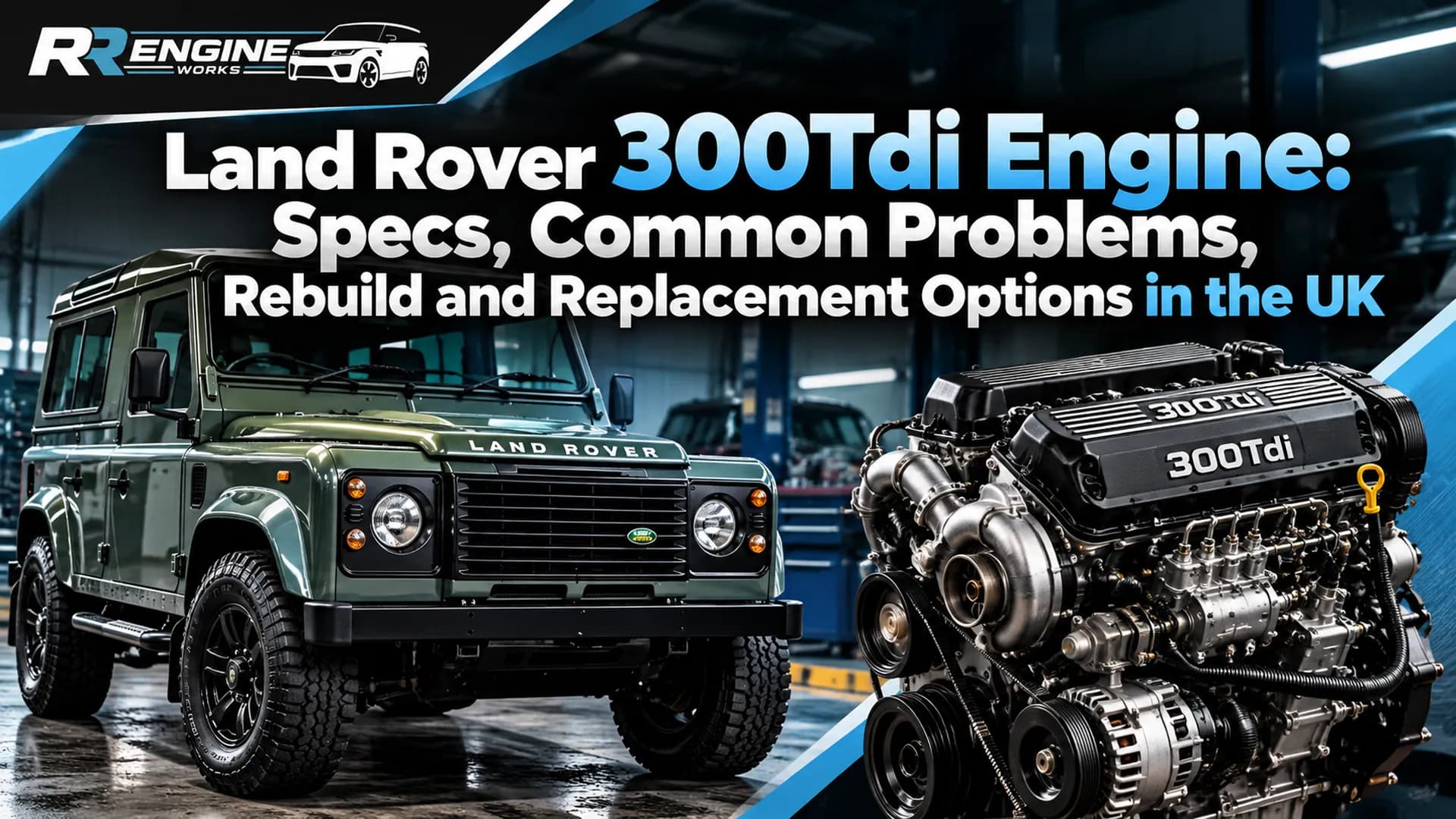
Your Defender is losing coolant, your Discovery is running hotter than it should, or someone has just told you the timing belt is overdue. Whichever it is, you are now asking the same question every 300Tdi owner eventually faces: repair it, rebuild it, recondition it, or replace it?
The Land Rover 300Tdi engine is a 2.5-litre, four-cylinder, turbocharged direct-injection diesel fitted to the Defender, Discovery and Range Rover Classic. It is tough, simple and well worth keeping alive, but it has a short list of known weak points that decide how long it lasts. This guide covers what the engine is, how to identify yours, what usually goes wrong, and how to choose between a rebuild, a reconditioned engine and a replacement.
At RR Engine Works in Grays, Essex, we handle all four routes. If you already know what you need, you can request a quote here and we will come back to you with options.
What Is the Land Rover 300Tdi Engine and Which Models Used It?
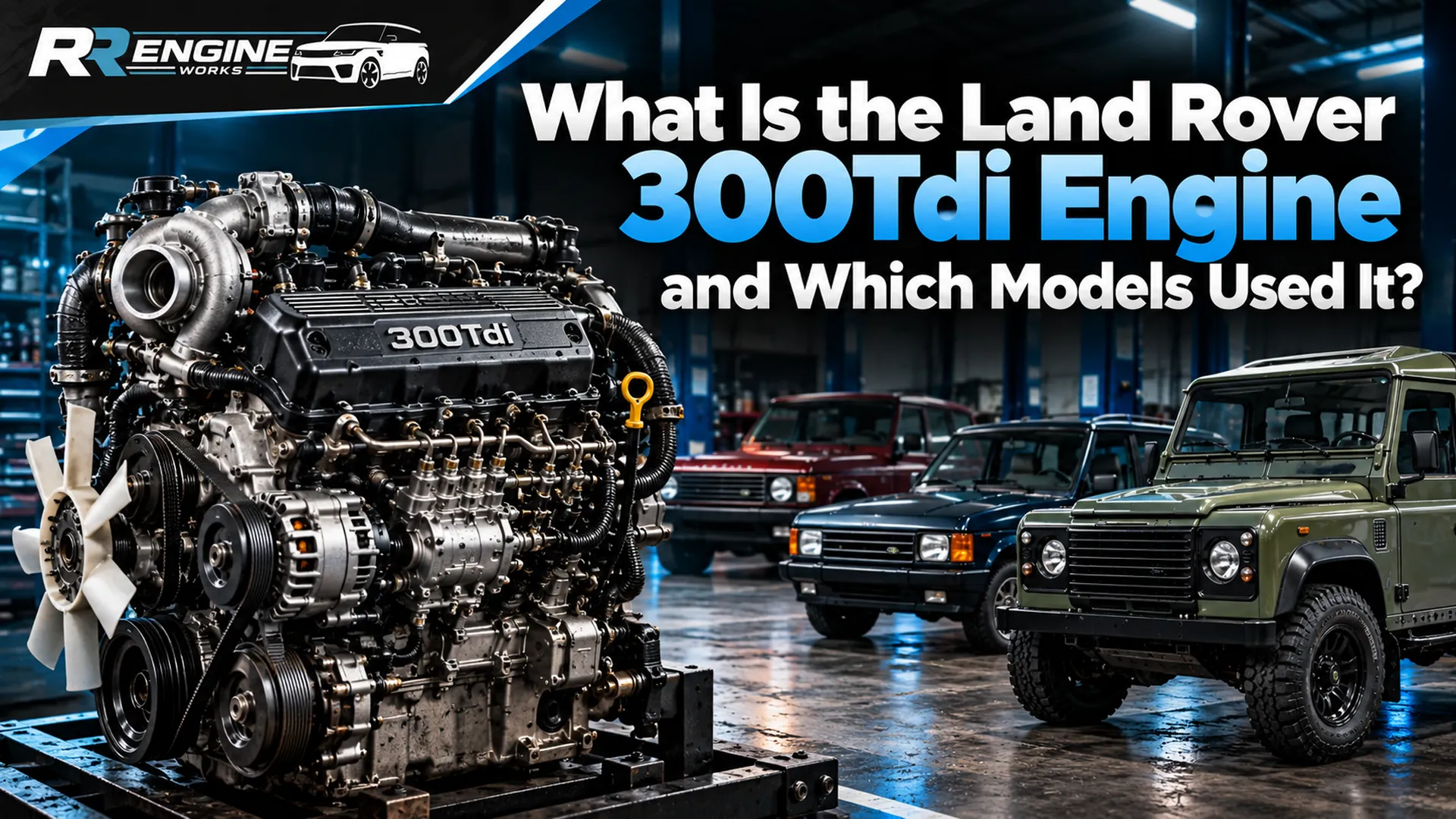
The 300Tdi is a 2.5-litre turbo diesel developed as the successor to the 200Tdi. It arrived in the mid-1990s and stayed in production until the Td5 took over around 1998. It is a mechanical-feeling, no-nonsense engine, which is a big part of why owners still choose to keep it running rather than swap to something newer.
You will find the 300Tdi in:
- Defender 90, 110 and 130, in station wagon, pick-up and utility forms
- Discovery 1 (often called Discovery Series I)
- Range Rover Classic, in its final years
It also turns up in many Series Land Rover conversions, where owners swap out a tired petrol or older diesel for something stronger and more economical. We cover that later in the guide.
What Are the 300Tdi Specifications and Engine Codes?
Here is the quick reference most owners are looking for:
Specification | Detail |
| Capacity | 2,495 cc (2.5 litre) |
| Layout | Inline four-cylinder, 8-valve |
| Aspiration | Turbocharged, intercooled |
| Fuel system | Direct injection, rotary injection pump |
| Power | Approx. 111 bhp at 4,000 rpm |
| Torque | Approx. 195 lb-ft at 1,800 rpm |
| Bore x stroke | 90.47 mm x 97 mm |
| Camshaft drive | Rubber timing belt |
The numbers are modest by modern standards. The real appeal is the torque low in the rev range, which is what makes the engine so good off-road and under load.
Engine codes are the part most owners get wrong. The 300Tdi was built in several variants, and the code on your engine tells you which vehicle it was built for. You will see codes in the 16L to 24L range, and they differ depending on whether the engine went into a Defender, Discovery or Range Rover Classic, and on whether it has EGR or an electronically controlled (EDC) injection pump.
This matters when you buy a replacement. The wrong variant can mean the wrong ancillaries, the wrong wiring or an engine that simply will not suit your gearbox and vehicle without modification. Always check the code on your existing engine before ordering anything.
How Do You Tell a 300Tdi From a 200Tdi?
At a glance the two engines look very similar, and the confusion costs people money. The surest check is the engine number stamped on the block, not the badge on the bonnet or the paperwork, because engines get swapped over the years.
A practical identification routine:
- Find and read the engine number on the cylinder block and cross-reference the code.
- Look at the cylinder head and inlet manifold. The 300Tdi has a revised head and manifold design compared with the 200Tdi.
- Check the injection pump. Some 300Tdi variants run electronic control, which the 200Tdi never did.
- Compare the ancillaries, including the pulley layout and how the belts run.
200Tdi | 300Tdi | |
| Capacity | 2,495 cc | 2,495 cc |
| Power | Approx. 107 bhp | Approx. 111 bhp |
| Built | Late 1980s to mid-1990s | Mid-1990s to about 1998 |
| Refinement | Good | Quieter, revised internals |
| Injection | Mechanical | Mechanical and electronic variants |
| Parts availability | Good | Very good |
Is the 300Tdi better? For most owners, yes, slightly. It is a more refined and developed engine. But a well-maintained 200Tdi will outlast a neglected 300Tdi every time. Condition and maintenance matter more than the badge.
What Is the Difference Between Defender and Discovery 300Tdi Engines?
This is the question that causes the most expensive mistakes. The core engine is the same, but the vehicle-specific details are not. When you are replacing an engine, the differences that count are:
- Engine mountings, which differ between vehicles
- Ancillaries, including the alternator, power steering pump and air conditioning provision
- Injection system, mechanical on some engines and EDC on others
- EGR, present on some variants and not others
- Wiring and sensors, which must match your vehicle's loom
- Air intake and exhaust, which are routed differently on each model
- Gearbox compatibility, whether you run an LT77 or R380 box
Take a real-world example. A customer with a Defender 110 finds a cheap Discovery 300Tdi on a classified site. The engine itself is sound, but the ancillaries, mounts and injection setup do not match. By the time the swap is sorted, the saving has gone. We always match the engine to the vehicle first, and we would rather tell you that before you buy than after.
What Are the Most Common 300Tdi Engine Problems?
The 300Tdi has a deserved reputation for durability. Most failures trace back to the same handful of causes, and most of them are preventable if you catch them early. The three that account for the bulk of expensive repairs are coolant loss, overheating and timing belt failure.
Other faults worth knowing about:
- Oil leaks, commonly from the rear main seal, rocker cover and sump area
- Turbocharger wear, showing as loss of boost, smoke or whistling
- Injector seal leaks, which cause rough running and hard starting
- Smoke, where black smoke points to fuel or air problems, blue to oil burning and white to coolant or unburnt fuel
None of these means the engine is finished. The point is to diagnose properly before spending money.
Why Does a 300Tdi Lose Coolant or Overheat?
Coolant loss is the classic 300Tdi complaint, and the most common culprit is the P gasket. This small seal sits at the front of the engine and is a known failure point. When it goes, coolant escapes without an obvious puddle, and owners often find themselves topping up the expansion tank for weeks without understanding why.
Other causes of overheating include:
- Silted radiator, where internal blockage reduces cooling capacity over time
- Failing thermostat, which can stick shut and cause rapid temperature rise
- Worn viscous fan, which stops pulling enough air at idle and in traffic
- Head gasket failure, usually the result of earlier overheating
- Water pump wear, shown by weeping from the pump housing
Watch for these warning signs:
- Temperature gauge creeping above its usual position
- Falling coolant level with no visible leak
- Sweet smell from the engine bay
- White smoke on start-up
- Milky residue under the oil filler cap
If the gauge climbs into the red, stop driving. Running a hot 300Tdi even a few more miles can warp the cylinder head and turn a cheap fix into a major repair. This is the single most expensive mistake we see.
A real scenario: a Discovery owner notices the coolant level dropping slowly over a month. The P gasket is the cause, and because the timing belt has to come off to reach it, it is the perfect moment to replace the belt, tensioner, idler and water pump together. Doing the work as one job costs far less than doing it in stages.
What Causes 300Tdi Timing Belt Failure and How Often Should It Be Changed?
The timing belt keeps the camshaft and injection pump in step with the crankshaft. When it fails, the engine stops instantly, and on this engine the consequences can include bent valves and piston damage. This is why it sits among the most serious 300Tdi risks.
Belt failure rarely happens because of the belt alone. The usual causes are:
- Age, as rubber hardens and cracks even with low mileage
- A failing tensioner or idler pulley, whose bearings seize or wear
- Crankshaft pulley problems, including a loose or damaged crank bolt
- Oil or coolant contamination from leaking seals or a weeping water pump
- Incorrect fitting or tension, a very common cause after poor DIY or budget work
Replacement intervals are commonly quoted as around 60,000 miles or five years, whichever comes first. Always check this against your vehicle's service schedule, and treat it as a maximum. If you have bought a 300Tdi and there is no proof of when the belt was last changed, assume it is overdue.
A proper timing belt job is a kit job: belt, tensioner, idler, and ideally the water pump and P gasket while everything is apart. Cutting corners here is false economy.
Worried about your belt or cooling system? Book a timing belt and cooling system inspection with RR Engine Works before a small job becomes a rebuild.
Should You Rebuild, Recondition or Replace a 300Tdi Engine?
If your engine has failed, or is heading that way, you have four realistic routes. The right one depends on what has actually gone wrong, the condition of everything else, and how you use the vehicle.
Option | What it involves | Best for |
| Repair | Fixing the specific fault (gasket, belt, seal, turbo) | Engines that are otherwise healthy |
| Rebuild | Strip, inspect, machine and rebuild your own engine | Owners who want to keep their original unit |
| Reconditioned engine | A fully overhauled engine supplied on an exchange basis | Fast turnaround and a known warranty |
| Used engine | A second-hand unit, tested but not overhauled | Tight budgets, with more risk |
When repair makes sense: the block, crank and bores are sound, and the fault is isolated. A P gasket or timing belt service is a repair, not a rebuild.
When a rebuild makes sense: you have overheated the engine, suffered a head gasket failure with damage, or the bores and bearings are worn. A proper 300Tdi engine rebuild involves stripping the engine, checking the block, crankshaft and head, machining and honing where needed, and fitting new pistons, rings, bearings, gaskets and an oil pump as required.
When a reconditioned engine makes sense: you need the vehicle back on the road quickly, or your original engine is too far gone to rebuild economically. A reconditioned 300Tdi has been overhauled to a defined standard and should come with a warranty.
When a used engine makes sense: only when the price is right and you accept the risk. Used engines have unknown histories. If you go this route, insist on a compression test result, evidence of mileage and a warranty in writing.
How Much Does a 300Tdi Engine Rebuild or Replacement Cost in the UK?
We will not quote a single figure here, because an honest answer depends on your engine. Costs vary with:
- Engine condition, which decides how much machining and how many parts are needed
- Parts required, from a basic gasket set to a full set of pistons, bearings and a crankshaft
- Vehicle model, because Defender, Discovery and Range Rover Classic setups differ
- Supply only versus supply and fit
- Warranty level and delivery requirements
A useful rule: if repair costs are heading towards the price of a reconditioned engine, replacement is usually the sensible call. If your original engine is basically sound and the vehicle has matching numbers or sentimental value, a rebuild keeps the character intact.
Not sure which route fits your engine? Get a free quote, or bring the vehicle to us at Unit 1, Hedley Ave, Grays RM20 4EL. We will assess it, explain what we find in plain terms, and tell you honestly if a cheaper fix will do the job.
Frequently Asked Questions About the 300Tdi
Is the Land Rover 300Tdi a reliable engine?
Yes, when maintained. It is widely regarded as one of the most dependable Land Rover diesels. Most serious failures come from neglected timing belts, cooling system faults and overheating, not from inherent design flaws.
How many miles will a 300Tdi last?
With regular servicing and a well-maintained cooling system, many run well beyond 150,000 miles, and some far further. Condition and history matter more than mileage.
How powerful is a 300Tdi?
Approximately 111 bhp and 195 lb-ft of torque from 2,495 cc.
What vehicles had the 300Tdi engine?
The Defender 90, 110 and 130, the Discovery 1 and the Range Rover Classic, plus many Series conversions.
What is the difference between a 200Tdi and a 300Tdi?
They share capacity and basic layout, but the 300Tdi has revised internals, a different head and manifold, slightly higher output and electronic injection on some variants.
Why does my 300Tdi lose coolant?
The P gasket is the most common cause, followed by the water pump, a silted radiator or a failing head gasket.
What causes 300Tdi timing belt failure?
Age, a worn tensioner or idler, a problem with the crank pulley, contamination from leaks, or poor fitting.
Should I rebuild or replace my 300Tdi?
Rebuild if your engine is repairable and you want to keep it original. Replace with a reconditioned engine if you need speed and a warranty, or if the damage is extensive.
Can I fit a 300Tdi in a Series Land Rover?
Yes, it is a popular conversion. You will need to consider engine mounts, gearbox (LT77 or R380), radiator, intercooler and propshafts. Plan the whole conversion, not just the engine.
Final Thoughts: Keep Your 300Tdi on the Road
The 300Tdi is worth looking after. Stay ahead of the timing belt, keep the cooling system healthy, and act on coolant loss the moment you notice it. That alone prevents most of the big bills.
When the engine does need serious work, the choice between rebuild, reconditioned and replacement should come from an honest assessment of the engine, not from a sales pitch. That is how we work at RR Engine Works.
Ready to get your 300Tdi sorted? Request a free quote at rrengineworks.co.uk, or call in at Unit 1, Hedley Ave, Grays RM20 4EL.