
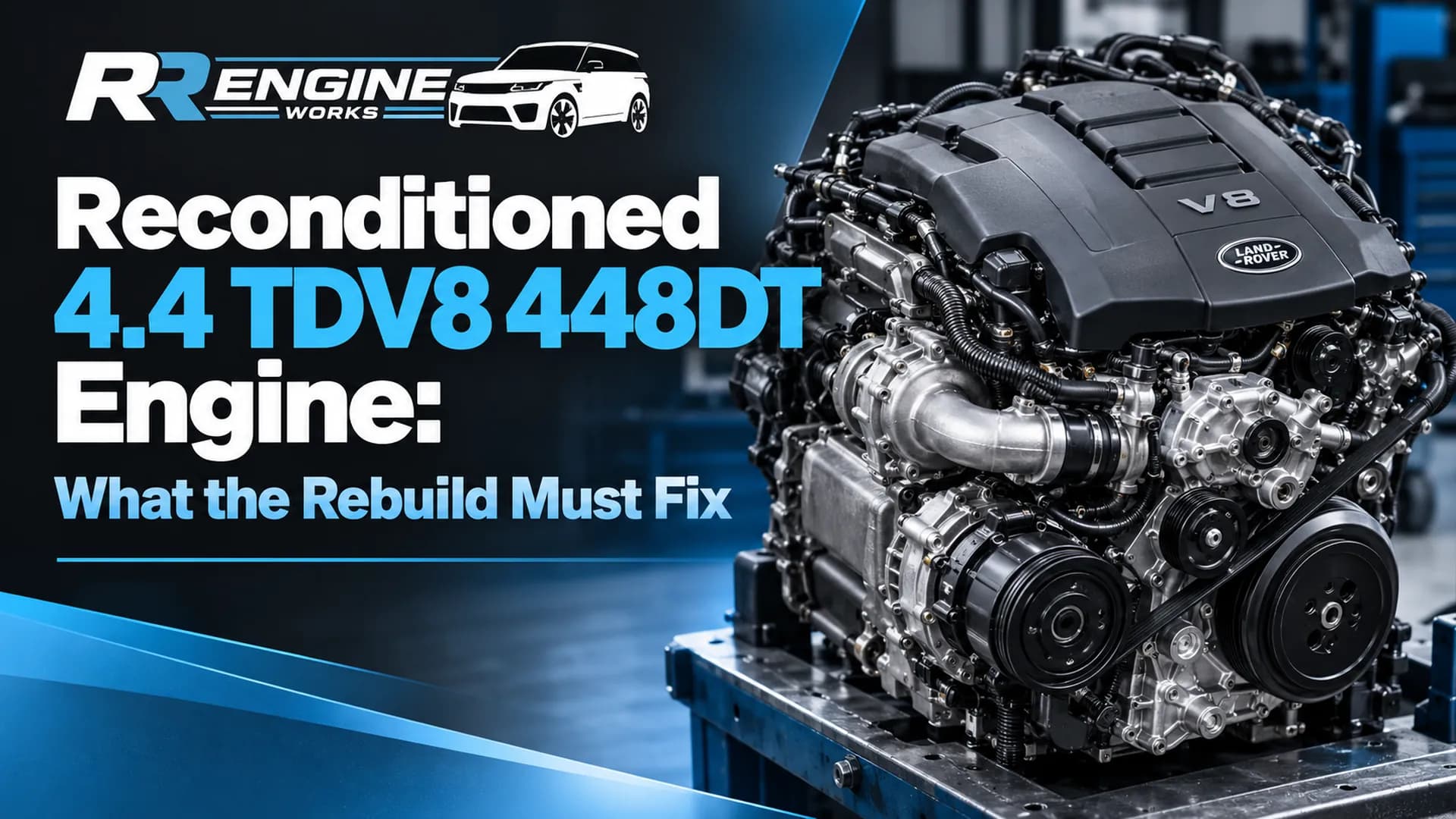
A reconditioned 4.4 TDV8 448DT engine is only as good as the problems it fixes. The 448DT is a strong V8 diesel, but it fails in a handful of recognisable ways:
- oil supply and bearing damage;
- worn timing chains at the rear of the engine;
- leaking oil coolers;
- turbo and boost faults.
A replacement engine that ignores those causes, or is fitted into a car where the cause is still present, can fail in the same way.
This guide explains what has to be put right, both inside the reconditioned engine and in the vehicle it goes into.
The 448DT in Brief
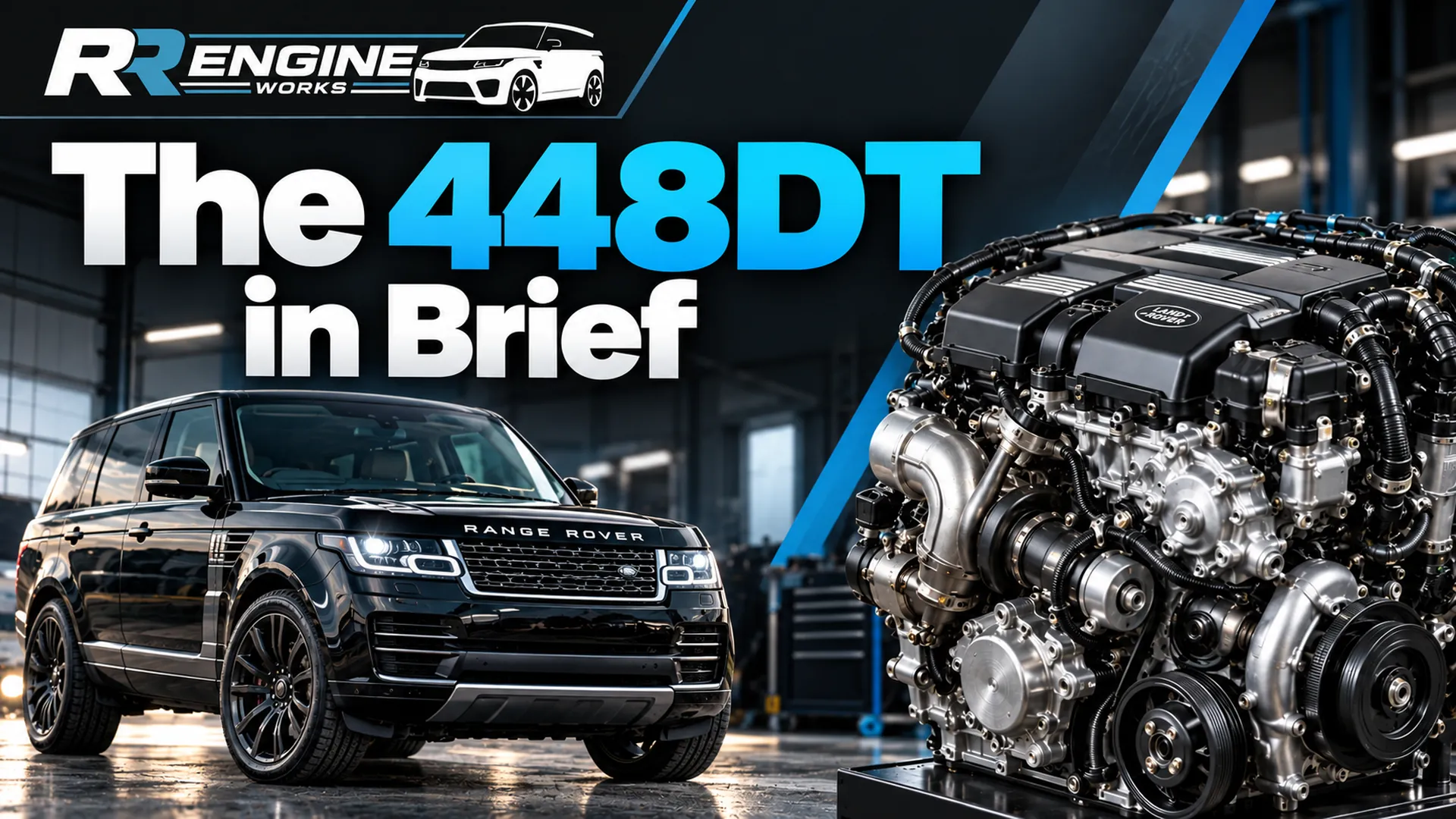
The 448DT is Land Rover's 4.4-litre (4,367cc) common-rail V8 diesel. It produces roughly 313–340hp and 700–740Nm, depending on version (Motorinsel).
TDV8 and SDV8 Applications
Badge | Vehicle | Approx. years |
| 4.4 TDV8 | Range Rover L322 (Mk3 Vogue) | 2010–2012 |
| 4.4 SDV8 / D340 | Range Rover L405 (Mk4) | 2013–2020 |
| 4.4 SDV8 / D340 | Range Rover Sport L494 | 2013–2020 |
Earlier L322s and first-generation Sports used the 3.6 TDV8 (368DT), which is a different engine.
Because emissions equipment, turbo set-up and calibration differ between the L322 and the later cars, a reconditioned 448DT must be matched to your vehicle's specification.
RR Engine Works covers these models on its Range Rover 4.4, Vogue Mk3, Vogue Mk4 and Range Rover Sport engine pages.
Why 448DT Engines Fail, and What a Reconditioning Must Cure
Oil Supply and Bearing Damage
The most expensive 448DT failures start with oil. The reported causes are:
- Oil starvation. Dirty oil, a low sump level or a blocked oil pick-up strainer can starve the bearings. A deep knock from the bottom of the engine, often with a low-oil-pressure warning, is the classic symptom (Rover Spares).
- Oil dilution. When the DPF regenerates, extra fuel is injected and some reaches the sump. Short trips that interrupt regeneration let that dilution build up.
- Oil pump problems. Individual cases of pump seizure have been reported, though specialist sources do not treat this as common.
What the reconditioned engine needs:
- crankshaft measured and ground, or replaced;
- new main and big-end bearings;
- oil pump renewed or proven within specification;
- a clean pick-up and strainer;
- oil pressure tested before supply.
What the vehicle needs:
- oil cooler, turbo oil feeds and oil lines flushed or replaced, because debris from the old bearings can lodge there;
- a fresh oil of the correct specification;
- if the car only does short trips, the DPF regeneration problem addressed as well.
Timing Chains, Coolers and Turbos
Rear timing chains. The 448DT's timing chains sit at the back of the engine. A rattle from the rear on a cold start, fading as oil pressure builds, is the warning sign. The chains are hard to reach, so a reconditioned engine is the ideal opportunity to renew chains, guides and tensioners.
JLR Engines puts a standalone preventative chain-and-tensioner job at £2,800–£3,800, and a rebuild after the chain has failed at £5,500–£8,500. VAT is not stated, and these are not RR Engine Works prices (JLR Engines).
Oil cooler. Rover Spares describes the engine oil cooler as one of the best-documented 4.4-specific faults. It can fail externally, with oil weeping and a burning smell, or internally, putting oil in the coolant. A replacement engine should never be fitted with a doubtful oil cooler.
Turbos and boost. Limp mode or a loss of boost is more often caused by a split intercooler hose than by a failed turbo. Turbos genuinely damaged by oil starvation, however, must be replaced or rebuilt. Otherwise they can shed debris into the new engine.
EGR and inlet carbon. Clean these parts or replace them while the engine is out. Heavy carbon deposits upset combustion and can feed soot into the oil.
Failure origin | Fix inside the engine | Fix in the vehicle |
| Bearing / oil starvation | Crank, bearings, oil pump, pick-up | Flush or replace oil cooler and lines; check turbos; correct oil |
| Timing chain wear | New chains, guides, tensioners | Correct oil grade and change intervals |
| Oil cooler failure | Clean oil galleries if contaminated | New cooler and seals; flush cooling system |
| Turbo failure | Inspect for debris | Replace turbos; clean intercooler and pipework |
| Carbon / EGR | Inlet ports cleaned | EGR valves and coolers cleaned or replaced |
Specifying and Fitting a Reconditioned 448DT
The Spec Sheet and Fitting Checklist
A reconditioned 448DT should come with a written list covering:
- Crankshaft condition: measured, ground or replaced.
- Bearings, piston rings and seals renewed.
- Oil pump renewed or tested.
- Timing chains, guides and tensioners renewed.
- Cylinder heads pressure-tested and skimmed if needed; valve stem seals renewed.
- Test results, at minimum oil pressure and compression.
- Variant confirmation: TDV8 or SDV8, and the vehicle specification it suits.
At fitting, the workshop should:
- confirm and fix the cause of the original failure;
- deal with the oil cooler, turbos, oil lines and intercooler as described above;
- transfer ancillaries correctly and renew gaskets and mounts where needed;
- code the engine management and complete a logged road test;
- set out the warranty in writing: duration, mileage limit, and whether labour is covered.
RR Engine Works' supply and fit service lists removal of the failed engine, ancillary transfer, consumables, ECU coding and a logged road test. Bare-engine prices are quoted plus VAT, and fitting is quoted in writing before work starts. If your own engine's block and crankshaft can be saved, an engine rebuild can be quoted alongside a reconditioned unit.
Frequently Asked Questions
Reconditioned 448DT FAQs
What fails on a 4.4 TDV8 448DT?
The most reported problems are bottom-end bearing damage linked to oil supply, rear timing-chain wear, oil cooler leaks, turbo and boost-hose faults, EGR carbon build-up and oil dilution from DPF regeneration.
Is a reconditioned 448DT better than a used one?
Usually, provided it is properly specified. A reconditioned engine should have renewed bearings, timing components and seals, plus test results. A used engine brings its own unknown wear with it.
Does a reconditioned 448DT come with new timing chains?
It should, but the definition of "reconditioned" varies between suppliers. Ask for the chains, guides and tensioners to be listed on the written specification.
Will a 448DT replace a 3.6 TDV8?
Not as a direct swap. The 3.6 TDV8 (368DT) is a different engine, and changing to a 448DT involves major wiring, mounting and calibration work.
How much does a reconditioned 448DT cost?
It depends on the specification, the ancillaries included, the fitting work, VAT and whether an exchange core is required. A rebuild after timing-chain failure is commonly quoted at £5,500–£8,500 by one UK specialist. For a vehicle-specific figure, ask for an itemised quote.
To discuss a reconditioned 448DT for your Range Rover or Sport, contact RR Engine Works on 01708 592377 via the contact page. Please give your registration, model year, mileage and what happened to the original engine.