
The temperature gauge creeps up, a sweet smell drifts through the vents, or you spot pink crust around the front of the engine. Now you need to know what it will cost to put right, and how quickly.
Here's the honest answer: Range Rover water pump replacement cost depends on your model year, your engine and how much of the car has to come apart to reach the pump. There is no single number that fits every vehicle.
This guide breaks down what moves the price, how a 2006 car differs from a 2018 one, and which symptoms mean you should stop driving. It also explains how RR Engine Works in Grays, Essex diagnoses and replaces the pump. We don't print fixed figures here, because parts and workshop rates change over time. You'll get a clear written quote once your car has been checked.
How Much Does a Range Rover Water Pump Replacement Cost?
The cost of a Range Rover water pump replacement is set by the engine, the pump design, the parts you choose and the labour needed to reach it. A pump that sits on the front of the engine behind a few ancillaries is a very different job from one buried deep in the vee of a V8.
If you're searching "range rover water pump replacement cost", you'll find averages online. Treat them with caution. They blend together different engines, years and garage types, so they rarely match your car.
What Decides the Cost of a Range Rover Water Pump Replacement in the UK?
Five things shape almost every quote:
- Engine type. A TDV6, SDV8, 5.0 V8 petrol and a newer Ingenium engine each have different layouts. Access and labour time change with each one.
- Pump design. Some engines use a mechanical pump driven by a belt or chain. Others use an electric pump. The part and the procedure are different.
- Parts quality. Genuine and OEM-quality pumps cost more than budget alternatives, but they tend to last longer and hold up under heat.
- Labour time. The deeper the pump sits, the more hours it takes to reach it safely.
- Linked work. While the cooling system is open, it often makes sense to replace the thermostat, hoses, belts or coolant. Doing it together avoids paying the same labour twice.
Here's how those factors compare in practice:
Cost factor | Effect on final quote | Why it matters |
| Engine and pump location | High | Decides how much has to be removed to reach the pump |
| Labour time | High | Longer access jobs take more workshop hours |
| Linked parts (thermostat, hoses, belts) | Medium | Worth doing together if they are worn |
| Parts quality | Medium | Affects durability and warranty confidence |
| Coolant and bleeding | Low | Needed on every job, but a smaller share of the total |
Think of this table as a guide to what drives the bill, not a price list. A garage that quotes a flat figure without seeing the car is guessing.
Does the Water Pump Replacement Cost Change by Model Year (2006 to 2018)?
Yes. Model year matters because it points to the generation, the engine and the condition of the surrounding parts. If you've searched for a 2006, 2008, 2011, 2012, 2013, 2014, 2015, 2016, 2017 or 2018 Range Rover water pump replacement cost, the year is a clue, but it is never the full answer.
Broadly, two generations cover these years:
- L322 (about 2002 to 2012): includes the 2006, 2008, 2011 and 2012 cars
- L405 (2013 onward): includes the 2013 to 2018 cars
Why Does a 2006, 2008 or 2011 to 2013 Range Rover Water Pump Cost Differ From a 2014 to 2018 Model?
Model years | Generation | What owners should expect |
| 2006, 2008 | L322 | Higher age and mileage. Hoses, fittings and clips are often brittle or corroded, so extra work is common |
| 2011, 2012 | L322 | Later diesel and V8 units. Cooling system condition varies a lot with service history |
| 2013 | L405 (first year) | New platform with lighter construction. Access and procedure differ from older cars |
| 2014 to 2018 | L405 | Tighter packaging and more electronics. Fewer corrosion problems, but more components may have to come off first |
On older cars, the pump itself is rarely the whole story. Years of heat cycling leave plastic pipes, thermostat housings and hose connections tired. A sensible quote allows for inspecting them.
On newer cars, the issue is different. The engine bay is crowded, so even a straightforward pump can take longer to reach. That's why two cars of different ages can end up with similar quotes for very different reasons.
Is a 2012 or 2013 Range Rover Water Pump Replacement Different From a 2016 to 2018 One?
Usually, yes. A 2012 car sits at the end of the L322 generation. A 2013 car is the first of the new L405. They share a badge, but the engineering underneath changed a lot.
By 2016 to 2018, the L405 had matured. Cooling layouts were refined, and the cars often have lower mileage than the older models. In our workshop, the most common difference is not the pump but what we find around it: older cars tend to need more supporting parts, while newer ones need more time to reach the pump cleanly.
A practical example: an owner brings in a 2012 car with a coolant smell and a damp patch near the front of the engine. On inspection, the pump is weeping, but two hoses are also brittle. Replacing them together costs more at the start than the pump alone, and it saves a second visit when the next hose splits.
What Are the Signs of a Failing Range Rover Water Pump, and Can I Still Drive?
A failing water pump rarely stays quiet. The earlier you spot the signs, the more likely you are to avoid engine damage.
What Are the Symptoms of a Bad Range Rover Water Pump?
Watch for these warning signs:
- Coolant leaks. Look for drips under the front of the car, or pink or blue crusty residue around the pump.
- Overheating. The temperature gauge climbs, or a warning appears on the dash.
- A whining or grinding noise. A worn bearing inside the pump often makes a noise that rises with engine speed.
- A sweet smell. Coolant has a distinctive scent, especially after a drive.
- Low coolant warnings. If you keep topping up with no obvious cause, there is a leak somewhere.
- Weak cabin heating. Poor coolant circulation can leave the heater lukewarm.
Any one of these can have other causes, such as a hose or radiator problem. That's why a proper pressure test matters before parts are ordered.
Is It Safe to Drive a Range Rover With a Failing Water Pump?
Usually not, beyond a short and careful trip to a garage. The pump keeps coolant moving. If it stops, the engine temperature can rise quickly.
Driving on can lead to a warped cylinder head or a blown head gasket. Those repairs cost far more than the pump itself.
Pull over safely and switch off if:
- The temperature warning comes on
- You see steam from the bonnet
- The gauge moves into the red
- The coolant light stays on after topping up
Don't open the cap while the engine is hot. Call for recovery and have the car checked.
How Is a Range Rover Water Pump Diagnosed and Replaced at RR Engine Works?
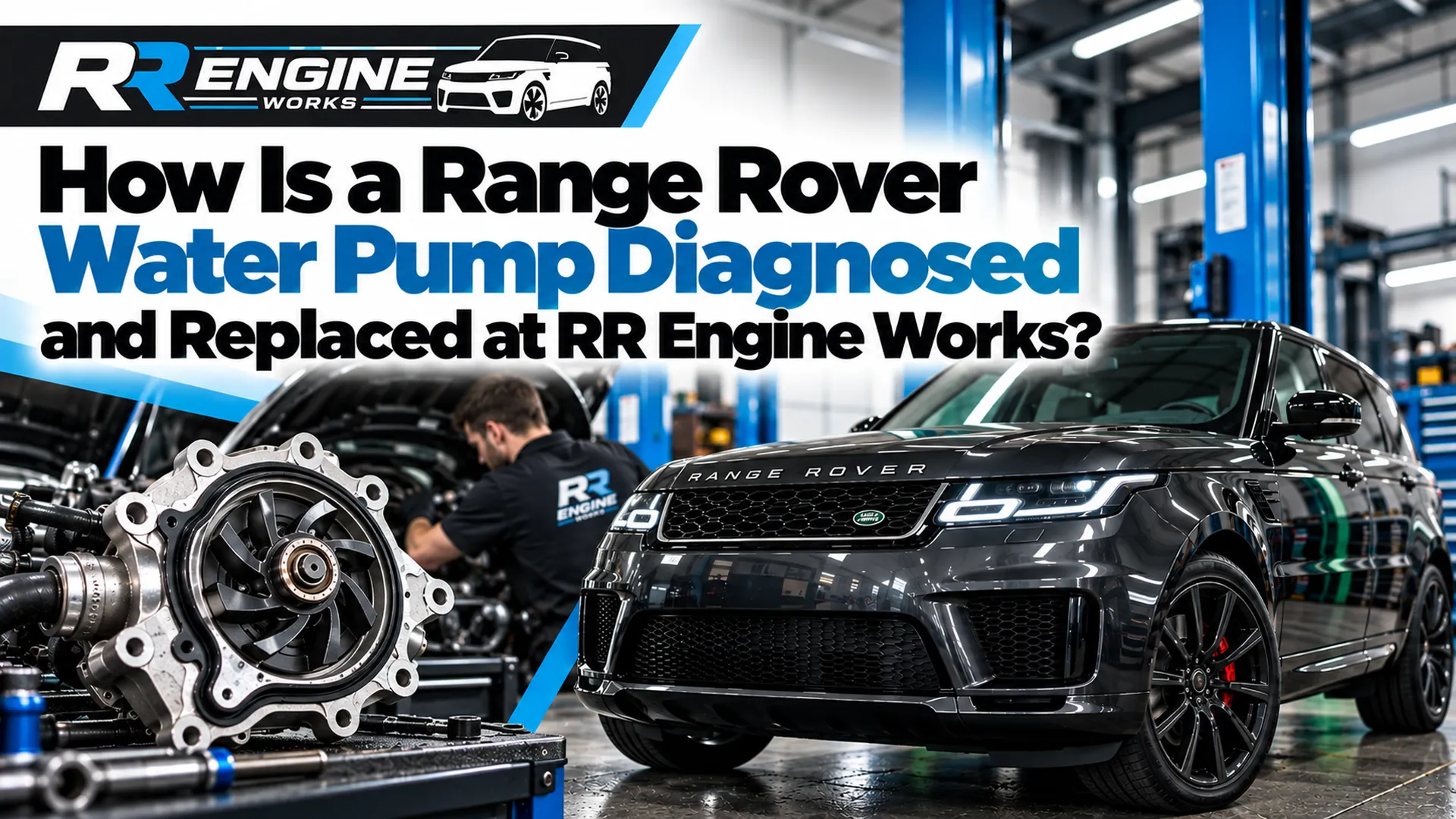
A clear process protects you from guesswork and repeat visits. Here is how the job runs.
What Happens During a Range Rover Water Pump Replacement, and How Long Does It Take?
- Initial inspection. We check the coolant level, condition and any visible leaks.
- Pressure test and leak trace. The cooling system is pressurised to confirm whether the pump, a hose or another part is at fault.
- Findings and photos. You see what we see, with the problem explained in plain language.
- Fixed quote. You approve a written quote before any work begins.
- Replacement. The pump is replaced with the correct seals, and any linked worn parts are dealt with as agreed.
- Refill and bleed. The system is refilled with the right coolant and bled to remove air pockets.
- Final checks. We run the engine up to temperature and check for leaks and stable readings.
The time it takes depends on the engine and how much needs to come off. Your quote should include an estimated timeframe.
We specialise in Range Rover, Land Rover and Jaguar engines, so we see these cooling faults regularly. If you've also noticed oil on the drive, read our guide to Range Rover oil leak repair too, since the two systems sit close together. You can also browse our engine repair services for related work.
How Do I Get a Fixed Quote for a Range Rover Water Pump Replacement in Essex?
It takes about a minute. Send us:
- Your registration number
- The engine type if you know it
- A short note on what you've noticed, such as leaks, noises or warnings
A photo of the leak or the temperature gauge helps too. You can also visit us at Unit 1, Hedley Ave, Grays RM20 4EL. We help owners across Essex, East London and the surrounding areas. Start at rrengineworks.co.uk.
Frequently Asked Questions
How much does a Range Rover water pump replacement cost?
It depends on your model year, engine, pump design and the labour needed to reach it. Linked parts such as the thermostat or hoses can also affect the total. A diagnosis is the only reliable way to get an accurate quote.
Is the water pump replacement cost different for a 2012 and a 2018 Range Rover?
Often, yes. A 2012 car belongs to the older L322 generation, while a 2018 car is an L405. The engines, layouts and access points differ, so labour and parts can vary.
How often does a Range Rover water pump need replacing?
There's no fixed interval. Pumps wear with age, mileage and heat. Following the service schedule and having the cooling system checked regularly helps you catch a weak pump early.
Can a failed water pump damage the engine?
Yes. If the pump stops circulating coolant, the engine can overheat. That can damage the head gasket and cylinder head, which are costly repairs.
Should I replace the thermostat and hoses with the water pump?
Often it makes sense, especially on older cars. The system is already drained and accessible, so replacing worn linked parts saves repeat labour.
Can I drive with a leaking water pump?
Only for a very short, careful trip to a garage, and only if the temperature stays normal. If the gauge rises or a warning appears, stop and call for recovery.
Final Thoughts
Range Rover water pump replacement cost isn't one number. It comes down to your model year, your engine and the work needed to reach and replace the pump properly. The best way to control the cost is to act early, before an overheating event turns a pump job into an engine job.
If you've noticed a coolant smell, a rising temperature or a leak at the front of the engine, don't wait. Contact RR Engine Works today for a proper diagnosis and a fixed quote, and get back on the road with confidence.