
The most common Range Rover Sport SVR engine problems are coolant leaks from plastic pipes in the engine vee, and timing chain and tensioner wear. Supercharger isolator rattle and drive belt wear also come up, along with carbon build-up on the inlet valves. These faults are not unique to the SVR. It uses the same 5.0-litre supercharged V8 family as other Range Rovers. But the SVR runs higher outputs and is often driven harder, so heat, oil condition and maintenance history matter even more. This guide explains each fault, why it happens on an SVR and which warning signs mean the car needs checking now.
The SVR Engine in Brief
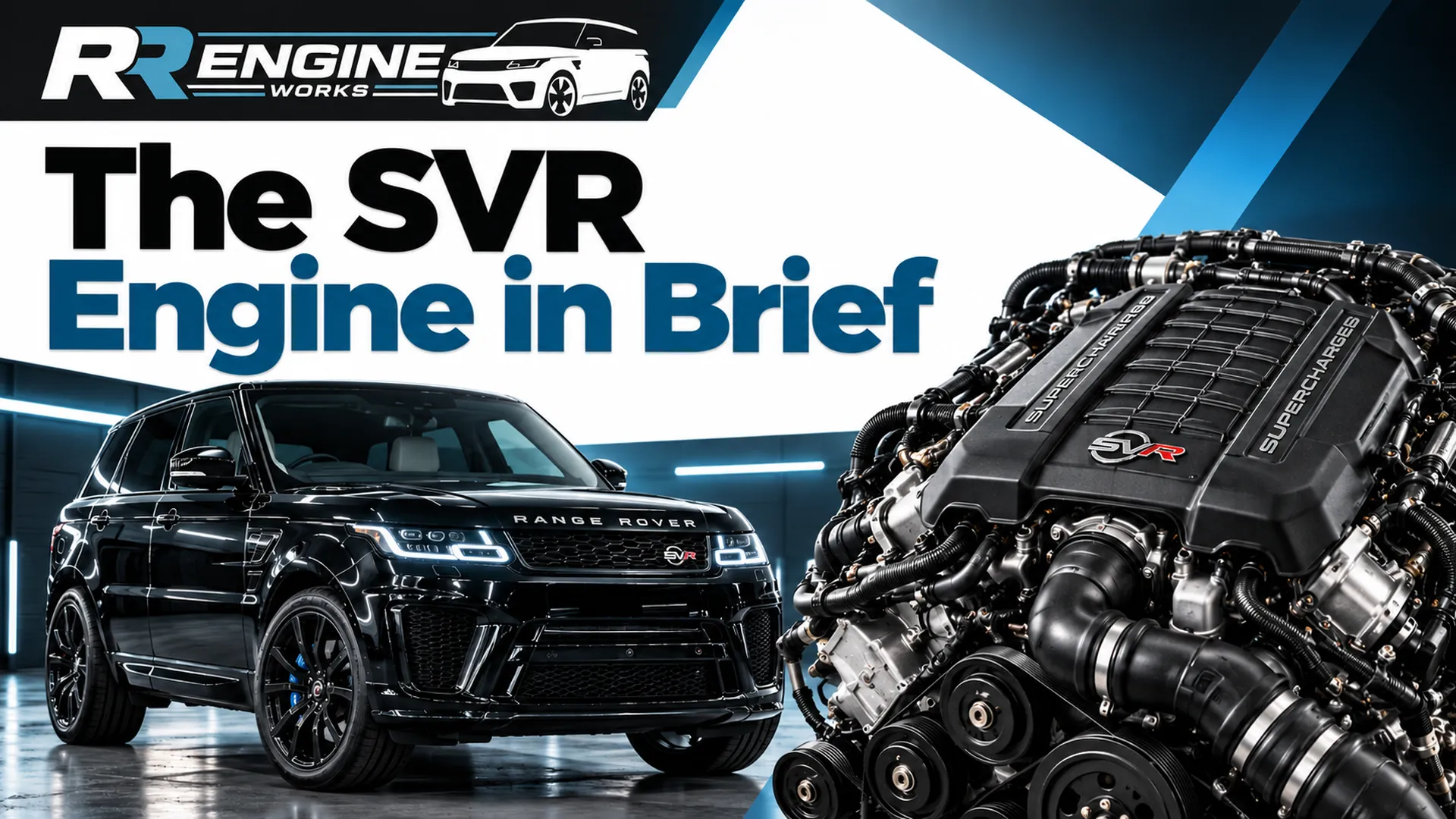
The Range Rover Sport SVR is the high-performance version of the second-generation Range Rover Sport (L494). Under the bonnet is the 5.0-litre supercharged V8, part of the AJ133 family, with a twin-vortex supercharger mounted in the vee of the engine. It drives an eight-speed ZF automatic gearbox.
Because the supercharger sits between the cylinder banks, the coolant pipes, thermostat housing and many sensors run in a hot, crowded space beneath it. That layout explains several of the faults below. It also explains why repairs in that area take time: the supercharger often has to come off to reach them.
SVR Versions at a Glance
Version | Approx. years | Stated output | Notes |
| Pre-facelift SVR | 2015–2017 | 550PS | Early L494 SVR |
| Facelift SVR | 2018–2022 | 575PS | Higher output, updated styling |
| Successor (L461 Sport SV) | 2023 onwards | — | Not an SVR, and not a 5.0 supercharged V8 |
Our Range Rover Sport SVR engine page has more detail on the SVR versions. For the 5.0 V8 across other models, see our 5.0 V8 engine page.
Common SVR Engine Problems
Cooling System Leaks and Overheating
The cooling system is the area most worth watching on any 5.0 supercharged V8, and the SVR is no exception. Plastic coolant crossover pipes and thermostat housings sit under the supercharger and endure repeated heat cycles. Over time they can turn brittle, crack or weep at their joints. Water pumps can also start to leak.
Why it matters more on an SVR: higher output means more heat to manage, and hard driving followed by a sudden stop heat-soaks the components in the vee. A small leak can then become a sudden loss of coolant. If the engine overheats, the damage can go well beyond the pipe. Specialist guides warn of cylinder head and liner damage after a serious overheat.
Signs: coolant level dropping between checks, a sweet smell after driving, white residue around the back of the supercharger, the temperature gauge rising, or a coolant warning on the dash. If the warning appears, stop safely rather than drive on.
Timing Chain, Supercharger and Carbon Faults
Timing chain and tensioner wear. The 5.0 V8 uses timing chains with hydraulic tensioners and plastic guides. Chains and guides wear faster when oil is changed late or degrades under heat. The usual early sign is a rattle for a few seconds after a cold start. Camshaft correlation fault codes can follow. Left too long, wear can affect valve timing and risk internal damage. Our timing chain replacement service covers the 5.0 V8 supercharged.
Supercharger isolator rattle. JLR technical bulletin LTB00482NAS6 describes a "clattering, knock or rattle" from the 5.0 supercharged engine. The cause is wear in the supercharger's torsional isolator or its spring support shaft, which creates excess free play in the drive. It covers Range Rover Sport models from the 2014 model year. The bulletin's check is to remove the drive belt and turn the pulley by hand. Free play or a knock points to the isolator. A rough or sticking pulley, damaged rotors or a loud whine points to the supercharger itself. Specialists warn that the knock at idle can be mistaken for bottom-end bearing failure, so proper diagnosis matters before anyone condemns the engine.
Supercharger drive belt and pulleys. A worn belt, tensioner or idler pulley can squeal, slip or fray, which reduces boost and performance. These are routine wear parts, but on a high-output engine they should be checked at every service.
Carbon build-up on inlet valves. The 5.0 V8 injects fuel directly into the cylinders, so fuel never washes over the inlet valves. Over time, carbon deposits can build up there. This can cause rough idle, misfires and lost power. Short trips make it worse. Walnut blasting is a common cleaning method.
Modified and remapped cars. Many SVRs have aftermarket tunes, pulleys or exhausts. Raising boost increases heat and load on the cooling system, chains and supercharger drive. A modified car is not automatically bad, but you should ask for full details of the work and who did it. Be cautious of any car whose modifications are undocumented.
What to Check on an SVR
An SVR's history tells you more than its mileage. A car that has had regular oil changes and cooling system attention can be a better prospect than a lower-mileage car with gaps in its service record.
SVR Engine Checklist
What to check | Why |
| Cold start, listening for a short rattle | Timing chain or tensioner wear |
| Idle, listening for a rhythmic knock or clatter | Supercharger isolator wear |
| Coolant level, and residue around the vee | Crossover pipe, housing or water pump leaks |
| Oil change history and intervals | Oil condition drives chain and tensioner wear |
| Fault codes and live data | Camshaft correlation, misfire or coolant temperature faults |
| Smoke or high oil consumption | Valve stem seals, rings or carbon issues |
| Modification records | Tunes and pulleys raise heat and load |
| Open recalls | Check by registration on GOV.UK |
If any of these flag a problem, the next step is a diagnosis, not a guess. Our engine diagnostics and repair service combines fault-code scans with live data to confirm the actual fault before recommending a repair. To book an inspection or ask about a specific car, contact the team or call 01708 592377.
FAQs
Range Rover Sport SVR Engine FAQs
Is the Range Rover Sport SVR engine reliable?
It can be, if it is maintained well. The 5.0 supercharged V8 has known weak points, mainly cooling system plastics, timing chains and the supercharger isolator. These are better managed by early checks than left until something fails.
Does the SVR have different engine problems from a standard 5.0 V8 Range Rover Sport?
The faults are largely the same, because it is the same engine family. The difference is the extra output and how SVRs tend to be driven, which put more stress on cooling, oil condition and the supercharger drive.
What is that rattle when my SVR starts from cold?
A rattle lasting a few seconds after a cold start is a classic sign of timing chain or tensioner wear. Have it checked promptly rather than waiting for warning lights.
Why does my SVR knock at idle?
A rhythmic knock or clatter at idle is often the supercharger isolator, which JLR describes in bulletin LTB00482NAS6. A proper diagnosis rules out more serious bottom-end faults.
Does the newer Range Rover Sport SV use the same engine?
No. The current Range Rover Sport (L461) SV does not use the 5.0 supercharged V8, so the faults described here apply to the L494 SVR.
Is it safe to remap an SVR?
Any increase in output raises heat and mechanical load. Before considering a remap, make sure the cooling system, chains and supercharger drive are in good condition, and keep full records of the work.