
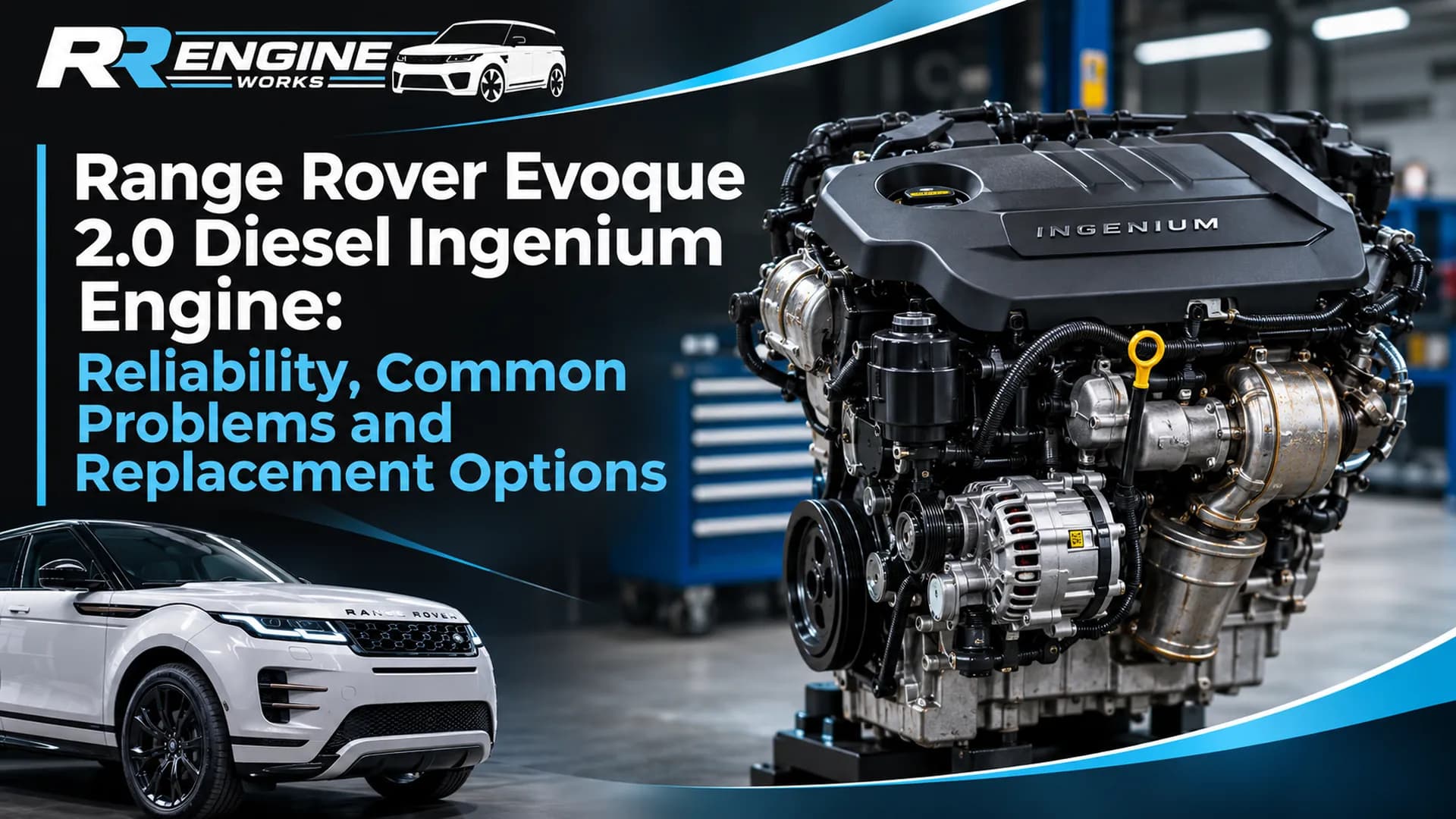
The oil level on the dipstick is higher than last time, and the oil smells faintly of diesel. Or there's a rattle on a cold morning, or a DPF warning that keeps coming back. Whichever it is, you want to know whether your Evoque is heading for a big bill.
The range rover evoque 2.0 diesel ingenium engine is a capable, efficient unit, and plenty of them cover high mileage without drama. But it has a few known weak points, and they reward owners who spot them early.
At RR Engine Works in Grays, Essex, we see Ingenium and older 2.2 diesel engines in the workshop regularly. This guide explains which engine your Evoque has, what tends to go wrong, how reliable it really is, and what your options cost.
What Engine Is in the Range Rover Evoque, and What Is the Difference Between the 2.2 and the 2.0 Diesel Ingenium?
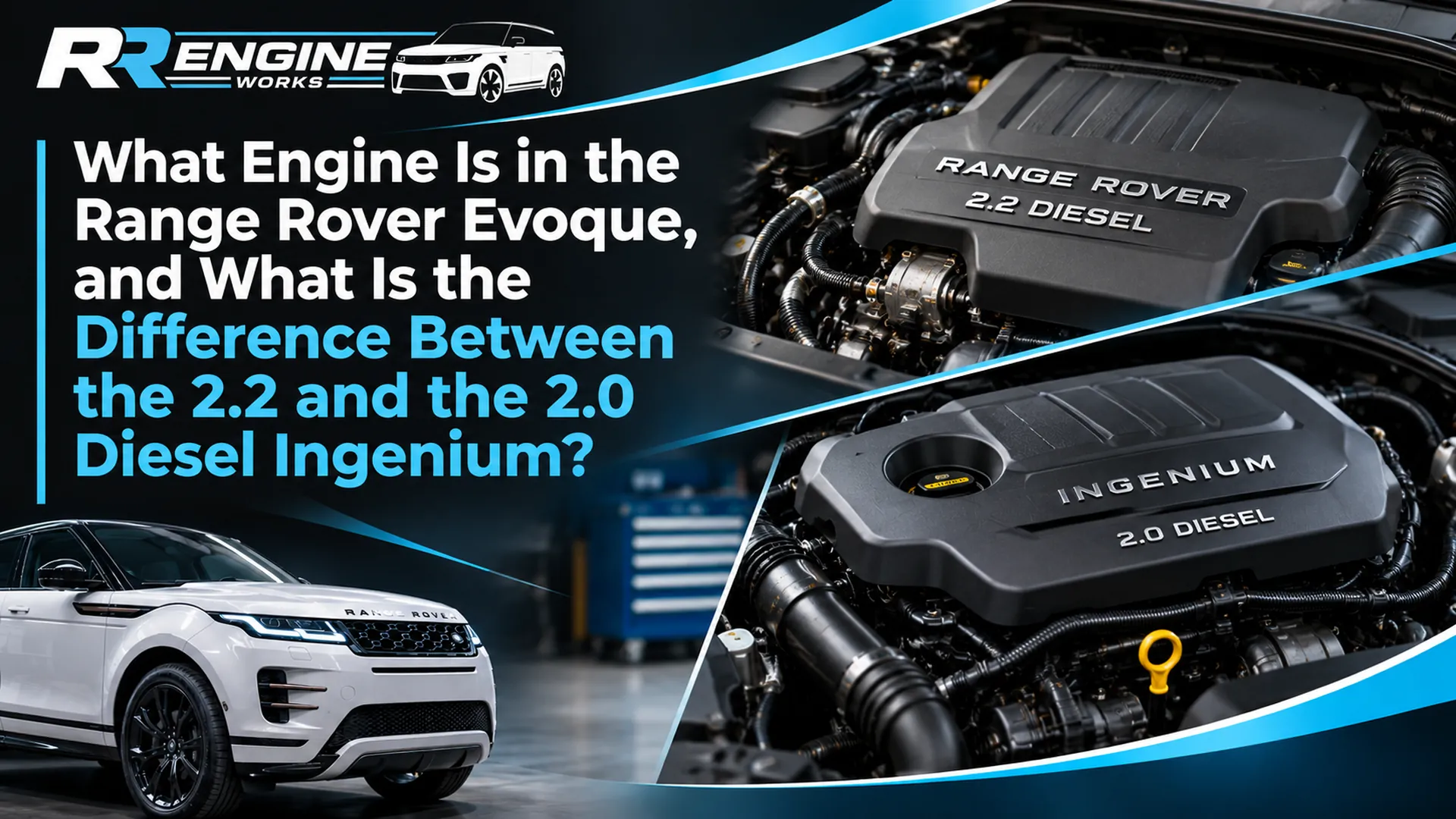
Two diesel engines have powered the Evoque, and owners mix them up all the time.
The first-generation Evoque, launched in 2011, used the 2.2-litre four-cylinder diesel (SD4 and TD4 variants). From around 2015, Land Rover introduced the 2.0-litre Ingenium diesel, which carried on into the second-generation Evoque. So if you're asking what engine is in a Range Rover Evoque 2.2 diesel, the answer is a Ford-derived 2.2 Duratorq-type unit, a different engine from the Ingenium.
A quick note on years: the Evoque did not exist in 2007, and a "2.0" diesel did not arrive in 2012. Searches for a range rover evoque 2007 or range rover evoque 2012 2.0 usually come from mislabelled listings. In 2012 you would be looking at the 2.2 diesel or the 2.0 turbo petrol.
Here is how the main engines compare:
Detail | 2.2 diesel (SD4/TD4) | 2.0 diesel Ingenium | 2.0 petrol (Si4) |
| Engine capacity | 2,179 cc | 1,999 cc | 1,999 cc |
| Layout | 4-cylinder, turbo diesel | 4-cylinder, turbo diesel | 4-cylinder, turbo petrol |
| Typical use | 2011 to 2015 cars | 2015 onwards | 2011 onwards |
| Real-world economy | Roughly 35 to 45 mpg | Roughly 38 to 50 mpg | Roughly 25 to 32 mpg |
Please treat these figures as guides. Power outputs and economy vary by variant, gearbox and driving style.
On evoque 2.2 diesel fuel consumption, most owners report high 30s to mid 40s in mixed driving, and the range rover evoque fuel average for the Ingenium diesel is slightly better. Short journeys, towing and city traffic pull both numbers down, and they also load up the DPF.
What Is the Best Range Rover Evoque Engine, and Which Evoque Engine Should You Avoid?
There is no single best answer, because it depends on how you drive.
- High mileage or motorway use: the evoque 2.0 ingenium diesel gives the best economy and relaxed cruising, provided it is serviced on time.
- Mostly short city trips: the petrol often suits better, because it avoids DPF and diesel dilution problems.
- Buying on a tight budget: a well-maintained 2.2 can be a sound choice, but check its service history closely.
So what is the best range rover evoque engine? For most drivers covering sensible mileage, a well-serviced 2.0 Ingenium diesel is a good balance. If your driving is mostly short hops, take a petrol seriously.
As for the range rover evoque engine to avoid, we'd steer clear of any Evoque with a patchy service history, regardless of engine. Early 2.2 cars that have missed oil changes, and Ingenium diesels used only for short journeys, are the ones we see failing most often. A cheap car with no paperwork is rarely cheap.
What Are the Most Common Range Rover Evoque 2.0 Diesel Ingenium Engine Problems, and How Reliable Is It?
Let's be honest about range rover evoque 2 0 diesel ingenium engine reliability. The engine is not fundamentally poor. Many run well past 100,000 miles. But the range rover evoque ingenium engine problems we see follow clear patterns, and most are linked to how the car has been used and serviced.
Here are the issues we see most often:
- Rising oil level and a diesel smell. Unburnt fuel can leak past the rings into the oil, especially on short journeys and during failed DPF regenerations. Left alone, it thins the oil and speeds up wear.
- Rattle on cold start. This can point to timing chain stretch or a failing tensioner. It should always be checked, never ignored.
- DPF warnings and restricted performance. A clogged DPF often leads to limp mode, poor economy and, eventually, more dilution.
- Turbo and EGR faults. Soot build-up and oil contamination can wear the turbo and clog the EGR valve.
- Coolant and oil leaks. Age and heat cycles harden seals and plastic fittings.
To help you judge urgency, here is a symptom guide:
Symptom | Likely cause | Urgency |
| Oil level rising, smells of diesel | Fuel dilution, failed regenerations | High |
| Rattle on cold start | Timing chain or tensioner | High |
| DPF light, loss of power | Blocked DPF, sensor or EGR fault | Medium to high |
| Whistling or loss of boost | Turbo wear or boost leak | Medium |
| Coolant or oil loss | Seal, hose or housing leak | Medium |
These 2 0 ingenium engine problems are manageable when caught early. They become expensive when owners keep driving and hope the warning light goes away.
A real example: a customer brought in a 2017 Evoque with a slowly rising oil level that he had put down to a "bad dipstick reading". He did mostly school runs and short trips. The oil was heavily diluted, and the timing chain had started to stretch. Replacing the oil and tackling the regeneration problem earlier would have cost a fraction of the final repair.
Stop driving and get the car checked if you notice:
- A loud rattle that doesn't fade after start-up
- A rapidly rising oil level or strong fuel smell from the oil
- Repeated limp mode with warning lights
- Oil pressure or temperature warnings
If you're already seeing these signs, request a free quote from our team and we'll tell you plainly what's going on.
Is the Evoque 2.2 Diesel Engine Any More Reliable Than the 2.0 Ingenium?
Owners of older cars often ask about range rover evoque 2.2 engine problems and whether the earlier engine is the safer bet. Neither engine is perfect, and the weak points differ.
Factor | 2.2 diesel | 2.0 diesel Ingenium |
| Typical weak points | Timing chain, turbo, injectors, oil cooler | Timing chain, oil dilution, DPF, EGR |
| Age-related issues | More common (older cars) | Less common (newer cars) |
| Emissions system trouble | Moderate | More frequent on short-trip cars |
| Running costs | Moderate | Slightly lower |
| Best for | Budget buyers with full history | Newer cars, motorway use |
Our view: the 2.2 gets more age-related faults simply because the cars are older, while the Ingenium suffers more from usage patterns, especially short journeys. A well-looked-after example of either can last. For wider background on the range rover evoque ingenium engine family, see our dedicated Ingenium engine page.
How Much Does Range Rover Evoque 2.0 Diesel Ingenium Engine Replacement Cost, and Should You Repair, Recondition or Replace It?
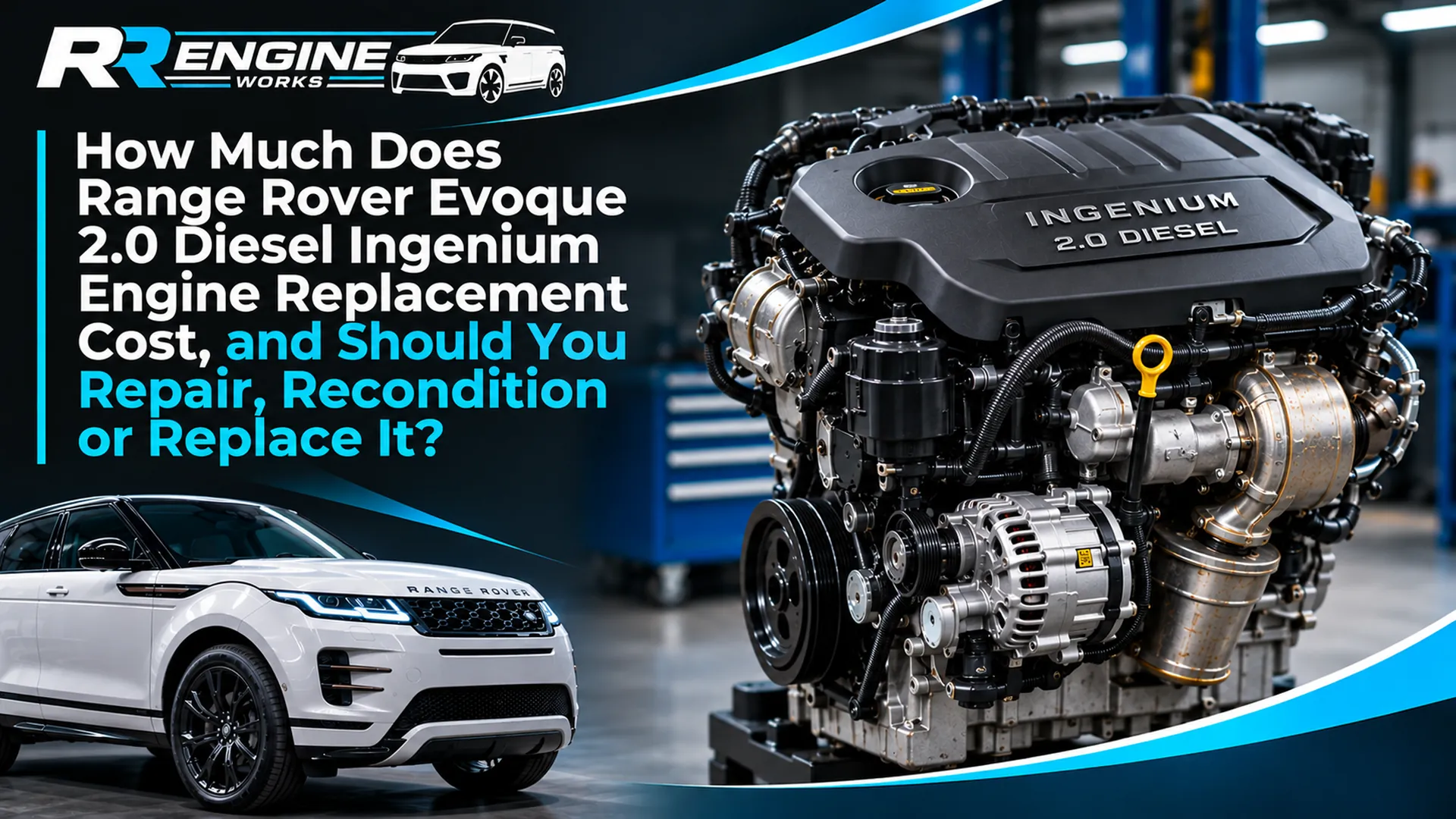
Let's talk numbers, because this is where most decisions get made.
Here are indicative UK ranges:
Work | Typical UK range |
| DPF cleaning or replacement | £400 to £1,500 |
| EGR valve or cooler repair | £500 to £1,200 |
| Turbocharger replacement | £900 to £1,900 |
| Timing chain and tensioner replacement | £1,500 to £3,200 |
| Reconditioned engine, fitted | £3,800 to £6,800+ |
| Used replacement engine, fitted | £2,500 to £4,800 |
These are guide figures, not quotes. The final price depends on the car, its mileage and what we find on inspection. A range rover evoque 2 0 diesel ingenium engine replacement is usually worth considering when there is internal damage, heavily diluted oil that has already caused bearing wear, or repeated failures.
When something goes wrong, you generally have three routes:
Option | Best for | Pros | Cons |
| Repair | Isolated faults caught early | Lowest upfront cost | Won't fix hidden wear elsewhere |
| Recondition | Worn but sound engines | Addresses root causes, often warrantied | Costs more than a repair |
| Replace | Severe internal damage | Known history, fresh start | Highest cost, sourcing matters |
If the fault is isolated and the oil is clean, repair usually wins. If the engine has run on diluted oil or shows timing chain damage, reconditioning or a quality replacement tends to be the better long-term investment.
What Should You Check Before Buying a Used Evoque 2.0 Diesel or a Replacement Ingenium Engine?
Whether you're buying a used car or sourcing an engine, run through this checklist:
- Full service history. Look for regular oil changes, ideally every 10,000 miles or 12 months, not the extended intervals.
- Oil level and smell. A high level or diesel smell is a warning sign.
- Cold-start behaviour. Listen for rattles in the first few seconds.
- DPF and chain history. Ask about previous warnings, regenerations or chain work.
- Engine code and VIN match. Confirm the unit suits your exact year and specification.
- Bench-test evidence and warranty. A reputable supplier tests every engine and puts the warranty terms in writing.
This list protects you from the two costliest mistakes: buying a car with hidden engine wear, and buying an engine that doesn't match your vehicle.
How Does Supply and Fit Work With RR Engine Works?
Here is how it works with us:
- Free quote. Send us your registration and a short description of the problem.
- Inspection. We assess the engine and tell you plainly whether repair is realistic.
- Options. You get a clear comparison of repair, reconditioning and replacement.
- Fitting and testing. Work is carried out at our workshop and the car is road-tested.
- Warranty and support. You're covered after fitting, with us on hand if questions come up.
Visit us: RR Engine Works, Unit 1 Hedley Ave, Grays RM20 4EL. Call us or use our quote form and we'll come back to you quickly.
Frequently Asked Questions
What engine is in a Range Rover Evoque 2.2 diesel?
It uses a 2.2-litre four-cylinder turbo diesel, fitted to first-generation Evoques from 2011 to around 2015. It is a different engine from the 2.0 Ingenium.
What is the engine capacity of a Range Rover Evoque?
The 2.2 diesel is 2,179 cc, and the 2.0 diesel Ingenium and 2.0 petrol are 1,999 cc.
What are the most common Evoque 2.0 diesel Ingenium problems?
Fuel dilution of the oil, timing chain wear, DPF blockages, and turbo or EGR faults.
Why is my Evoque 2.0 diesel oil level rising?
Usually unburnt fuel is leaking into the oil, often after short trips or failed DPF regenerations. Have it checked promptly.
What is the best Range Rover Evoque engine?
For high mileage, a well-serviced 2.0 Ingenium diesel is a good all-rounder. For mostly short trips, the petrol often suits better.
How much does an Evoque Ingenium engine replacement cost?
Roughly £2,500 to £4,800 for a fitted used unit and £3,800 to £6,800+ for a reconditioned engine. Get a written quote for your car.
Is the Evoque 2.2 more reliable than the 2.0 Ingenium?
Neither is clearly better. The 2.2 suffers more age-related faults, while the Ingenium suffers more from short-trip use.
Final word
The Evoque's diesel engines reward owners who stay on top of oil changes, drive them properly and act on early warnings. A rattle, a rising oil level or a DPF light is cheap to deal with early and expensive to ignore.
Get your free engine quote from RR Engine Works today. Send us your registration and we'll give you honest advice on the best route for your Evoque.