
Range Rover Velar engine problems are not spread evenly across the range. The early 2.0 Ingenium diesels (D180 and D240) attract by far the most owner complaints. Those complaints centre on timing chains, turbos, the diesel particulate filter (DPF) and fuel diluting the engine oil.
The revised 2.0 diesel (D200), the petrol engines and the six-cylinder units are generally regarded as stronger. They still have their own weak points, and some have recall work outstanding.
This guide sets out which engine you have, what tends to go wrong, and which symptoms mean you should stop driving.
Which Engine Does Your Velar Have?
Velar Engine Line-Up
Engine | Type | Approx. availability | Reputation |
| D180 / D240 | 2.0 four-cylinder Ingenium diesel | Early cars (2017 on) | Most reported problems |
| D200 | 2.0 four-cylinder diesel (revised, mild hybrid) | From 2021 | Reported as more reliable |
| D275 / D300 | 3.0 six-cylinder diesel (V6, later straight-six) | Throughout; switched to straight-six around 2021 | Generally strong; watch for knocks |
| P250 / P300 | 2.0 four-cylinder Ingenium petrol | Throughout | Generally fine; timing and turbo to check |
| P380 / P400 | 3.0 six-cylinder petrol (later straight-six mild hybrid) | Throughout | Strong but thirsty; coolant use to watch |
| P400e | 2.0 petrol plug-in hybrid | Later cars | Hybrid system adds complexity |
The table is based on Autocar's Velar buying guide.
Engine availability varied by year and trim. Confirm yours from the V5C logbook or the engine code. RR Engine Works' Velar engine page lists the codes it covers.
Known Velar Engine Problems
2.0 Ingenium Diesel (D180, D240, D200)
Autocar reports that the early 2.0 diesels have a high reported failure rate. Owners describe problems with the DPF, timing chain, turbos, oil dilution, cylinder wear and coolant leaks.
Oil dilution and DPF blockage
- What happens: The DPF traps soot and burns it off during "regeneration", which needs sustained driving. Short trips interrupt the process. Extra fuel can then wash into the sump and thin the oil.
- Signs: A rising oil level, a fuel smell from the oil, and DPF warnings.
- Why it matters: Specialists link diluted oil to timing-chain and turbo wear on this engine family.
Timing chain stretch
- What happens: The timing chain stretches over time.
- Signs: A rattle on cold start lasting a few seconds or longer. CarChecker cites a typical failure window of around 60,000–100,000 km, with some earlier reports (CarChecker).
- Why it matters: If the chain jumps or breaks, the valves and pistons can collide.
- Fix: RR Engine Works offers timing chain replacement for Ingenium engines.
Turbo faults
- Signs: Sudden power loss, an engine warning light and blue smoke.
- Before replacing the turbo: Check for oil supply problems and boost leaks.
Other reported faults
- AdBlue/NOx sensor problems.
- A piston-cooling solenoid fault (code P25A9) that can trigger a false low-oil warning.
Fix for DPF problems: Find the root cause first, such as short trips, a faulty sensor or an EGR fault. Then clean or replace the DPF. RR Engine Works provides DPF replacement where cleaning won't recover the filter.
The revised D200 from 2021 is reported to be more reliable. It still benefits from the same habits: correct oil, timely changes and regular longer runs.
Petrol, Six-Cylinder and Hybrid Engines
Engine | Reported issues | Source |
| 2.0 petrol (P250/P300) | Timing chain rattle on cold start; high-pressure fuel pump or cam phaser faults; oil use at high mileage; turbo issues | JLR Engines; Autocar |
| 3.0 six-cylinder diesel | Knocking that may indicate crankshaft or bearing trouble; turbo seal leaks and intake carbon on later D300 | Autocar; JLR Engines |
| 3.0 six-cylinder petrol | Heavy coolant use, possibly from the water pump | Autocar |
| Mild-hybrid models | Belt tensioner failure; costly alternator / starter-generator repairs | Autocar |
| P400e plug-in hybrid | Hybrid faults, battery drain, start-up problems | JLR Engines |
Recalls on later six-cylinder cars:
- JLR recall N908 covers 2024–2025 model-year Velars with the 3.0 Ingenium six-cylinder. The oil filter housing may crack and leak oil onto hot parts. The fix is a free replacement (JLR notice via NHTSA).
- A separate recall, announced in South Africa, covers an idler pulley that can damage the oil pressure sensor on Velars built between March 2024 and April 2026. Check by VIN whether this applies in the UK.
- UK owners can check open recalls on the government recall checker.
Diagnosing a Velar Engine Fault
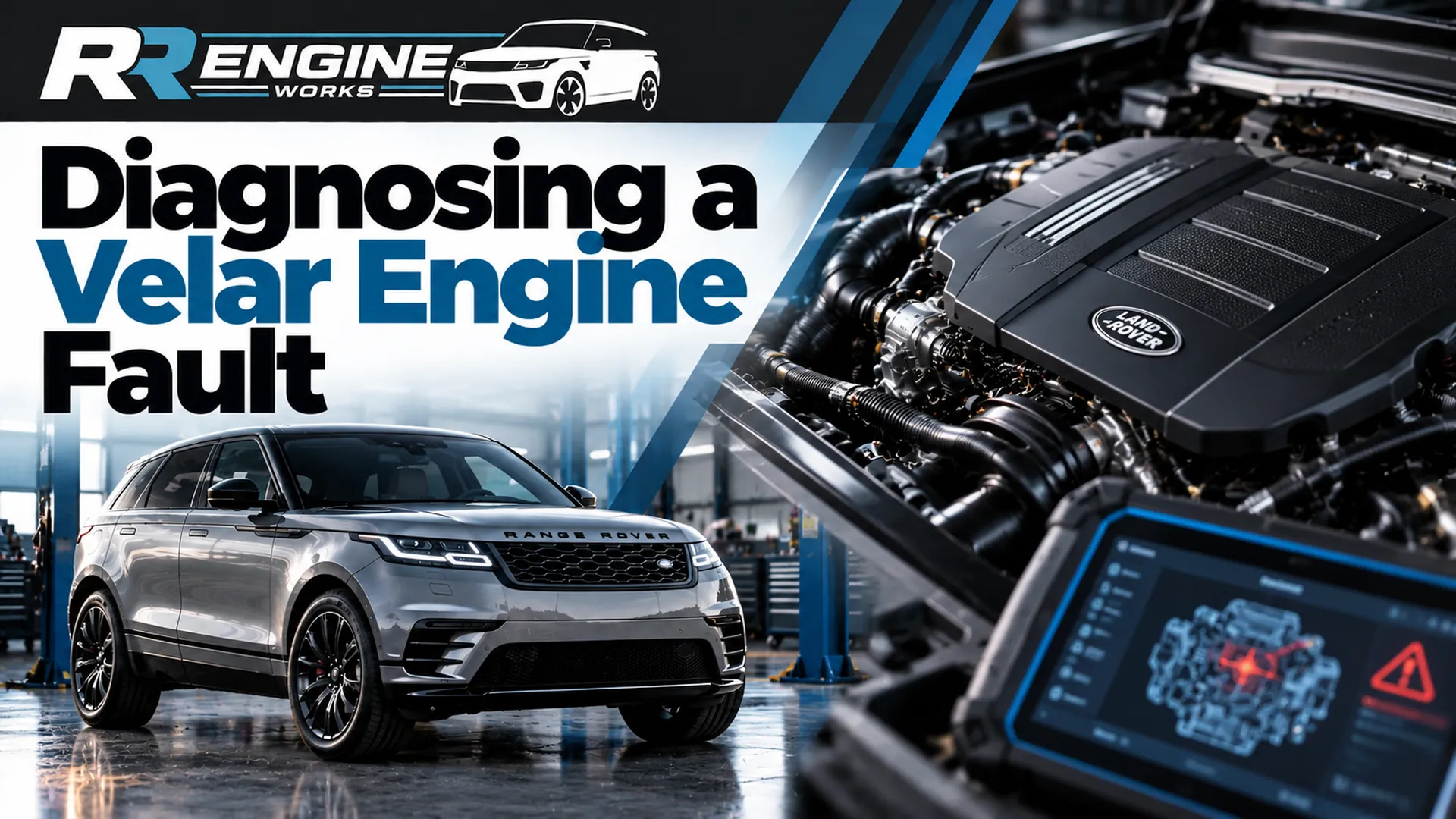
Many Velar warnings point to sensors, emissions equipment or the hybrid system rather than internal engine damage. A proper diagnosis should include:
- fault codes and live data;
- oil level and oil condition, including a check for fuel dilution;
- a cooling-system pressure test if coolant is disappearing;
- a check of timing-chain correlation data;
- a compression test if internal wear is suspected.
RR Engine Works' engine diagnostics service covers warning lights, misfires and power loss.
Warning Signs and When to Stop Driving
Stop and arrange recovery if you see or hear any of these:
- An oil-pressure warning, or a low-oil warning together with engine noise.
- Knocking or a loud, persistent timing rattle.
- Overheating or steam.
- Heavy smoke.
- A burning-oil smell, particularly on 2024–2025 six-cylinders.
Book a diagnosis soon if you notice any of these:
- A rising oil level.
- Repeated DPF warnings.
- Limp mode.
- A short rattle on cold start.
- Slow coolant loss.
- Hybrid or start-up warnings.
Frequently Asked Questions
Range Rover Velar Engine Problems FAQs
Which Velar engine is the most reliable?
No official failure-rate data has been published. Autocar picks the six-cylinder diesels and describes the 2.0 petrols as more reliable than the early 2.0 diesels. The revised D200 is reported to be an improvement on the D180 and D240.
What are the common problems with the Velar D240?
Owners and specialists report timing chain stretch, turbo faults, DPF blockage with oil dilution, AdBlue/NOx sensor faults and coolant leaks.
Why is my Velar's oil level going up?
On the diesel models, fuel is probably diluting the oil because DPF regenerations are being cut short. Have it checked promptly, because diluted oil protects the engine less well.
Does the Velar have a timing chain or belt?
The Ingenium engines use timing chains. A cold-start rattle should be investigated, especially on the 2.0 engines.
Are there recalls on the Velar engine?
Yes, on some later six-cylinder cars. Recall N908 replaces the oil filter housing on 2024–2025 model years. Check any vehicle's recall status by VIN.
If your Velar shows any of these symptoms, contact RR Engine Works on 01708 592377 via the contact page. Please share your registration, engine, mileage and symptoms.