
Range Rover Sport crankshaft failure is one of the most serious faults a 3.0 V6 diesel can suffer.
Land Rover's own technical bulletin traces the problem to the main bearing shells rotating in the 3.0 TDV6 and SDV6. Once a bearing spins, oil can no longer reach the crankshaft properly. The bearing then wears quickly, the crank can seize, and in the worst cases it breaks.
Warning signs are often brief and sometimes absent altogether. If you hear a deep knock or see an oil-pressure warning, stopping straight away gives the best chance of a rebuild rather than a full replacement.
Which Range Rover Sport Engines Are Affected?
The problem is associated with the 3.0-litre V6 diesel, sold as TDV6 and SDV6, in:
- the first-generation Range Rover Sport (L320), from the 3.0 diesel's introduction;
- the second-generation Range Rover Sport (L494) with the V6 diesel.
It is not associated with the petrol V8s, or with the newer straight-six Ingenium D250/D300 diesels.
RR Engine Works covers these engines on its Range Rover Sport and Range Rover 3.0 engine pages.
What Land Rover's Bulletin Says
Land Rover's service bulletin SSM 72578, "Crankshaft/Crankshaft Bearing Concerns – 3.0 TDV6 Diesel Engine", lists the Range Rover Sport L320 and L494 among the affected models. The Range Rover L405 and Discovery 4 are also listed (SSM 72578, NHTSA copy).
Bulletin detail | What it says |
| Cause | Rotation of the main bearing shells |
| Symptoms | Loud rumbling or knocking that worsens under load; seized crank; holed sump or block with oil and metal debris; oil-pressure warning flashing or on |
| Production change | Crankshafts with tighter main bearing run-out (50 → 30 microns) from engine number 011215-1001200 |
The bulletin is a technician advisory, not a recall. Engines built after the production change can still fail if they are starved of oil. The engine number is stamped on the cylinder head, so a specialist can confirm which side of the change your engine falls.
Why the Crankshaft Fails
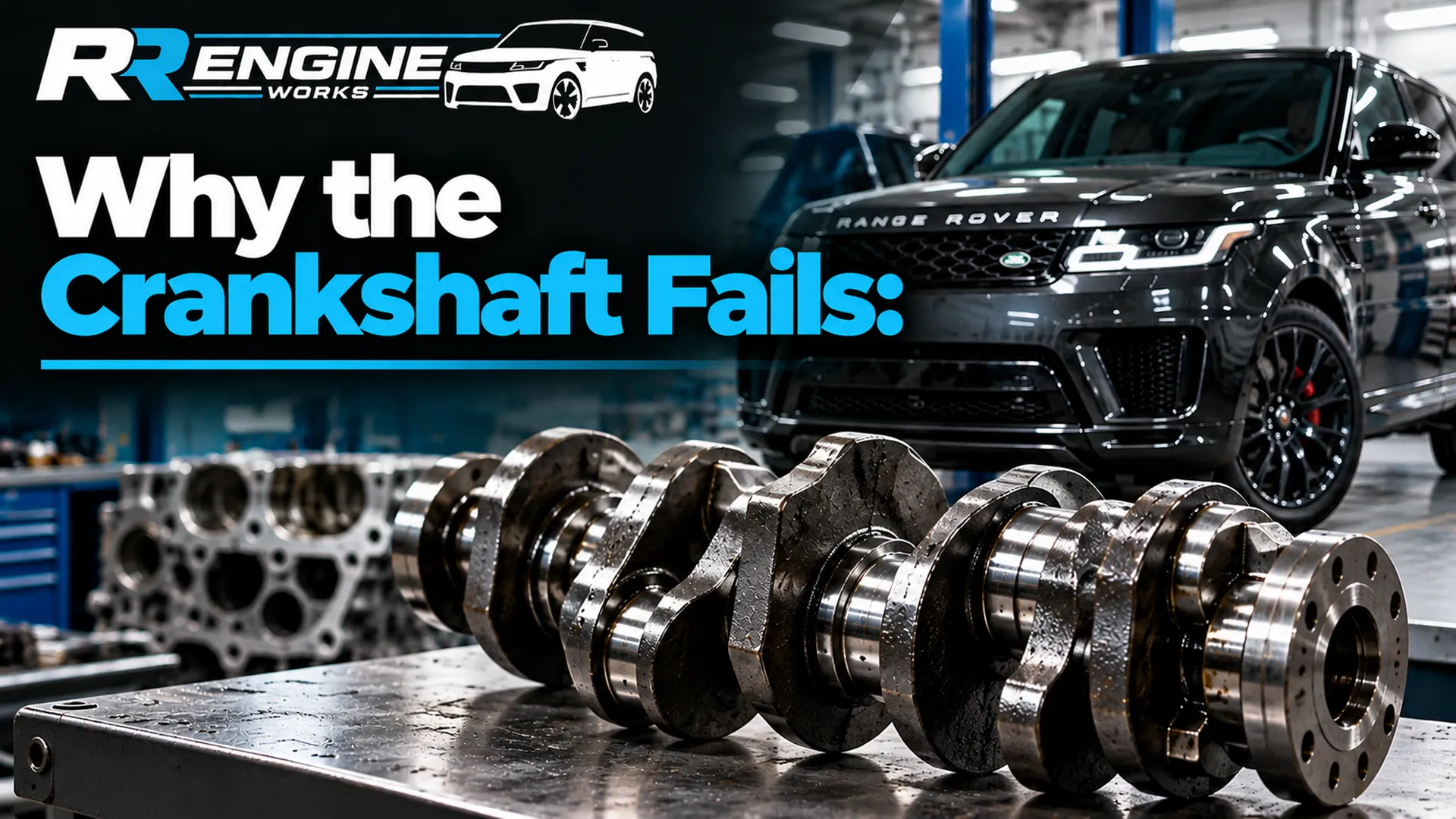
The main bearing shells sit between the crankshaft and the engine block, held in place on a thin film of pressurised oil. If a shell rotates in its housing, its oil hole can move out of line with the oil supply. Lubrication then breaks down, and the damage escalates quickly.
Specialists explain the problem in two ways:
- Bearing rotation. The view most widely shared, and the cause Land Rover's bulletin names.
- Crankshaft fatigue. Some specialists also point to fatigue at the crank's thinnest sections (Trevor Burgess Autos). This remains debated.
Engine Finders reports that failures typically appear between about 60,000 and 100,000 miles, based on owner and specialist reports rather than a published failure rate (Engine Finders).
Contributing Factors Owners Can Control
Specialists commonly link the failure to oil supply and oil quality:
- Long oil-change intervals. Many specialists recommend changing the oil well before the maximum interval, especially on cars that tow or mostly do short trips.
- Oil grade. Use the engine's specified oil, not a generic substitute.
- A blocked oil pick-up strainer. Carbon and sludge, including EGR-related deposits, can restrict oil flow at the pick-up.
- Coolant contaminating the oil. For example, from a leaking EGR cooler.
- Fuel diluting the oil. This happens when DPF regeneration is repeatedly interrupted.
- Turbo failure. Debris from a failed turbo can contaminate the oil system.
None of these guarantees a failure, and keeping on top of them doesn't make an engine immune. They are, however, the factors an owner can influence.
Warning Signs and What to Do
Stop the engine as soon as it is safe, and arrange recovery, if you notice any of the following:
- a deep knock or rumble from the bottom of the engine that gets worse with revs or load;
- the oil-pressure warning flashing or staying on;
- sudden loss of power with mechanical noise;
- an engine that stalls and won't turn over.
Book an inspection promptly if you notice:
- metallic flakes in drained oil or on the oil filter at a service;
- an unexplained drop in oil level;
- a light knock when the engine is warm at idle.
Driving on a spinning bearing is the main reason repairable damage becomes a written-off block.
RR Engine Works' engine diagnostics can check oil pressure and oil condition, and can carry out a strip inspection where needed.
Rebuild or Replace After Crankshaft Failure
Situation | Usual route |
| Bearing damage caught early; crank grindable or replaceable; block bores undamaged | Bottom-end rebuild: crank ground or replaced, new bearings, oil pump and pick-up checked |
| Crank snapped, block holed or bearing housings damaged | Engine replacement with a reconditioned or used unit |
| Car under warranty or recently out of it | Approach the dealer or manufacturer first and ask about goodwill |
Whichever route you take, the oil system must be cleaned properly. That means flushing or replacing the oil cooler, checking the turbo oil feeds, and clearing the pick-up. Some specialists also fit anti-rotation ("tang") main bearings during a rebuild.
Cost guide (third-party figures, not RR Engine Works prices):
- Engine Finders puts a fitted reconditioned 3.0 V6 engine at about £7,610 including VAT. That figure includes an oil cooler and EGR flush.
- Trevor Burgess Autos reports dealer crate-engine quotes above £12,000.
Frequently Asked Questions
Range Rover Sport Crankshaft Failure FAQs
What are the symptoms of Range Rover Sport crankshaft failure?
A deep knocking or rumbling from the bottom of the engine that worsens under load, an oil-pressure warning, metal debris in the oil, and in severe cases a seized engine or a holed sump.
Which Range Rover Sport engines suffer crankshaft failure?
The 3.0 TDV6 and SDV6 V6 diesels in the L320 and L494. Land Rover's SSM 72578 addresses crankshaft and bearing concerns on this engine family.
Can you drive with a crankshaft knock?
No. Stop as soon as it's safe. Continuing to drive can turn a repairable bearing failure into a broken crankshaft and a damaged block.
Can a Range Rover Sport crankshaft failure be repaired?
Often, yes, if it's caught early. A rebuild with a reground or replacement crankshaft and new bearings may be possible. If the block is damaged, the engine will need replacing.
How can I reduce the risk of crankshaft failure?
Change the oil more often than the maximum interval, use the specified oil grade, investigate any coolant or fuel contamination, and respond to oil-pressure warnings straight away.
If your Range Rover Sport has a knock or an oil-pressure warning, contact RR Engine Works on 01708 592377 through the contact page. Please give your registration, engine, mileage and symptoms.