
If your Range Rover has suddenly started hesitating between gears, juddering at low speed, or flashing a transmission warning on the dash, you're probably asking one question: how much is this going to cost me?
It's a fair question, and it's one that doesn't have a single straightforward answer, despite what a lot of quote pages online would have you believe. Gearbox replacement cost on a Range Rover or Land Rover depends on your exact model, which transmission is fitted, how far the fault has progressed, and whether you actually need a full replacement or something far less drastic.
This guide walks through all of it, model by model, symptom by symptom, so you know exactly what you're dealing with before you book anything in.
How Much Does a Range Rover or Land Rover Gearbox Replacement Cost?
There's no fixed, universal price for a Range Rover or Land Rover gearbox replacement, and any page that gives you one flat number without asking about your vehicle first is oversimplifying things.
What you pay depends on several moving parts working together, the model and generation of your vehicle, the transmission type it's fitted with, the extent of the damage, and which replacement route you choose. A car with a minor valve body fault will cost a fraction of what a full transmission replacement costs on a vehicle with a cracked casing or catastrophic internal failure.
Rather than quote a single figure, it's more useful, and more honest, to break down exactly what drives the price up or down.
What Determines Your Gearbox Replacement Cost?
A handful of factors consistently shape the final bill on any gearbox job:
- The transmission fitted to your vehicle, a ZF 6HP unit, an 8HP45, an 8HP70, a 9HP48, or an Aisin gearbox all differ in complexity, parts availability, and labour time.
- The extent of the fault, a solenoid or valve body issue is a targeted repair; a damaged torque converter or worn clutch pack pushes the job toward a rebuild or full replacement.
- The replacement route chosen, repair, rebuild, reconditioned exchange, used unit, or new OEM gearbox all sit at different points on the cost scale.
- Labour and diagnostic time, proper fault-finding using live data and diagnostic scanning takes time, and it's time well spent, because it stops you paying to replace a gearbox that didn't need replacing.
- Calibration and adaptation after fitting, a new or reconditioned unit typically needs programming and an adaptation reset before it drives correctly, and that's a labour cost in itself, not an optional extra.
Reconditioned vs Used vs New Gearbox, What's the Difference?
This is one of the most misunderstood parts of the whole process, and it's worth getting right before you agree to anything.
A reconditioned gearbox has been stripped down, inspected, and rebuilt with new wear components, clutch packs, seals, gaskets, and often the valve body, before being tested and reassembled. It's a well-balanced middle ground between cost and reliability, and it's what most specialists recommend for older or higher-mileage Range Rovers.
A used gearbox is exactly that: a unit pulled from another vehicle, usually at a lower mileage than your existing box, but without the same rebuild work behind it. It's the cheapest option, but you're taking on more risk around remaining lifespan.
A new OEM gearbox is a brand-new unit direct from the manufacturer or an authorised supplier. It's the most expensive route by some distance, and for most owners outside of warranty work or very low-mileage vehicles, it's rarely the most sensible option financially.
Here's how the three compare at a glance:
Option | Condition | Typical Lifespan Expectation | Best Suited For |
| Used gearbox | Second-hand, tested but not rebuilt | Lower, depends on donor mileage | Budget-conscious short-term fix |
| Reconditioned gearbox | Fully rebuilt with new wear parts | Close to original, well-tested | Most owners, balance of cost and reliability |
| New OEM gearbox | Brand new, unused | Full expected lifespan | Warranty work, very low-mileage vehicles |
Labour Cost vs Parts Cost: What You're Actually Paying For
When a quote comes in, it's easy to focus on the headline number and skip past what's actually included. A proper gearbox replacement quote should break down into distinct elements: diagnosis, removal of the old unit, the replacement gearbox itself, fitting, fresh transmission fluid and filter, calibration and coding, and a road test to confirm everything's behaved correctly.
If a quote doesn't separate labour from parts, ask for that breakdown. It's a reasonable request, and any specialist confident in their pricing will have no issue providing it.
Land Rover & Range Rover Gearbox Cost by Model
Not every Range Rover or Land Rover shares the same gearbox, and treating them as identical is where a lot of generic advice falls apart. The model, generation, and engine combination all affect which transmission is fitted, and that has a direct knock-on effect on repair complexity and parts availability.
Range Rover (L322, L405, L460) Gearbox Replacement
The L322 generation typically ran ZF 6HP and later 8HP70 units depending on year and engine. The L405 moved further into ZF 8HP territory, while the newer L460 platform brings more advanced electronic control and calibration requirements.
Older L322s with higher mileage are more likely to present with worn clutch packs or valve body wear, while later models more commonly show software-related faults that respond well to reprogramming rather than a full unit swap.
Range Rover Sport, Evoque & Velar Gearbox Replacement
The Range Rover Sport has been fitted with both 6HP and 8HP ZF units across its generations, and SV and high-output variants can carry additional calibration considerations worth flagging to your specialist upfront.
The Evoque is a slightly different story, depending on generation, it may run an Aisin six-speed unit or a ZF 9HP48, including configurations tied to plug-in hybrid (P300e) models. These aren't interchangeable in terms of parts or diagnostic approach, so correct identification matters before any repair work begins.
The Velar, built around ZF 8HP45 and 8HP70 transmissions, most commonly presents with judder or transmission fault codes rather than complete failure, which is exactly why a proper diagnostic step before replacement matters so much on this model.
Land Rover Defender & Discovery Gearbox Replacement
The Defender's TDCi and later six-speed automatic setups differ meaningfully from Discovery and Discovery Sport transmissions, which have their own service history and common failure points. Freelander models bring yet another set of considerations.
Because of this spread, "Land Rover gearbox replacement cost" genuinely can't be answered with one number across the range, it has to be tied to your specific model and engine combination.
Does Your Gearbox Really Need Replacing? (Repair vs Replacement)
Here's something worth sitting with before you commit to a full replacement: a transmission warning light does not automatically mean your gearbox needs replacing.
A huge number of gearbox complaints trace back to a software fault, a fluid problem, a failing solenoid, or a valve body issue, all of which are repairable without touching the rest of the unit. Jumping straight to "I need a new gearbox" without proper diagnosis is how owners end up paying for far more than they needed to.
Common Signs of Gearbox Failure You Shouldn't Ignore
Gearbox Slipping or Judder While Driving
Slipping, where the engine revs rise without a corresponding increase in speed, points toward clutch pack wear or hydraulic pressure problems. Judder, particularly on light throttle at low speed, is a classic torque converter symptom on ZF-equipped Range Rovers.
Warning Light or Delayed Gear Engagement
A transmission warning light paired with a pause before the car engages Drive or Reverse often signals a fault code worth scanning immediately, rather than a mechanical failure requiring immediate replacement. Fault codes like those in the P07xx range are common starting points for a proper diagnostic scan, though the exact code and its meaning depend entirely on your gearbox generation.
Which Gearbox Does Your Vehicle Have? (ZF 6HP, 8HP & 9HP Explained)
This sounds like a technical detail, but it's genuinely the first thing worth establishing. Two Range Rovers with the same model name can carry different transmissions depending on year, engine, and trim, so identification by VIN or registration, not just model name, is the correct starting point for accurate pricing.
- ZF 6HP, an earlier six-speed automatic, found across older Range Rover and Range Rover Sport generations.
- ZF 8HP45 / 8HP70 / 8HP75, eight-speed units used widely across later Range Rover, Sport, and Velar models, varying by torque capacity.
- ZF 9HP48, a nine-speed unit associated with certain Evoque configurations, including hybrid variants.
- Aisin transmissions, used in specific Evoque and Discovery Sport applications, distinct from ZF units in both design and repair approach.
Can You Still Drive With a Gearbox Fault?
This depends heavily on the symptom. Persistent slipping, a refusal to properly engage Drive or Reverse, serious shuddering, an illuminated warning light, or grinding and clunking under load are all reasons to stop driving and get the vehicle assessed rather than continuing on and hoping it settles.
Milder symptoms, occasional hesitation, for example, may not need you to pull over immediately, but they're still worth booking in promptly. Gearbox problems rarely improve by being left alone, and continuing to drive on a genuine fault can turn a repairable issue into a full replacement.
Choosing the Right Gearbox Replacement Specialist
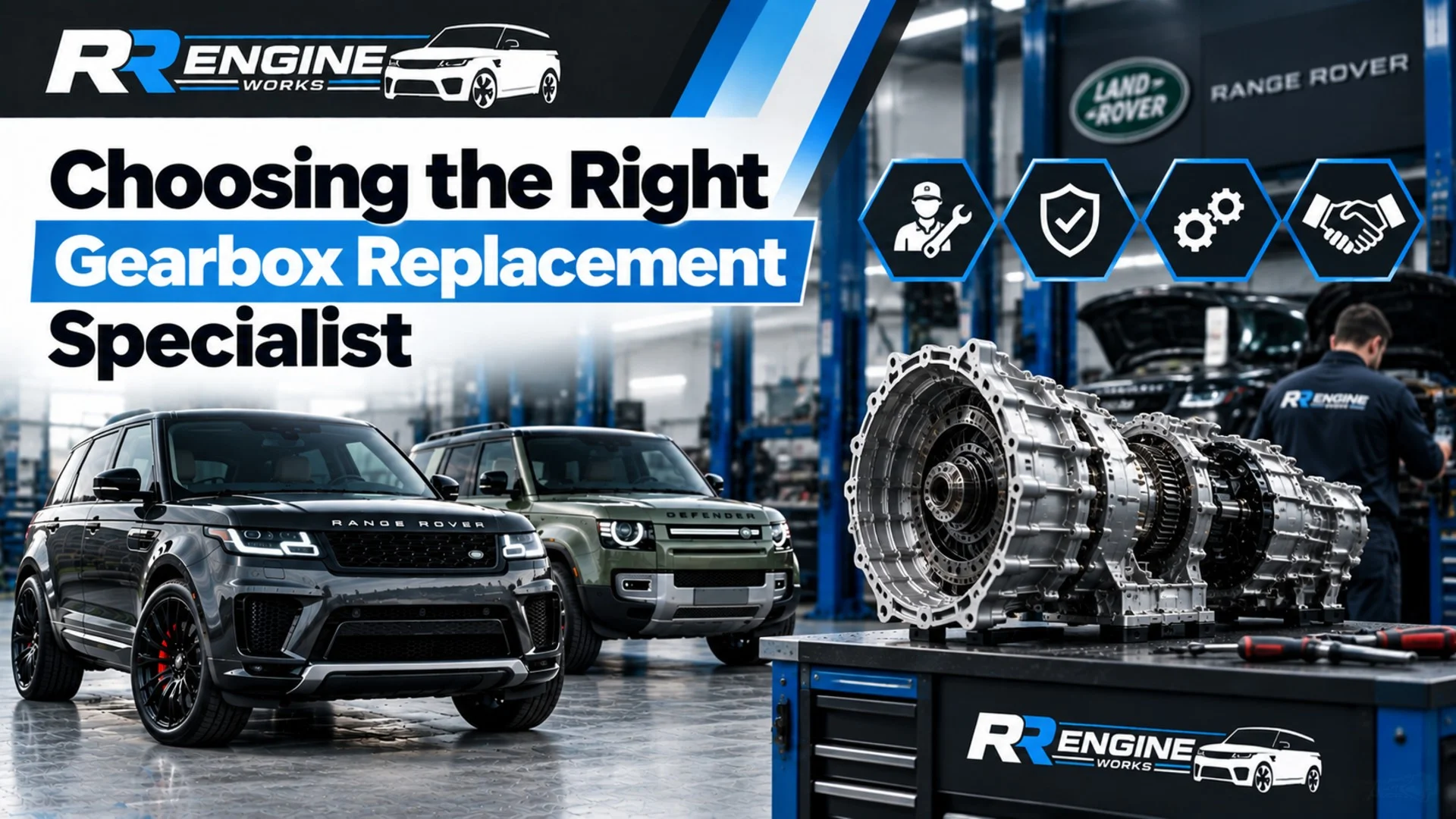
Once you know roughly what you're dealing with, the next decision is who does the work, and this choice affects both cost and outcome more than most owners expect.
Main Dealer vs Independent Specialist, Which Is Right for You?
Main dealers offer brand-backed parts and processes, but that typically comes with higher labour rates and longer lead times, especially for older Range Rover models where dealer support can be more limited.
Independent specialists who focus specifically on Land Rover and Range Rover transmissions often bring more hands-on experience with exactly these gearboxes, faster turnaround, and more flexibility around repair versus replacement decisions, without the dealer overhead built into the price.
Neither option is automatically "right." What matters is whether the workshop has genuine, demonstrable experience with your specific transmission type, proper diagnostic equipment, and a track record of correctly identifying repairable faults rather than defaulting to full replacement.
What Warranty Should You Expect on a Replacement Gearbox?
A reputable gearbox replacement should come with clear warranty terms covering both parts and labour, commonly somewhere in the 12 to 24 month range depending on whether you've chosen a used, reconditioned, or new unit. Before agreeing to any work, it's worth confirming:
- What the warranty actually covers, the unit itself, labour, or both
- Whether ongoing servicing is required to keep the warranty valid
- What's excluded, particularly around consequential damage
- Whether the warranty is documented in writing, not just promised verbally
A specialist confident in their work will have no issue putting all of this in writing before you commit.
Get an Accurate, No-Obligation Quote From RR Engineworks
If your Range Rover or Land Rover is showing any of the symptoms covered above, the most useful next step isn't guessing at cost, it's getting a proper diagnostic assessment from people who work on these transmissions every day.
At RR Engineworks, based at Unit 1 Hedley Ave, Grays, RM20 4EL, the team specialises specifically in Range Rover and Land Rover gearbox diagnostics, repair, and replacement, identifying your exact transmission type first, then giving you a clear, honest recommendation on whether you need a repair, a rebuild, or a full replacement.
Frequently Asked Questions
How much does a Range Rover gearbox replacement cost? It varies significantly based on your model, the transmission fitted, and the extent of the fault. A targeted repair such as a valve body fix costs considerably less than a full reconditioned or new gearbox replacement, which is why a proper diagnostic assessment should always come before a quote.
How do I know if my Range Rover gearbox needs replacing? Look out for persistent slipping, judder at low speed, delayed engagement into Drive or Reverse, a transmission warning light, or grinding noises under load. Many of these symptoms are repairable without a full replacement, so diagnosis is essential before assuming the worst.
Is it cheaper to repair or replace a Range Rover gearbox? Repair is almost always cheaper than replacement when the fault is limited to a specific component like a solenoid, valve body, or torque converter. Replacement becomes necessary when internal wear or damage is too extensive for a targeted repair to resolve.
What's the difference between a reconditioned and a used gearbox? A reconditioned gearbox has been stripped down and rebuilt with new wear components before being tested, offering more reliability. A used gearbox is a tested but unrebuilt unit taken from another vehicle, typically cheaper but with more uncertainty around remaining lifespan.
Can I drive my Range Rover with a gearbox warning light on? It depends on the symptom accompanying the light. Mild hesitation may allow you to book a diagnostic appointment shortly after, but persistent slipping, grinding, or a failure to engage gear means you should stop driving and have it assessed promptly to avoid further damage.
How long does a Range Rover gearbox replacement take? This depends on the extent of the work and parts availability, but a full replacement typically involves diagnosis, removal, fitting, fluid and filter replacement, calibration, and a road test, all of which take longer than a straightforward service.
Do I need a specialist for a Land Rover gearbox replacement, or can any garage do it? While a general garage can attempt the work, Land Rover and Range Rover transmissions, particularly ZF and Aisin units, benefit from specialist diagnostic equipment and model-specific experience, which reduces the risk of misdiagnosis and unnecessary replacement.
Final Thoughts
A gearbox warning light or a sudden judder is unsettling, but it's rarely the end of the road for your Range Rover or Land Rover. In a lot of cases, what looks like a looming full replacement turns out to be a solenoid, a valve body, or a software issue that's entirely repairable.
The real value isn't in finding the cheapest quote, it's in finding a specialist who correctly identifies what's actually wrong before recommending a fix. That's the difference between paying for what you need and paying for more than you should.
If your vehicle is showing any of the symptoms covered in this guide, get it properly assessed before assuming the worst. RR Engineworks offers exactly that kind of diagnostic-first approach, based at Unit 1 Hedley Ave, Grays, RM20 4EL, get in touch for an honest assessment and a clear, no-obligation quote tailored to your specific vehicle.