
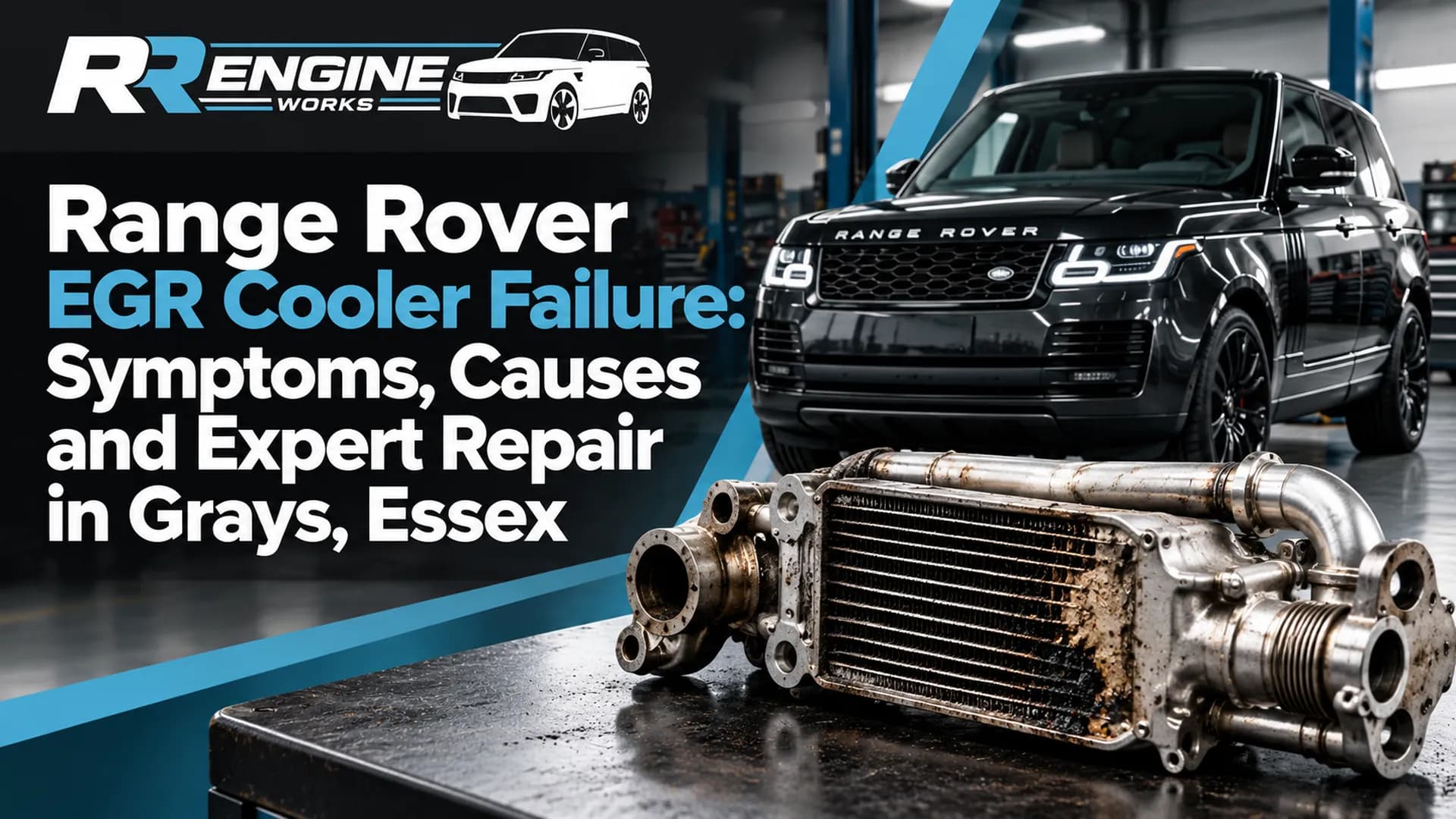
Your Range Rover's coolant level keeps dropping, yet there's no puddle on the drive. Then white smoke appears on a cold start, or the car suddenly feels flat and drops into limp mode. That pattern is the classic sign of Range Rover EGR cooler failure, and it's one of the few faults where waiting a week can turn a repair into an engine rebuild.
The EGR cooler sits on the diesel exhaust gas recirculation circuit and uses engine coolant to cool the exhaust gas. When it cracks internally, coolant can leak into the exhaust or intake and, in worse cases, reach the cylinders. At RR Engine Works, Unit 1 Hedley Ave, Grays RM20 4EL, we diagnose and repair this fault before it causes lasting damage.
What Are the Signs of Range Rover EGR Cooler Failure?
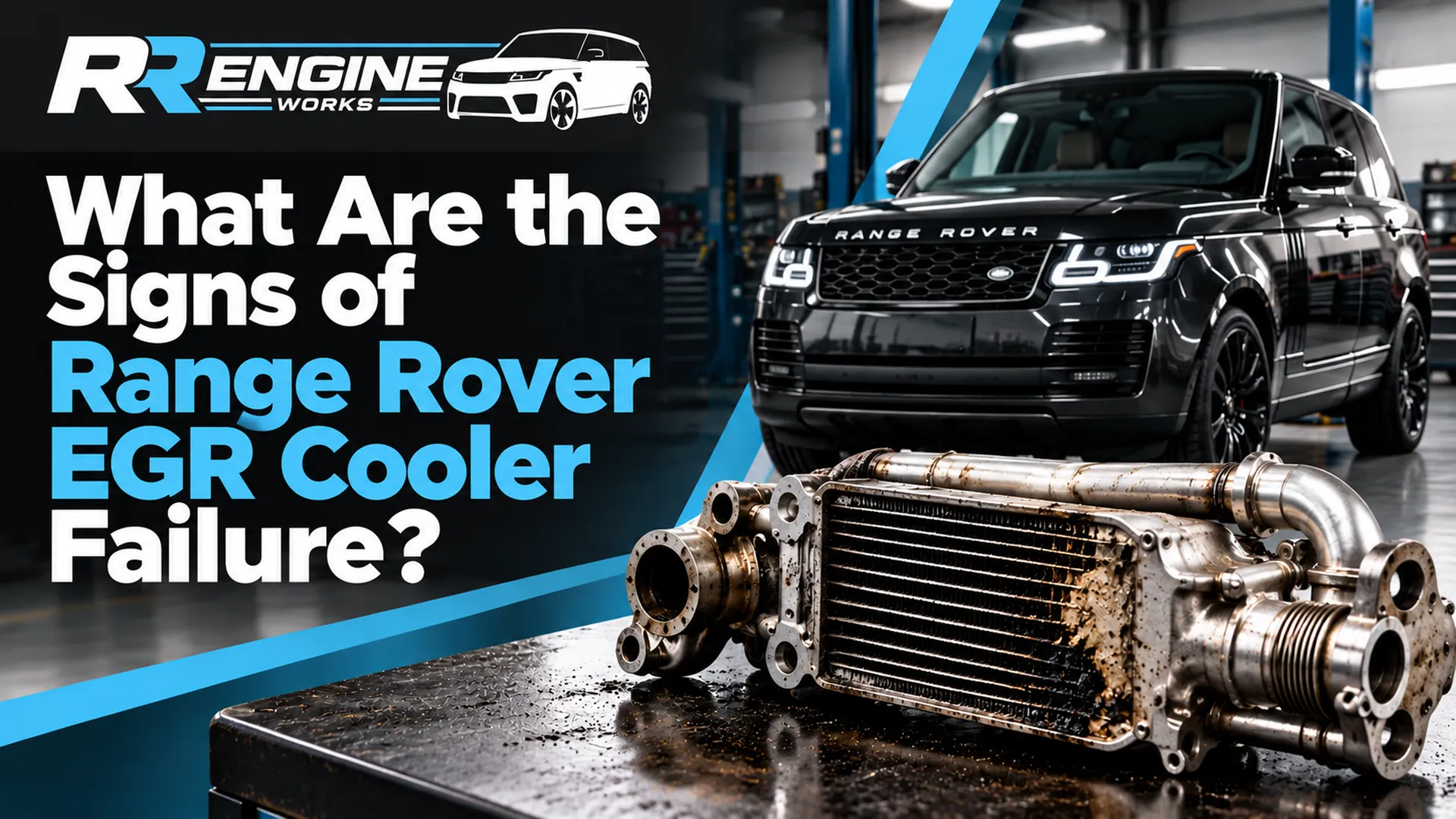
An EGR cooler problem rarely announces itself with one dramatic event. It builds up. Drivers often notice small oddities first, like topping up coolant more often than usual, and only connect them to the cooler once smoke or power loss appears. Catching it at the small-signs stage is what keeps the repair bill manageable.
Which EGR Cooler Failure Symptoms Should You Never Ignore?
Here are the EGR cooler failure symptoms we see most often on Range Rover diesels. If you recognise two or more, get the car checked.
- Unexplained coolant loss. The level drops, but you can't find an external leak. The coolant is being burned off through the exhaust.
- White smoke from the exhaust. It's most obvious on a cold start and often has a sweet smell. That smell is coolant vaporising.
- Overheating or a rising temperature gauge. Lost coolant means less cooling capacity.
- Bubbling or a pressurised expansion tank. Exhaust gas pushing into the cooling system can cause this.
- Power loss or limp mode. The engine management reacts to faults in the EGR circuit or to overheating.
- Dashboard warnings. Coolant level, engine fault, or EGR-related fault codes.
Each of these has other possible causes, such as a head gasket, a hose or a sensor. That's why we pressure test and scan before recommending any parts. A symptom list narrows the field, but it doesn't confirm the fault.
Are EGR Cooler Symptoms Different on a Range Rover Evoque or Range Rover Sport?
The failure mechanism is the same, but the way it shows up can differ. The table below separates a cooler fault from a plain valve fault, which is a common source of confusion.
Fault | Typical signs | Coolant loss? |
| EGR cooler failure | White smoke, sweet smell, overheating, pressurised cooling system | Yes, often steady |
| EGR valve stuck open | Rough idle, poor throttle response, stalling | No |
| EGR valve stuck closed | Black smoke, loss of power under load, higher emissions | No |
On EGR cooler Range Rover Evoque symptoms, owners of diesel models mostly report coolant loss with a slight hesitation, often during short, stop-start use. On the Range Rover Sport, the EGR ventil (the valve) is often blamed first. But coolant loss points to the cooler, not the valve. If your car loses coolant, don't clean the valve and hope. Check the cooler.
Why Do Range Rover EGR Coolers Fail, and Which Model Years Are Affected?
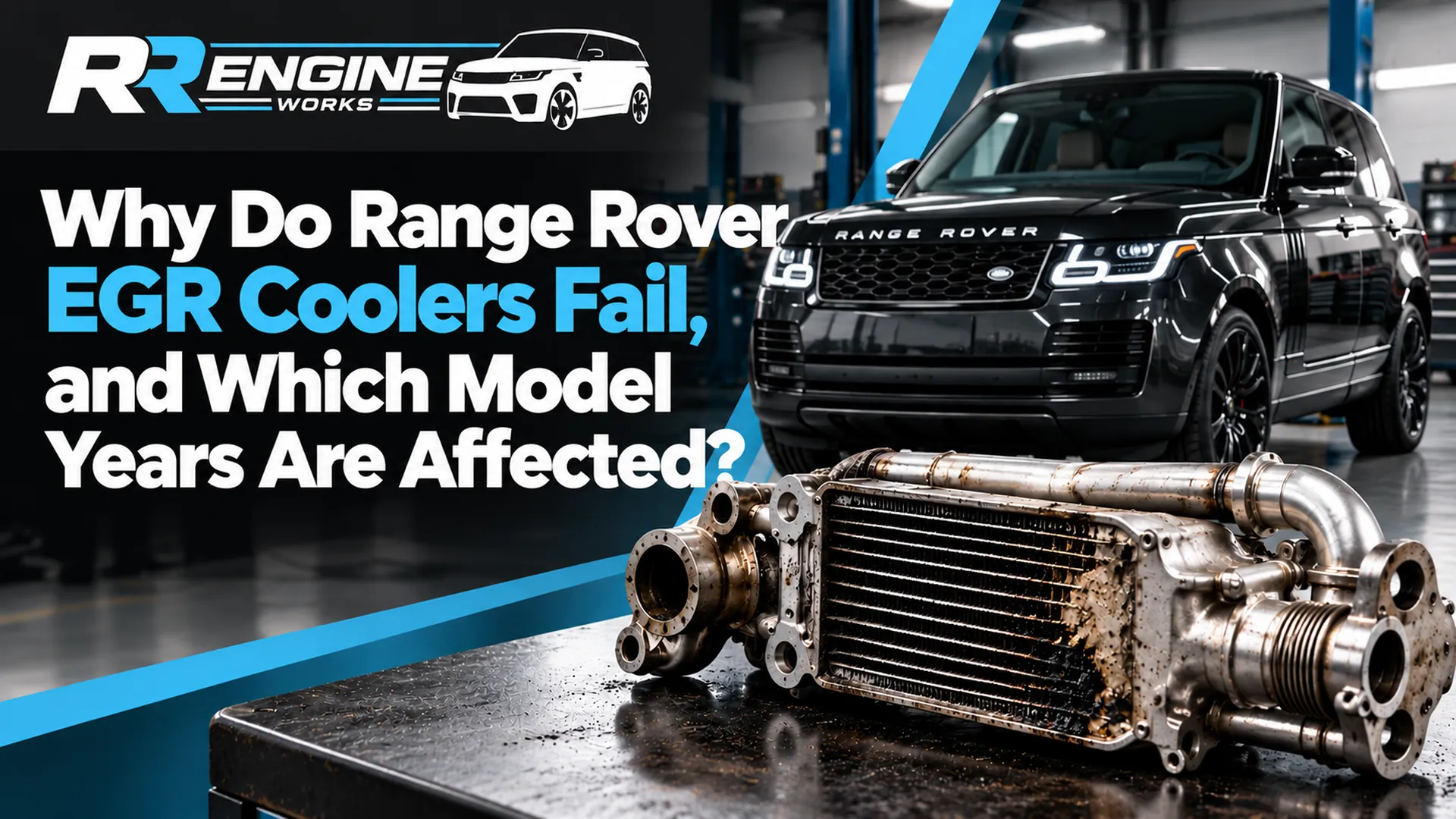
Understanding why the cooler fails helps you judge whether your own car is at risk. It also explains why a quick patch rarely lasts.
What Causes an EGR Cooler to Fail and Leak Coolant?
The EGR cooler works under harsh conditions. Hot exhaust gas passes through one side while coolant circulates on the other. Over time, several things wear it down:
- Thermal stress. Repeated heating and cooling fatigues the internal walls until they crack.
- Soot and carbon build-up. Deposits restrict flow and create hot spots, which accelerates cracking.
- Short-trip driving. The engine rarely reaches full temperature, so deposits build faster.
- Age and mileage. Like any heat exchanger, the cooler has a finite life.
Once a crack opens, coolant escapes into the exhaust path. At first it's a slow loss. As the crack grows, so does the damage risk.
Are 2013, 2016, 2017 and 2018 Range Rovers at Risk of EGR Cooler Failure?
Risk depends more on the engine variant than on the badge. Diesel models carry the EGR system, so the 2013, 2016, 2017 and 2018 Range Rover years all include cars that can develop this fault. Petrol versions are a different case, and a symptom like coolant loss on a petrol car points elsewhere.
We don't claim every car of a given year will fail. What we say is simpler: if your diesel Range Rover is in this age and mileage bracket and is losing coolant, the cooler should be one of the first things checked. A 2016 Range Rover EGR cooler failure and a 2018 Range Rover EGR cooler failure look much the same on the diagnostic bench.
Is It Safe to Keep Driving With a Failing EGR Cooler?
No. We'd rather say that plainly than soften it. A leaking cooler can let coolant reach the cylinders. Liquid can't be compressed, so it can bend components or cause serious engine damage. Even without that, losing coolant risks overheating.
If you've confirmed coolant is disappearing, stop driving the car and arrange recovery or a workshop visit. A diagnostic check costs far less than a damaged engine.
How Is Range Rover EGR Cooler Failure Fixed, and What Does It Cost?
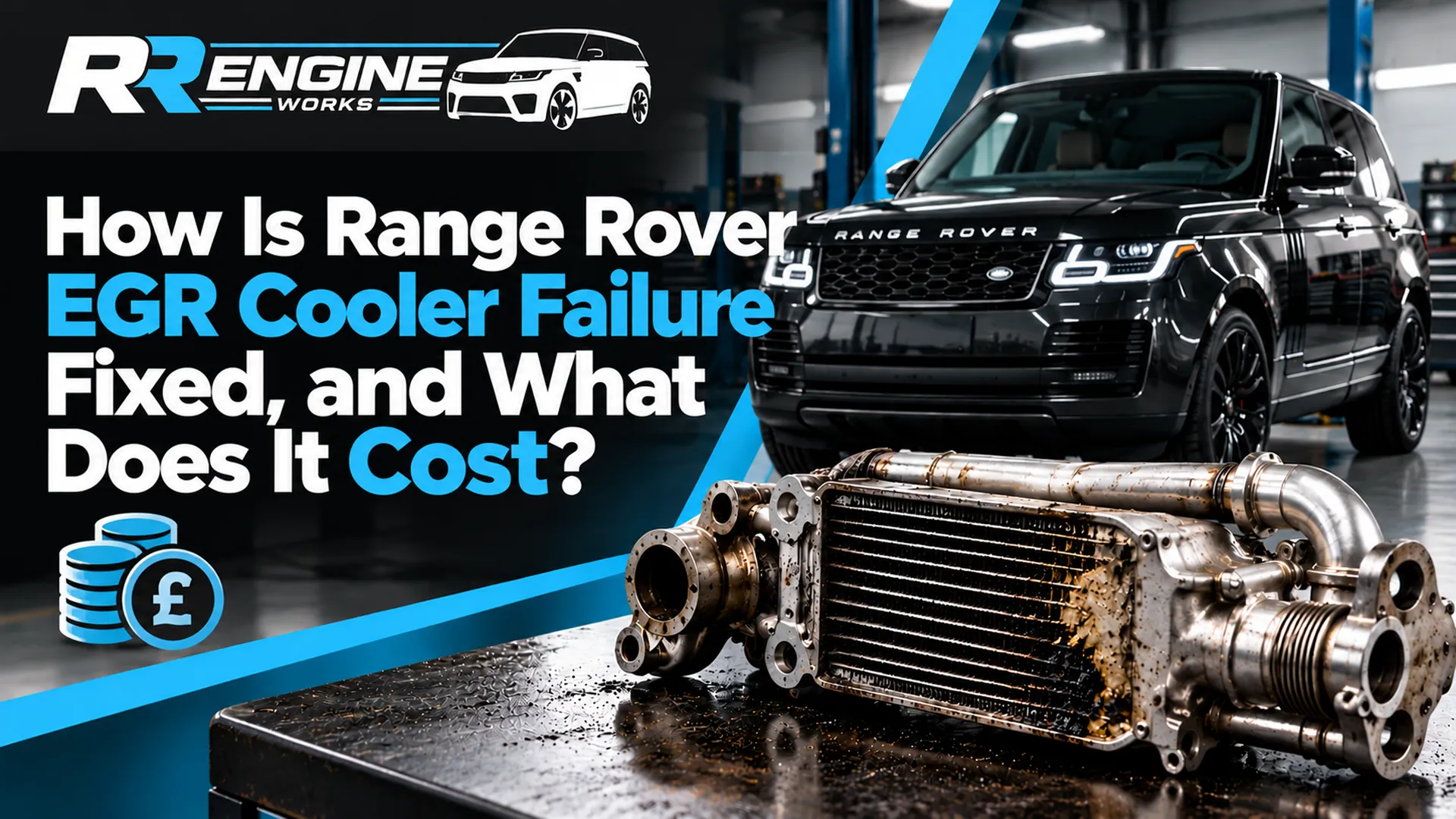
This is the section most owners care about, so here's an honest answer. Repair is about more than swapping one part. Done properly, it finds out whether the leak has already caused damage elsewhere.
What Does a Proper EGR Cooler Failure Repair Involve?
A thorough range rover egr cooler failure fix at our workshop follows a clear order:
- Diagnosis. We scan for fault codes and pressure test the cooling system to confirm where the leak is.
- Coolant ingress check. We look for signs that coolant has entered the intake or cylinders, because that changes the scope of the job.
- Cooler removal and replacement. The failed unit comes out and a new one goes in.
- Cleaning. We clear carbon from the EGR valve and intake path so the new cooler isn't exposed to the same deposits.
- Cooling system refill and bleed. Air pockets cause overheating, so this step matters.
- Road test and recheck. We confirm the coolant level holds and the fault codes stay clear.
A typical case: a customer brings in a diesel Range Rover that has been topping up coolant weekly with no visible leak. A pressure test and inspection point to the cooler. Replacing it early, before liquid reaches the cylinders, usually keeps the job to a straightforward range rover coolant repair rather than an engine problem.
What affects the price? We don't publish a flat figure, because it depends on factors that vary from car to car:
- Engine and model (Evoque, Sport and full-size Range Rover differ in access and parts)
- Whether the failure has caused further damage
- Related parts that need replacing, such as the EGR valve or hoses
- Labour time for your specific vehicle
We give a written quote after diagnosis, so you know the cost before work begins.
How Do I Book an EGR Cooler Diagnosis and Quote in Grays?
Booking is simple. Call or message RR Engine Works with your model, year and engine, and describe what the car is doing: coolant loss, smoke, power loss, or warning lights. Then bring the car to Unit 1 Hedley Ave, Grays RM20 4EL. We'll diagnose it and explain your options in plain English.
[Internal link: Range Rover diagnostics service] | [Internal link: Range Rover engine repair] | [Internal link: Contact page]
Range Rover EGR Cooler Failure: Common Questions
Can I drive my Range Rover with a failing EGR cooler?
It's not recommended. Coolant loss risks overheating and, in severe cases, serious engine damage. Stop driving once you've confirmed a loss.
How do I know if it's the EGR cooler or the head gasket?
Both can cause coolant loss and white smoke. Only a pressure test and a proper inspection can tell them apart, so avoid guessing.
Can an EGR cooler be repaired, or must it be replaced?
A cracked cooler is normally replaced, because a repair on a unit that has cracked internally rarely lasts.
Is the EGR cooler the same as the EGR valve?
No. The valve controls exhaust gas flow, while the cooler lowers its temperature. Valve faults don't usually cause coolant loss.
How long does the repair take?
It depends on the model and on whether other damage is found. We confirm the timeframe after diagnosis.
Don't Wait for the Smoke to Get Worse
Coolant loss with no visible leak is the clearest early warning of Range Rover EGR cooler failure, and early action is what keeps the repair small. If your diesel Range Rover shows any of the signs above, book a diagnosis with RR Engine Works in Grays, Essex. Call us or send your details through the contact page, and we'll tell you exactly what's wrong before any work starts.