
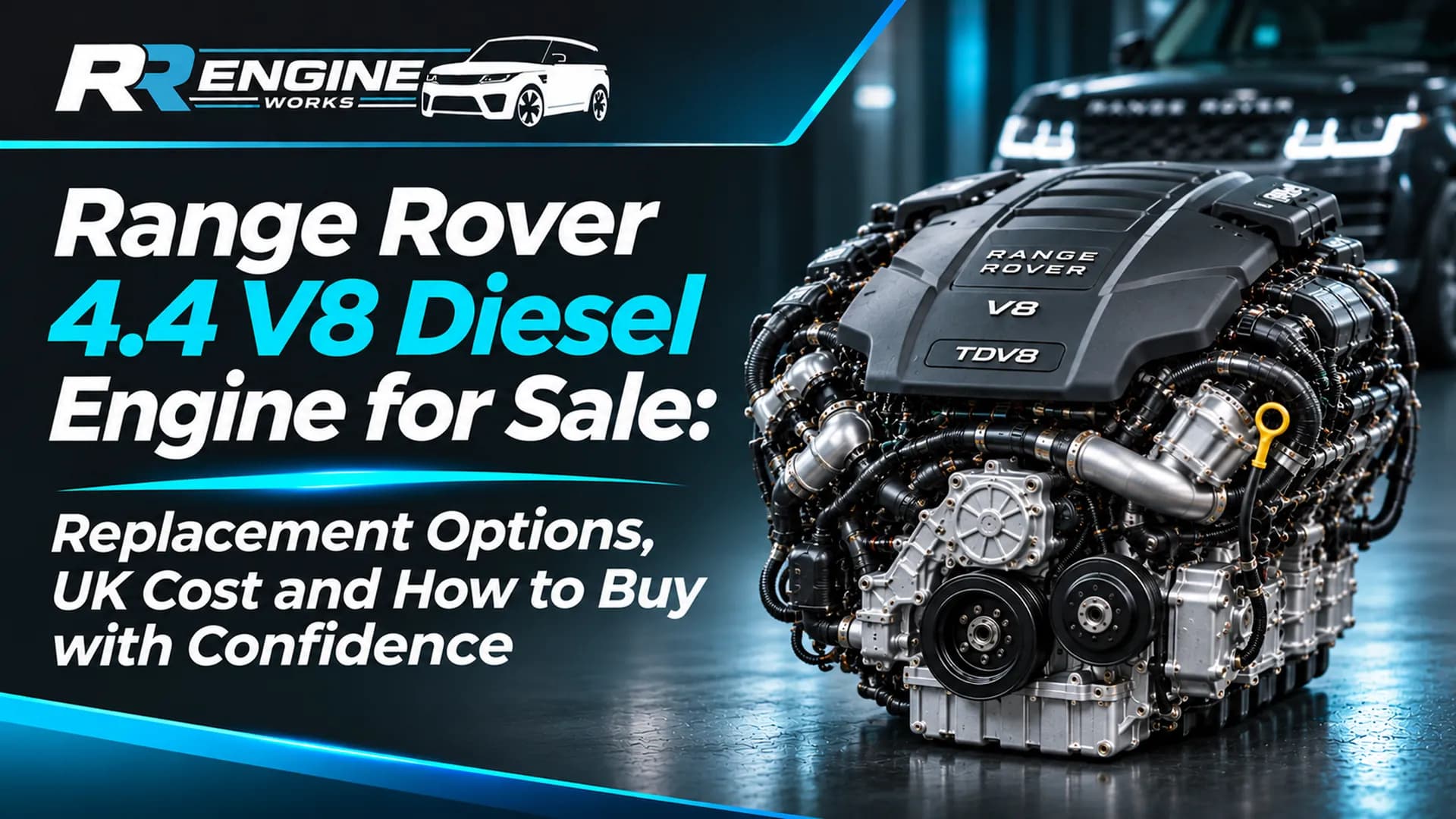
A rattle on cold start, a coolant smell after a long drive, or a workshop quote that makes you wince. If you own a Range Rover with the 4.4 V8 diesel, you have probably felt at least one of these. Few engines feel as effortless on the motorway, and few can cost as much when something goes wrong.
The Range Rover 4.4 V8 diesel engine, known as the 4.4 TDV8 in the L322 era, delivers serious torque and a relaxed, long-legged drive. It also has a few well-known weak points, and most of them are cheaper to deal with early than late.
This guide covers what you need to know: specs, real-world fuel economy, the faults we see most often, what repairs involve, and how to buy a replacement engine in the UK without getting burned. It draws on the kind of 4.4 TDV8 engines and failures that come through our workshop in Grays, Essex.
Quick answer: the 4.4 V8 diesel is a twin-turbo diesel V8 that makes roughly 313 PS and 700 Nm in its L322 form. It is strong and refined, but it is expensive to repair because of its tight packaging and rear-mounted timing chains. A well-maintained example can serve you for years. A neglected one can become a very costly problem.
Jump to:
- Specs, horsepower, mpg and oil capacity
- Reliability and common problems
- Engines for sale, replacement options and cost
- FAQs
What Are the Range Rover 4.4 V8 Diesel Engine Specs, Horsepower, MPG and Oil Capacity?
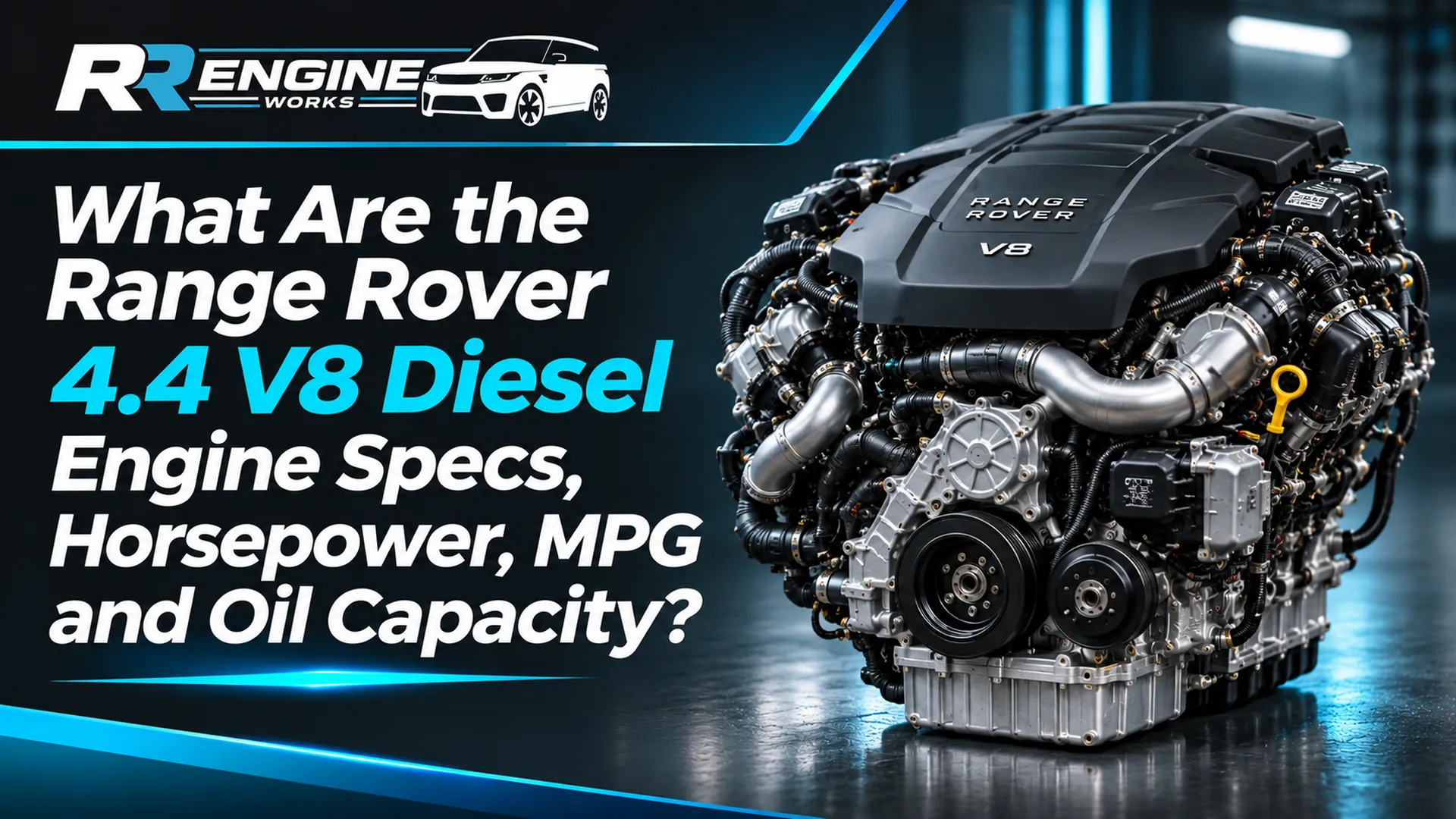
The 4.4 TDV8 (engine code AJD-V8, also seen as 448DT) is a 4.4-litre diesel V8 with sequential twin turbochargers. It arrived in the L322 Range Rover around 2010, replacing the smaller 3.6 TDV8. It is also found in the Range Rover Sport of the same period. Later Range Rover L405 models carried an updated version of the 4.4 diesel V8, sold as the SDV8, with higher output.
The engine is built for effortless pull rather than outright speed. Peak torque arrives low in the rev range, so a heavy Range Rover feels relaxed at 70 mph and handles towing without complaint.
What Are the Key Specs of the Range Rover 4.4 TDV8 Engine, and Which Models and Years Use It?
Here is a quick-reference table for the L322 version. Figures vary slightly by model year, so always confirm yours against your handbook or official Land Rover documentation.
Feature | Range Rover 4.4 TDV8 (L322) |
| Engine code | AJD-V8 / 448DT |
| Layout | V8, 32-valve |
| Capacity | 4.4 litres (4,367 cc) |
| Induction | Sequential twin-turbo |
| Power | Approx. 313 PS (around 308 bhp) |
| Torque | Approx. 700 Nm |
| Official combined mpg | Roughly high 20s to around 30 mpg |
| Real-world mpg | Roughly low to mid 20s, depending on use |
| Oil capacity | Roughly 8 to 9 litres with filter (confirm in your handbook) |
| Timing drive | Chains at the rear (gearbox end) of the engine |
Fitment at a glance:
Model | Engine | Notes |
| Range Rover L322 (approx. 2010–2012) | 4.4 TDV8 | The classic Vogue 4.4 V8 diesel |
| Range Rover Sport (approx. 2010–2013) | 4.4 TDV8 | Same engine family |
| Range Rover L405 (approx. 2013 onward) | 4.4 SDV8 | Updated, more powerful version |
Don't confuse this with the earlier 3.6 TDV8. It looks similar under the bonnet but is a different engine with different parts and a different output of around 272 PS. Ordering the wrong one is an expensive mistake, which is why we always match engines by registration and engine code.
Searching for a Range Rover Vogue 4.4 V8 diesel engine for the UK market? The Vogue name is a trim level, not a different engine. The 4.4 TDV8 is the same unit across trims.
What About Horsepower, MPG and Fuel Consumption in Daily Use?
On paper the 4.4 diesel returns respectable economy for a two-and-a-half-tonne luxury SUV. In daily life, expect these ranges:
- Motorway cruising: the best case, often high 20s to low 30s mpg if you keep a steady speed.
- Mixed driving: low to mid 20s mpg is a sensible expectation.
- Short urban trips: economy drops quickly, and the engine never reaches full operating temperature.
- Towing: fuel consumption can fall into the teens depending on load.
Lots of short journeys do more than hurt your mpg. They also strain the diesel particulate filter (DPF) and the EGR system, which is why economy and reliability are linked on this engine.
Is the Range Rover 4.4 V8 Diesel Engine Better Than the 4.4 V8 Petrol, and Is the Fuel Economy Worth It?
It depends on how you drive, but for most owners the diesel makes more sense. A quick note first: the older L322 had a 4.4 V8 petrol engine in the early 2000s. It is a completely different engine from the later diesel and sits in a different era of the car's life. In today's used market, most buyers compare the diesel against the later 5.0 V8 petrol.
Point | 4.4 V8 diesel (TDV8) | V8 petrol (earlier 4.4 or later 5.0) |
| Torque | Very strong, low-down | Lower, needs revs |
| Fuel economy | Noticeably better | Much thirstier |
| Towing | Excellent | Good, but less relaxed |
| Refinement | Smooth and quiet | Smooth, with a better exhaust note |
| Service and repair cost | High on major faults | High, with different weak points |
| Best for | Motorway miles, towing, long trips | Low-mileage, short-trip owners |
Our verdict: if you cover long distances or tow, the diesel earns its keep. If your Range Rover mostly does short school runs and town trips, a petrol may suit you better, because short journeys are hard on a diesel.
Reading a Range Rover 4.4 V8 diesel engine review from an owner? Treat it as one data point. Servicing history and driving pattern matter more than any single opinion.
Is the Range Rover 4.4 V8 Diesel Engine Reliable? Common TDV8 Problems and Warning Signs
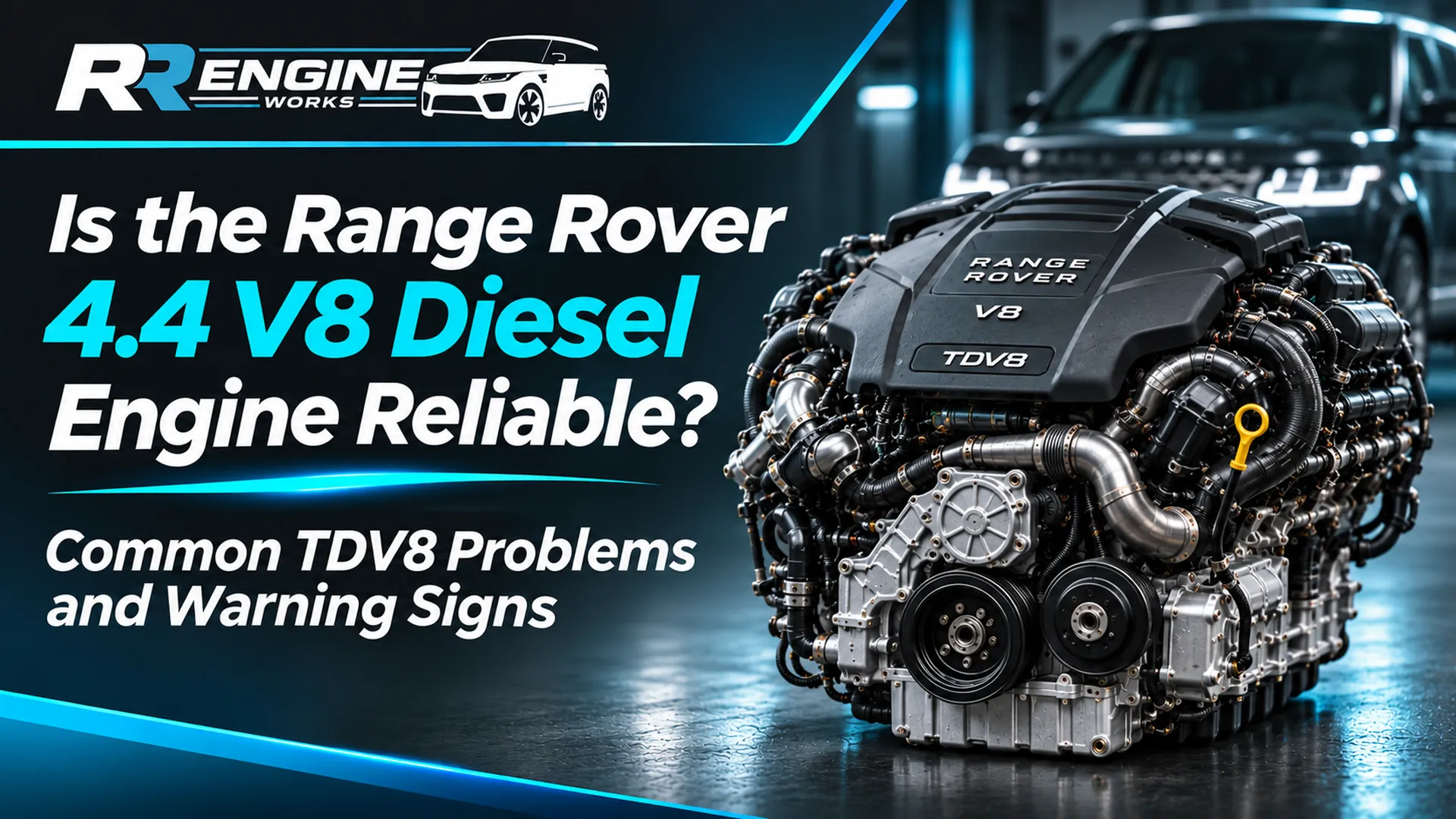
The honest answer: it can be, but it is not forgiving. The 4.4 TDV8 is a strong engine when it is serviced on time, warmed up properly and checked for leaks. It becomes expensive when small warnings are ignored. Almost every serious failure we see started as a minor fault that nobody caught.
What Are the Most Common Range Rover 4.4 TDV8 Engine Problems and Their Symptoms?
Here are the faults owners report most often, with the signs that go with each.
- Timing chain and tensioner wear: a rattle or clatter for a few seconds on a cold start is the classic warning. The chains sit at the rear of the engine, so ignoring this risks serious engine damage.
- Coolant crossover pipe leaks: a sweet smell, falling coolant level or white residue around the engine V. A small leak can drain coolant quietly and lead to overheating.
- Turbo actuator and turbo faults: sudden power loss, limp mode, or a whistling noise under load.
- EGR valve and swirl flap issues: rough running, black smoke, poor economy or hesitation. This is more commonly discussed on the earlier 3.6 TDV8 but still worth checking on the 4.4.
- DPF and emissions faults: repeated regeneration warnings, usually on cars that mostly do short trips.
Each of these has a different cost and urgency. Here is how to read them:
Symptom | Likely cause | Urgency |
| Rattle on cold start | Timing chain or tensioner wear | High: get it checked now |
| Coolant level dropping | Crossover pipe or hose leak | High: leaks escalate fast |
| Loss of power, limp mode | Turbo actuator or boost fault | Medium |
| Black smoke, rough running | EGR or swirl flap problem | Medium |
| DPF warning light | Blocked filter from short trips | Low to medium |
Stop driving and arrange recovery if you see a red oil pressure light, an overheating warning that will not clear, or a heavy metallic rattle. Driving on is how a repair becomes a replacement.
A real-world scenario: an owner notices a faint rattle for a second or two each morning and decides it is "just a diesel noise." Six months later the chain stretches further, the timing slips and the engine suffers major damage. Caught at the first sign, it would have been a chain and tensioner job. Left alone, it is an engine replacement.
Hearing a rattle or losing coolant? Send us your registration and a short description for a free assessment.
How Much Does Range Rover 4.4 TDV8 Timing Chain Replacement Cost, and Is the Engine Worth Keeping?
Range Rover 4.4 TDV8 timing chain replacement is one of the most expensive jobs on this engine, and the reason is labour, not parts. The chains are mounted at the back of the engine, against the gearbox. To reach them, the engine and gearbox usually have to come out of the car. That is many hours of work before a single part is replaced.
Because of this, the job often runs into thousands of pounds. We will not quote a figure without seeing your car, because the price depends on the vehicle's condition, whether other parts need replacing at the same time, and the parts you choose.
So is it worth keeping? Use this as a guide:
- Repair makes sense when the fault is caught early, the rest of the engine is healthy and the car is in good condition overall.
- Replacement makes sense when there is already internal damage, repeated problems or a high-mileage engine with an unknown history.
- Walking away makes sense when repair costs approach or exceed the value of the whole vehicle, and the car has other expensive issues.
Resale value matters too. A Range Rover with a documented engine replacement or a fresh timing chain job is much easier to sell than one with an unexplained rattle. Keep every invoice.
How to protect your engine:
- Change the oil early. Many specialists suggest around 6,000 to 10,000 miles, rather than the longest factory interval.
- Check coolant weekly, and investigate any drop instead of topping up and forgetting.
- Let the engine warm up before driving hard, and avoid constant short trips.
- Take a long run now and then so the DPF can regenerate properly.
- Act on strange noises straight away. An inspection costs far less than an engine.
Range Rover 4.4 V8 Diesel Engine for Sale: Replacement Options, UK Cost and How to Buy with Confidence
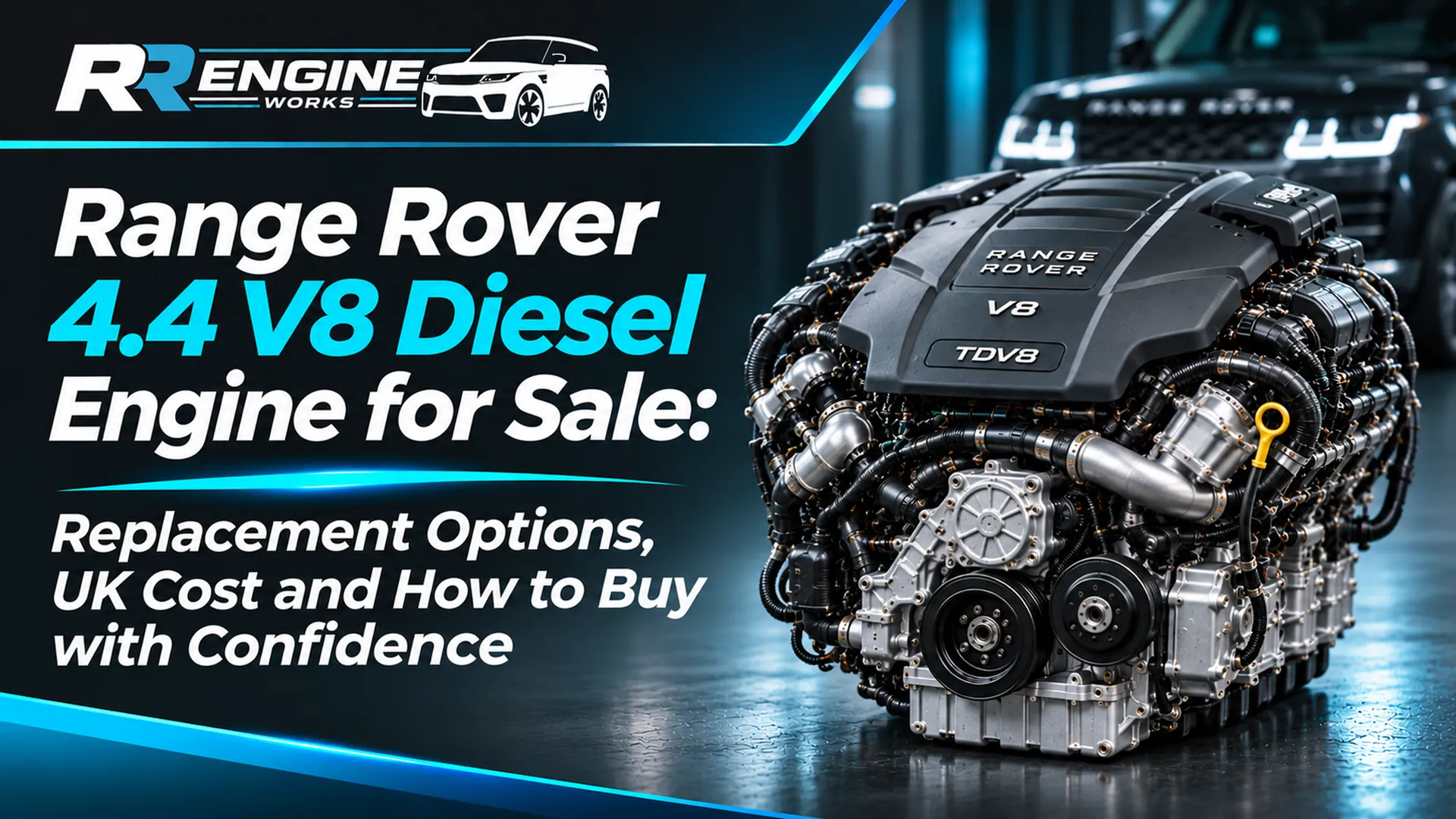
If you are searching for a Range Rover 4.4 V8 diesel engine for sale, you are probably in one of two positions: your engine has failed, or you want to avoid failure before it happens. Either way, it pays to understand your options before you buy. The cheapest listing is rarely the cheapest outcome.
Should You Repair, Recondition or Replace a Range Rover 4.4 V8 Diesel Engine?
Here is how the main options compare:
Option | Best for | Main advantage | Main drawback |
| Repair | A single, isolated fault | Lowest upfront cost | Does not address hidden wear |
| Reconditioned engine | Most owners with a failed engine | Strong value, often with a warranty | Quality varies by supplier |
| Used engine | Tight budgets | Lowest purchase price | Unknown history, higher risk |
| New engine | High-value or newer vehicles | Maximum peace of mind | Highest cost |
For most owners, a tested, reconditioned engine with a clear warranty gives the best balance of price and confidence. A used engine can look like a bargain, but with no known history you are buying a gamble, and the labour to fit it is the same whatever engine goes in.
What affects the total cost:
- Engine variant: 4.4 TDV8 or 4.4 SDV8, and the model year.
- Condition: reconditioned, used or new.
- Labour: removal and refitting is a big job on this car.
- Extra parts: it is common to replace hoses, seals, belts and fluids at the same time.
- Warranty length: longer cover usually costs more but protects you better.
Questions to ask any engine supplier:
- Has the engine been tested before sale, and how?
- What does the warranty cover, and for how long?
- Is fitting included, or can you recommend a trusted fitter?
- What happens if the engine fails within the warranty period?
- Can you confirm the engine matches my car by registration and engine code?
A supplier who answers all five clearly is usually one you can trust.
Why Buy Your Range Rover 4.4 V8 Diesel Engine from RR Engine Works in Grays, Essex?
An engine is only as good as the people standing behind it. At RR Engine Works, Range Rover, Land Rover and Jaguar engines are what we focus on. We see the same faults often, so we know what to look for and what to avoid.
- Specialist focus on Land Rover and Range Rover engines, including the 4.4 TDV8 and SDV8.
- Tested engines and clear warranty terms, so you know exactly what you are buying.
- UK-wide delivery, with a local base at Unit 1 Hedley Ave, Grays RM20 4EL for customers in Essex and the surrounding area.
- Honest advice. If repairing your engine is smarter than replacing it, we will tell you.
Getting your quote takes three simple steps:
- Enter your registration, and we confirm your exact engine.
- Check the details with us so there are no mistakes on variant or year.
- Receive your quote, including warranty terms and delivery options.
Ready to see what your replacement engine will cost? Enter your registration now for a free engine quote.
Looking for a different engine? See our related guides on the Range Rover 3.0 Ingenium engine, SDV6 and TDV6 engines, and Land Rover turbo failure.
Frequently Asked Questions About the Range Rover 4.4 V8 Diesel Engine
Is the Range Rover 4.4 V8 diesel engine reliable?
It can be, when it is serviced on time and warmed up properly. The main risks are timing chain wear, coolant leaks and turbo faults. Most serious failures follow missed servicing or ignored warning signs.
What are the most common Range Rover 4.4 TDV8 engine problems?
The usual faults are timing chain and tensioner wear, coolant crossover pipe leaks, turbo actuator faults, EGR and swirl flap issues, and DPF problems on cars used for short trips.
How much horsepower does the Range Rover 4.4 V8 diesel engine make?
The L322 4.4 TDV8 makes around 313 PS (roughly 308 bhp) and about 700 Nm of torque. The later L405 4.4 SDV8 is more powerful.
What is the oil capacity of the Range Rover 4.4 V8 diesel engine?
It is roughly 8 to 9 litres including the filter, but the exact figure and oil specification should be confirmed in your handbook or with a specialist before an oil change.
What mpg does a Range Rover 4.4 V8 diesel get?
Official combined figures sit around the high 20s to roughly 30 mpg. Real-world mixed driving is more often in the low to mid 20s, and towing or short trips can push it lower.
How much does Range Rover 4.4 TDV8 timing chain replacement cost?
It is usually a multi-thousand-pound job, mainly because the chains are at the rear of the engine and the engine often has to come out. The exact price depends on your car and what else needs replacing.
What is the difference between the 3.6 and 4.4 TDV8?
The 3.6 TDV8 is the earlier, smaller engine with lower output. The 4.4 is larger, more powerful and was introduced around 2010. They are not interchangeable.
Where can I buy a Range Rover 4.4 V8 diesel engine in the UK?
You can buy from a specialist engine supplier such as RR Engine Works. Always check that the engine is tested, comes with a warranty and is matched to your car by registration.
Conclusion: Protect Your Range Rover 4.4 V8 Diesel Engine Before It Costs You More
The 4.4 V8 diesel gives you the effortless torque and refinement that made the Range Rover famous. It also rewards the owners who pay attention. Change the oil early, watch the coolant, take cold-start rattles seriously and act on warnings straight away.
If your engine has already failed, or you want certainty before it does, the right replacement puts you back on the road with confidence and a warranty behind you.
Get your free engine quote from RR Engine Works today. Enter your registration and our team will confirm your engine, then give you clear pricing, warranty details and delivery options.