

Your Land Rover's dashboard just lit up with an amber warning, the power feels weaker than usual, and you're wondering whether you're about to be stuck in limp mode on the motorway. If that sounds familiar, you're dealing with one of the most common, and most misunderstood, issues affecting modern diesel Land Rovers: a struggling or blocked diesel particulate filter (DPF).
You're not alone. DPF problems are one of the leading reasons Land Rover and Range Rover owners end up searching for answers at 11pm after a warning light appears out of nowhere. The good news is that most DPF issues are diagnosable, explainable, and fixable, provided you understand what's actually happening inside your exhaust system and act before things escalate.
This guide walks through everything you need to know: the symptoms, the root causes specific to Land Rover diesel engines, how regeneration actually works, what the fault codes mean, and when cleaning is enough versus when replacement becomes necessary.
What Are the Symptoms of Land Rover DPF Problems?

A DPF problem rarely appears without warning. Your vehicle is designed to flag issues early, the trick is knowing what those signals actually mean before they turn into a breakdown or an expensive repair bill.
How Do I Know If My Land Rover's DPF Is Blocked?
A blocked DPF shows up through a combination of dashboard warnings and noticeable changes in how the car drives. Here's what typically points to a blockage:
- A dashboard message reading "DPF Full" or "Exhaust Filter Full", this is the most direct signal your vehicle can give you.
- Sluggish acceleration, even when you press the accelerator normally.
- A rougher idle than what you're used to.
- Increased fuel consumption, since the engine is working harder to push exhaust gases through a restricted filter.
- A faint burning or unusual exhaust smell, particularly after the car has attempted regeneration.
If you're noticing two or more of these together, it's worth getting the DPF checked rather than waiting to see if it clears itself.
What Does the Land Rover DPF Warning Light Mean?
Land Rover's DPF warning system isn't a single light, it's a graduated escalation designed to give you time to respond before the problem becomes serious.
Amber Warning vs Red Warning, What's the Difference?
Warning Type | What It Means | Recommended Action |
| Amber DPF light | The filter is accumulating soot and needs a regeneration drive | Drive at sustained speed (Land Rover recommends above 37 mph for roughly 20 minutes) to allow the system to burn off soot naturally |
| Red DPF light | The filter is critically restricted or regeneration has failed repeatedly | Stop unnecessary driving and book a professional diagnostic check, continuing to drive risks further damage |
Ignoring an amber warning for too long is one of the most common ways a manageable issue turns into a red-warning situation requiring specialist intervention.
Why Has My Land Rover Gone Into Limp Mode?
Limp mode is the engine management system's way of protecting your engine from further damage once it detects a serious fault, and a severely blocked DPF is a frequent trigger. When soot restriction reaches a critical level, the ECU deliberately reduces power output, RPM range, and sometimes turbo boost to limit stress on the engine and exhaust components.
If your Land Rover has entered limp mode, it's not something to drive around indefinitely. It's the vehicle telling you a diagnostic check is overdue.
Can a Blocked DPF Cause Poor Fuel Economy or Rising Oil Levels?
Yes, and this is where many owners get caught out. A struggling DPF often means the engine is triggering repeated regeneration attempts, which involves injecting extra fuel into the cylinders to raise exhaust temperature. Some of that unburned fuel can end up diluting the engine oil.
Watch for:
- A noticeably higher oil level on the dipstick than expected
- Engine oil that smells faintly of diesel
- Oil that appears thinner or darker than normal between services
This isn't just a DPF issue at that point, it's an early warning sign of oil dilution, which can affect lubrication and, over time, contribute to premature wear on components like the timing chain.
What Causes DPF Problems in Land Rover Diesel Engines?

Understanding the "why" behind DPF issues makes a real difference, both in preventing them and in having an informed conversation with whoever ends up fixing the problem.
Why Do Short Journeys Cause Land Rover DPF Blockages?
This is, by far, the most common root cause we see. A DPF needs to reach a specific exhaust temperature for long enough to burn off the soot it's collected, a process called regeneration. Short trips, stop-start city driving, and cold-weather journeys simply don't give the exhaust enough time to get hot enough.
Over weeks or months of short commutes, soot builds up faster than it's cleared. Eventually, the ECU flags the filter as full, and a driving pattern that felt completely normal suddenly results in a dashboard warning.
Why Does Land Rover DPF Regeneration Keep Failing?
Regeneration failure isn't always about driving habits, sometimes it's mechanical or electrical.
Active, Passive & Forced Regeneration Explained
- Passive regeneration happens automatically during normal motorway-speed driving, where exhaust temperatures are naturally high enough to burn soot without any extra intervention.
- Active regeneration is triggered by the ECU when soot levels reach a threshold; it injects additional fuel to raise exhaust temperature and complete the burn-off process, usually while you're still driving.
- Forced regeneration is a manual process carried out with a diagnostic tool, typically used when the automatic process has failed repeatedly and the vehicle needs assistance to complete a full regeneration cycle.
If active regeneration is repeatedly interrupted, by short journeys, a faulty pressure sensor, or a failing exhaust temperature sensor, the soot load keeps climbing until the system locks into a fault state and stops attempting regeneration altogether. This is sometimes referred to as a regeneration lockout.
Which Land Rover Models Are Most Affected by DPF Issues?
DPF problems aren't limited to one model, they show up across the range, though the underlying causes and severity can differ.
DPF Problems by Model, Defender, Discovery, Range Rover & More
- Land Rover Defender, particularly diesel variants used for short, low-speed journeys or off-road work where sustained high-speed driving is rare.
- Land Rover Discovery & Discovery Sport, commonly reported DPF regeneration issues, especially on vehicles used mainly for school runs and local trips.
- Land Rover Freelander (Freelander 2), an older platform where DPF sensor faults and blockages are a well-known recurring issue.
- Range Rover, larger diesel engines can be more forgiving, but urban-only driving still triggers regeneration problems.
- Range Rover Sport, frequently searched in connection with DPF warning lights and regeneration failure, particularly on lower-mileage examples used for city driving.
- Range Rover Evoque & Velar, smaller diesel engines in these models can be especially sensitive to short-journey driving patterns.
Are Ingenium Diesel Engines More Prone to DPF Failure?
The Ingenium engine family has attracted a lot of attention regarding DPF and related regeneration issues, and it's worth understanding why.
2.0 Ingenium, TDV6 & SDV6 DPF Problems Compared
- 2.0 Ingenium diesel, this engine has been closely linked in specialist repair circles to DPF blockage combined with oil dilution, largely because of how frequently active regeneration is triggered on vehicles doing predominantly short journeys. In more severe cases, sustained oil dilution has been connected to increased wear risk on the timing chain.
- 3.0 TDV6, generally more tolerant of mixed driving conditions, though regeneration problems still occur on vehicles used mainly for low-speed trips.
- 3.0 SDV6, similar profile to the TDV6, with DPF issues typically tied to driving pattern rather than a specific design flaw.
- TDV8 / SDV8, larger capacity engines that tend to reach effective exhaust temperatures more easily during everyday driving, though they're not immune to blockage under consistently short-journey use.
The pattern across all of these is consistent: driving style has a bigger influence on DPF health than most owners realise, but some engines, particularly the 2.0 Ingenium, are more sensitive to the knock-on effects when regeneration doesn't complete properly.
How Do You Diagnose and Repair a Land Rover DPF Fault?
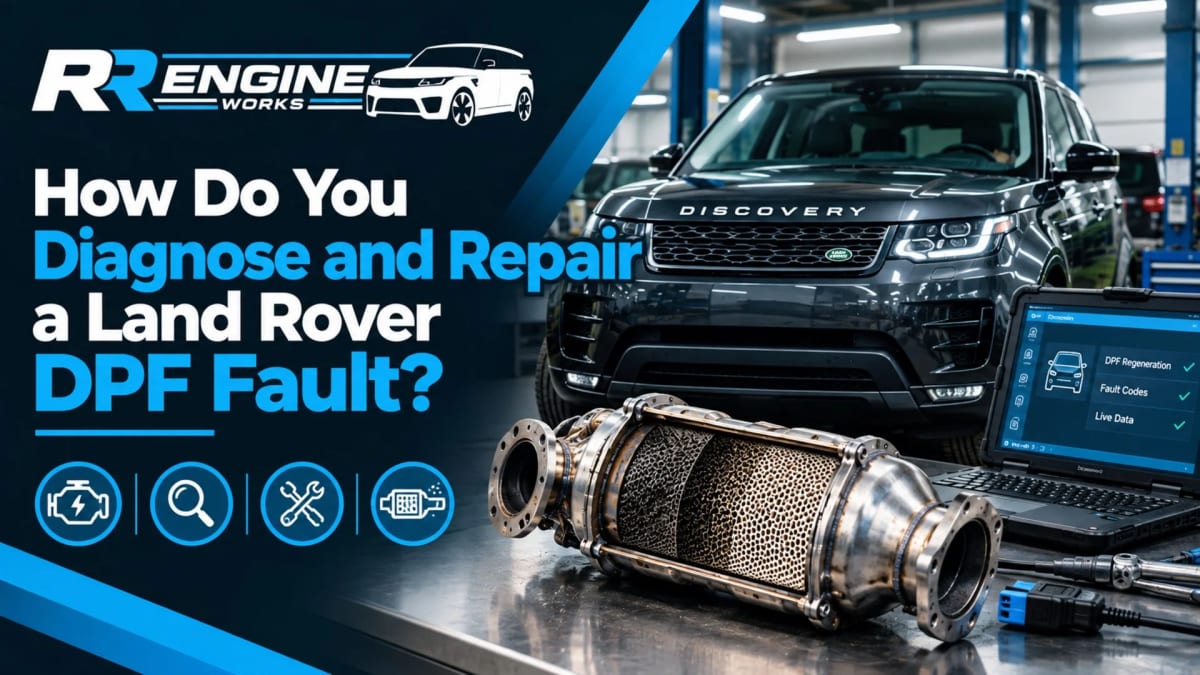
Once symptoms appear, the next step is proper diagnosis. Guessing at a DPF problem, or relying on a generic "DPF cleaner" additive, often masks the issue rather than resolving it.
What Do Common Land Rover DPF Fault Codes Mean?
Diagnostic fault codes give a much clearer picture of what's actually wrong than the dashboard warning alone.
P2002, P2463 & P246B Explained
- P2002, indicates the DPF's efficiency has dropped below the acceptable threshold, meaning the filter isn't removing particulates as effectively as it should.
- P2463, commonly associated with excessive soot accumulation or restriction within the filter itself.
- P246B, typically relates to the conditions required for regeneration not being met, which can point to sensor faults, short-journey driving patterns, or issues elsewhere in the exhaust system.
These codes are read using a diagnostic scanner connected to the vehicle's ECU, and they're an essential first step before any physical work is carried out.
Should I Clean or Replace a Blocked Land Rover DPF?
This is one of the most common questions we're asked, and the honest answer is: it depends on the extent of the blockage and the condition of the filter itself.
DPF Cleaning vs Replacement, Cost & Suitability
Factor | DPF Cleaning | DPF Replacement |
| Best suited for | Moderate soot blockage with no physical damage to the filter substrate | Cracked, melted, or structurally damaged filters, or repeated failed cleanings |
| Typical outcome | Restores flow and regeneration capability at lower cost | Full reset of filter performance, longer-term reliability |
| Cost consideration | Generally more affordable | Higher upfront cost, but sometimes unavoidable |
| When it's not appropriate | Filter substrate is cracked or degraded | Soot blockage alone with no structural damage |
A proper diagnostic check, including a look at differential pressure readings and the physical condition of the filter, is the only reliable way to know which option actually applies to your vehicle. Choosing cleaning when replacement is genuinely needed (or vice versa) tends to be a false economy.
Can DPF Problems Damage the EGR, Turbo or Engine Oil?
DPF issues rarely stay isolated for long. The emissions system is interconnected, and problems tend to travel:
- EGR (Exhaust Gas Recirculation) system, soot and carbon buildup associated with DPF problems can also affect EGR valve operation, leading to further performance and emissions issues.
- Turbocharger, increased back pressure from a restricted DPF can place additional strain on the turbo over time.
- Engine oil, as covered earlier, repeated failed regeneration attempts can lead to fuel finding its way into the oil, diluting it and reducing its protective properties.
This is exactly why we recommend a full diagnostic approach rather than treating DPF, EGR, and turbo issues as separate problems, on Land Rover diesels, they're very often connected.
Where Can I Get My Land Rover DPF Diagnosed and Repaired?

Reading about DPF problems only gets you so far, at some point, the vehicle needs proper hands-on diagnosis from people who work on these systems regularly.
Why Choose RR Engine Works for Land Rover DPF Repairs?
At RR Engine Works, DPF diagnostics and repair on Land Rover and Range Rover diesel models is something we handle regularly, not as an occasional job, but as a core part of what we do. That matters because DPF problems on this brand tend to follow specific patterns, from Ingenium oil dilution concerns to model-specific regeneration quirks, and recognising those patterns quickly saves you time and unnecessary expense.
Our approach typically includes:
- A full diagnostic scan to identify fault codes and pull live data, including differential pressure and soot load readings
- An honest assessment of whether cleaning or replacement is the right call for your specific filter's condition
- A check of related systems, EGR, turbo, and oil condition, where DPF problems have knock-on effects
- Clear communication about cost and next steps before any work begins
We'd rather explain what's actually wrong with your vehicle than push a one-size-fits-all fix.
How Do I Book a DPF Diagnostic Check?
If your Land Rover is showing DPF warning signs, whether that's an amber light, reduced power, or a rising oil level, the sooner it's checked, the more options you typically have.
Contact RR Engine Works, Grays, Essex
You can find us at Unit 1, Hedley Ave, Grays, RM20 4EL. Get in touch to book a diagnostic check or ask a question about symptoms you're seeing, we're happy to talk through what you're experiencing before you commit to bringing the vehicle in.
Frequently Asked Questions About Land Rover DPF Problems
What is a DPF on a Land Rover?
A diesel particulate filter (DPF) is a component in the exhaust system that traps soot and particulate matter produced by the diesel engine, preventing it from being released into the atmosphere. It periodically burns off this collected soot through a process called regeneration.
Why does my Land Rover DPF keep blocking?
The most common cause is driving patterns, frequent short journeys, stop-start traffic, and cold-weather trips don't allow the exhaust to reach the temperature needed for regeneration. Faulty sensors or EGR-related issues can also contribute.
Can I drive a Land Rover with the DPF light on?
With an amber warning, yes, in fact, driving at sustained speed is often the recommended way to clear it. With a red warning, it's best to avoid unnecessary driving and get the vehicle checked, as this indicates a more serious restriction.
How long does Land Rover DPF regeneration take?
Active regeneration typically takes around 20–30 minutes of sustained driving above roughly 37 mph, though this can vary depending on how much soot has accumulated.
How much does Land Rover DPF cleaning cost?
Cost varies depending on the extent of the blockage and the vehicle model, which is why a diagnostic assessment is the best starting point before any pricing can be confirmed.
Can a blocked DPF be repaired without replacing it?
In many cases, yes, professional cleaning can restore a blocked filter to working condition, provided the filter substrate itself isn't cracked or physically damaged.
Does motorway driving clean a Land Rover DPF?
Sustained motorway-speed driving supports passive regeneration by keeping exhaust temperatures high enough to burn off soot naturally, which is why it's often recommended for vehicles that mostly do short journeys.
Can DPF problems cause engine oil dilution?
Yes, particularly when regeneration attempts fail repeatedly. Extra fuel injected during active regeneration can end up in the engine oil, diluting it, something worth checking for if you're seeing a rising oil level.
Getting Ahead of Land Rover DPF Problems
DPF issues on Land Rover diesels are rarely random, they follow recognisable patterns tied to driving habits, specific models, and particular engine families like the Ingenium range. Understanding those patterns puts you in a much stronger position, whether that means adjusting how you drive, catching a fault code early, or knowing when it's time to bring the vehicle in for a proper look.
If your Land Rover is showing any of the warning signs covered here, a DPF light, reduced power, unusual fuel consumption, or a rising oil level, don't wait for a manageable issue to become a costly one. Get in touch with RR Engine Works at Unit 1, Hedley Ave, Grays, RM20 4EL to book a diagnostic check and get a clear, honest answer on what your vehicle actually needs.