
You start your Range Rover on a cold morning and hear a rattle that wasn't there last month. Or the oil level is somehow higher than when you last checked it. Or a "Restricted Performance" message appears halfway down the A13 and the car suddenly feels half as powerful.
If any of that sounds familiar, you're probably searching for Land Rover 3.0 Ingenium engine problems because you want to know three things. What's wrong? How serious is it? What will it cost to put right?
This guide answers all three. We'll cover how the 3.0 Ingenium works, how it differs from the older 3.0 SDV6 (a mix-up that causes a lot of wrong diagnoses), the faults we actually see on diesel and petrol versions, the warning signs worth acting on, and your realistic options for repair, rebuild or replacement.
The short version: the 3.0 inline-six is a better engine than the troubled 2.0 Ingenium and the old V6 diesel it replaced. But it has weak points. They're predictable, and most of them get far worse if you ignore them.
What Is the Land Rover 3.0 Ingenium Engine, and Is It Reliable?
The 3.0 Ingenium is generally a reliable engine when it's serviced properly and used in the way it was designed for. It's smoother, more efficient and better engineered than the 3.0 SDV6 diesel it replaced. Most of its problems come from emissions hardware, oil condition and driving patterns, not from a fundamental design flaw in the block or crank.
That's the honest answer to "is the 3.0 Ingenium engine reliable?" Now for the detail behind it.
The land rover 3.0 ingenium engine is a turbocharged, 2,996cc inline-six. It belongs to the modular Ingenium family that Jaguar Land Rover (JLR) builds in-house at its Engine Manufacturing Centre in Wolverhampton. It comes in two main forms:
- AJ20D6 – the 3.0 diesel Ingenium engine. It uses common-rail direct injection, a diesel particulate filter (DPF), exhaust gas recirculation (EGR) and an AdBlue/SCR system to control NOx emissions. It's sold as the D250, D300 and D350.
- AJ20P6 – the 3.0 petrol Ingenium engine. It's a turbocharged straight-six, and early P400 versions add an electric supercharger to sharpen low-speed response. It's sold as the P360 and P400, and it forms the base of the P440e and P510e plug-in hybrids.
Almost every application also uses a 48-volt mild hybrid (MHEV) system. A belt-integrated starter generator (BiSG) recovers energy when you slow down and gives a little help when you pull away. That smooths stop-start and cuts fuel use. It also adds parts that can go wrong, and those faults are often mistaken for engine faults.
Compared with the four-cylinder 2.0 Ingenium, the six-cylinder engine is less stressed and has more inherent balance, so it doesn't need balance shafts. It also suits heavy vehicles like the Range Rover and Defender far better. A 2.0 diesel pulling a 2.3-tonne Discovery works hard all the time. A 3.0 doing the same job barely notices.
Which Range Rover and Land Rover Models Use the 3.0 Ingenium Engine?
The 3.0 Ingenium arrived with the petrol P400 in the Range Rover Sport around 2019. The diesel versions followed from the 2021 model year, replacing the SDV6 across the range. Here's where you'll find it:
Model | 3.0 Ingenium variants | Approximate years |
| Range Rover (L405 & L460) | D300, D350, P400, P440e, P510e | 2020 onwards |
| Range Rover Sport (L494 & L461) | D250, D300, D350, P400, P440e, P510e | 2019 onwards |
| Range Rover Velar | D300, P340/P400 | 2020 onwards |
| Land Rover Defender (L663) | D250, D300, P400 | 2020 onwards |
| Land Rover Discovery (L462) | D250, D300, P360 | 2020 onwards |
| Jaguar F-Pace | D300, P400 | 2020 onwards |
Availability varies by market and model year. Your V5C and engine number confirm exactly what you have, and it's worth checking before you book any work.
If you drive a range rover 3.0 ingenium engine or a range rover sport 3.0 ingenium engine, the advice in this guide applies directly to you. The mechanical faults are broadly shared across models. What changes is how much work it takes to reach the parts, and that has a big effect on labour costs.
3.0 Ingenium vs 3.0 SDV6: What's the Difference?
This is the most common mix-up we see, both online and in other workshops. Plenty of articles about "3.0 Land Rover engine problems" are really describing the older V6 diesel. Owners then worry about faults their engine doesn't have, or miss the ones it does.
To add to the confusion, the engine codes 306DT and DT306 turn up in sales listings for both engines. Strictly speaking, 306DT belongs to the older V6 family. Always go by the vehicle's build data, not the advert.
3.0 SDV6 / TDV6 | 3.0 Ingenium (D250/D300/D350) | |
| Layout | V6, two cylinder banks | Inline-six, single cylinder head |
| Origin | Ford/PSA-derived "Lion" family | JLR in-house design |
| Common codes | 306DT, 30DDTX | AJ20D6 |
| Approximate years | c. 2009–2020 | 2020 onwards |
| Timing drive | Belt-driven, with belt replacement intervals | Chain-driven, designed to last the engine's life |
| Electrics | 12V | 48V mild hybrid on most versions |
| Signature failures | Crankshaft and bearing failure, oil pump problems | Timing chain wear, oil dilution, DPF/EGR faults, MHEV faults |
| Main maintenance focus | Belt changes, oil pressure | Oil quality, regeneration habits, emissions system health |
In practice, an SDV6 owner worries about the crank. A 3.0 Ingenium owner should be paying attention to oil condition, how the car is used and the emissions hardware. Different engines need different checks.
What Are the Most Common Land Rover 3.0 Ingenium Engine Problems?
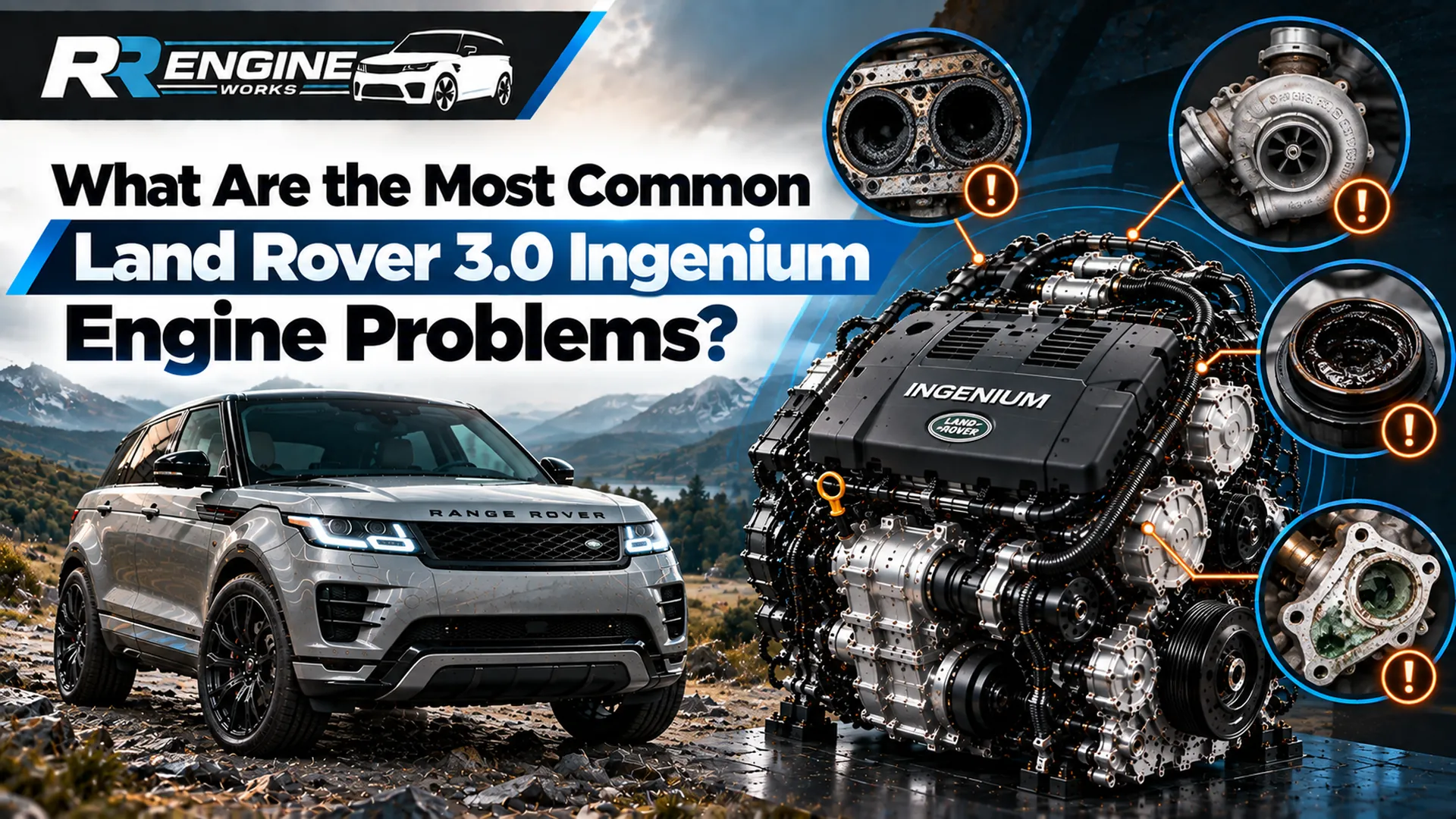
Read through any 3.0 ingenium engine problems forum thread on the Land Rover owner communities and the same few themes come up again and again. Owners describe a rattle on cold starts, an oil level that keeps creeping up, repeated DPF warnings, unexplained restricted performance messages, and mild hybrid warnings that come and go.
Those reports match what we see in the workshop. The faults below are listed roughly by how often they appear and how much damage they can do if ignored.
What Problems Affect the 3.0 Diesel Ingenium Engine (D250, D300, D350)?
Most ingenium 3.0 diesel engine problems come back to one theme: diesel emissions systems and oil condition are closely linked. When one goes wrong, the other usually follows.
Does the 3.0 Ingenium Have Timing Chain Problems?
Yes, it can. It's not as widespread as on the 2.0 Ingenium, but it's the fault with the most serious consequences, so it deserves attention.
The 3.0 Ingenium uses a timing chain with hydraulic tensioners and plastic-faced guides. It isn't meant to need routine replacement. In practice, its lifespan depends heavily on oil quality and oil pressure. Worn or diluted oil speeds up wear on the chain and guides, and a tensioner that can't hold pressure lets the chain go slack.
Typical 3.0 Ingenium timing chain failure symptoms include:
- A cold-start rattle lasting a few seconds. It sounds like a metallic chatter from the back of the engine and fades once oil pressure builds. This is often the earliest warning sign, and the one owners most often ignore because it goes away.
- Rattle that gets longer or louder over time. A noise that used to last two seconds and now lasts ten points to a tensioner or guide that's getting worse.
- Camshaft/crankshaft correlation fault codes. The engine management detects that the cam and crank timing no longer line up exactly. This can trigger a warning light or restricted performance.
- Rough running or poor starting. If the chain has stretched enough to move the timing, the engine may misfire or idle unevenly.
Here's why it matters. Like the rest of the Ingenium family, the timing drive sits at the back of the engine against the gearbox. That makes it a major job, not a quick fix under the bonnet. If a chain jumps teeth or snaps, the valves and pistons can collide, and a timing chain repair becomes an engine rebuild or replacement.
Real-world scenario: A D300 Defender used mainly for school runs develops a short rattle on cold mornings. The owner leaves it for six months because the noise always fades. By the time the car comes in, the guides have worn badly and the tensioner is at the end of its travel. It's a big repair, but caught at this stage it's still a timing chain job and not a new engine. A few more months could have turned it into a far bigger bill.
Can a 3.0 Ingenium timing chain snap? It's uncommon, but it happens, almost always after a long period of warning signs. A rattle on start-up is not something to "keep an eye on". Get it diagnosed.
Why Is the Oil Level Rising on My 3.0 Ingenium Diesel?
A rising oil level sounds like good news but it isn't. On a 3.0 Ingenium diesel it nearly always means diesel fuel is getting into the engine oil. This is called oil dilution, and it's one of the most damaging faults this engine can have, mostly because it does its damage quietly.
Here's how it happens. During active DPF regeneration, the engine management injects extra fuel late in the combustion cycle to raise exhaust temperatures and burn off soot in the filter. Some of that fuel gets past the piston rings and drains into the sump. If the regeneration finishes, most of it evaporates off. If the regeneration keeps getting interrupted because the engine is switched off, the fuel builds up in the oil.
Diesel thins the oil and weakens its protective film. That puts the parts that rely most on oil pressure at risk:
- Crankshaft and connecting rod bearings, which rely on a strong oil film to avoid metal-to-metal contact
- Timing chain tensioners, which use oil pressure to hold the chain tight
- Turbocharger bearings, which spin at extremely high speeds and need clean, correctly thick oil
Signs of oil dilution to watch for:
- Oil level above the maximum mark on the dipstick or in the electronic level reading
- Oil that smells of diesel or feels noticeably thin between your fingers
- An oil service warning appearing early. The engine management estimates dilution, and frequent early warnings are a clue.
If you've ever asked "why does my engine oil smell like diesel?", this is the answer. The fix isn't just an oil change. You need to deal with the cause, which usually means the way the vehicle is driven or a regeneration that keeps failing.
Can Short Journeys Cause DPF and Oil Dilution Problems on a D300?
Yes. Short journeys are the single biggest cause of both problems.
A DPF needs sustained exhaust heat to clean itself. On the motorway, much of this happens passively, without extra fuel. On a ten-minute town trip, the exhaust never gets hot enough. Soot builds up, the engine starts an active regeneration, and then you switch off outside the shop before it's finished. Do that several times a week and you get both a blocked DPF and diluted oil.
If your D300 or D350 mostly does short trips, a few habits make a real difference:
- Take a 20–30 minute drive at steady speed once a week to give the DPF a chance to clean itself fully.
- Don't switch off mid-regeneration where you can avoid it. Signs include a raised idle, the cooling fan running after a short trip, or a hot, acrid smell.
- Check the oil level regularly. A rising level is your early warning.
- Shorten the oil change interval. We recommend roughly every 8,000–10,000 miles or annually for short-trip cars, rather than relying only on the maximum interval.
Is a D300 suitable for short journeys only? Honestly, a petrol or plug-in hybrid suits mostly short trips better. If you love the diesel's torque and towing ability, it'll cope, provided you follow the habits above.
What Causes EGR, Turbo, Injector and AdBlue Faults on the 3.0 Ingenium?
The rest of the 3.0 diesel's common faults sit in the emissions and fuel systems. Each has its own cause, but they often trigger each other, which is why a proper diagnosis matters more than simply swapping parts.
EGR valve and EGR cooler problems. The EGR system sends some exhaust gas back into the intake to reduce NOx. Over time, soot mixed with oil vapour builds up as a hard carbon deposit, which can stick the EGR valve or block the cooler. Symptoms include poor acceleration, a rough idle, EGR fault codes and restricted performance. An EGR cooler that leaks internally can also lose coolant into the intake, so it's worth checking if your coolant level keeps dropping for no visible reason.
Turbocharger and turbo actuator faults. Turbo trouble on the 3.0 Ingenium is often down to the actuator that controls boost, not the turbo itself. A sticking actuator causes overboost or underboost codes, loss of power and limp mode. Real turbo failure is usually caused by poor oil, so oil dilution and late services increase the risk. Boost leaks from split intercooler hoses can produce similar symptoms and are much cheaper to fix, which is why a proper diagnosis matters before anyone quotes for a turbo.
Fuel injector problems. Injectors can wear or stick on high-mileage engines, or on engines that have had poor-quality fuel. Signs include a rough idle, misfire codes, a knock from one cylinder, white or black smoke and higher fuel consumption. A leaking injector also adds to oil dilution. Injector coding and balance-rate testing tell us which injector is at fault so you don't replace all six unnecessarily.
AdBlue, SCR and NOx sensor faults. The SCR system sprays AdBlue (urea) into the exhaust to break down NOx. Typical faults include failed NOx sensors, crystallised urea injectors and AdBlue heater or pump faults. These problems are usually more annoying than dangerous to the engine. But the system can count down to a no-start condition if it isn't fixed, so don't ignore an AdBlue warning.
Real-world scenario: A Range Rover Sport D300 arrives with a restricted performance message. It has already had a new NOx sensor fitted elsewhere, and the fault keeps coming back. A full diagnosis finds the real cause: a partly sticking turbo actuator was upsetting the exhaust readings, and the NOx sensor was simply reporting the knock-on effect. Fixing the actuator cleared the fault for good. That's the difference between reading the fault code and finding what's actually causing it.
What Are the Common 3.0 Ingenium Petrol Engine Problems (P360, P400, P510e)?
The good news for petrol owners is that most 3.0 ingenium petrol engine problems are less serious than the diesel's. There's no DPF, no EGR cooler and no AdBlue to worry about. The petrol straight-six is widely considered the strongest engine in the Ingenium range.
Still, 3.0 petrol ingenium engine problems do happen. The main ones are:
- Coolant leaks and cooling system faults. Plastic coolant pipes, housings and the water pump can weep or fail with age and repeated heat cycles. Watch for a slowly dropping coolant level, a sweet smell, or overheating warnings. Left alone, overheating can warp the cylinder head.
- Oil leaks. Seals and gaskets around the engine can seep as they age. Small leaks are often minor, but oil dripping onto hot exhaust parts needs attention.
- Sensor and ignition faults. Failing coils, spark plugs or sensors can cause misfires, a rough idle and a check engine light. These are usually simple repairs once they're properly diagnosed.
- Timing chain wear. The petrol shares the chain-driven layout, so the same advice applies. A cold-start rattle deserves investigation, and good oil quality is the best protection.
- Plug-in hybrid complexity (P440e and P510e). The PHEVs add a high-voltage battery, an electric motor and their own cooling circuits. Faults can come from the hybrid system and not the engine itself, so diagnosis needs equipment that reads both.
Petrol engines don't suffer diesel dilution. Fuel can still get into the oil on cars that only ever do very short, cold trips, though, so the advice on checking oil level and keeping service intervals sensible still applies.
Can 48V Mild Hybrid Faults Put a 3.0 Ingenium Into Limp Mode?
Yes, and it catches out a lot of owners. Because the mild hybrid system is closely tied into how the engine starts, charges and runs, an MHEV fault can look exactly like an engine problem.
The three main parts involved are:
- The BiSG (belt-integrated starter generator). It replaces the traditional alternator and handles smooth restarts. If it fails, you may notice charging warnings, stop-start not working, rough restarts, or squealing from the drive belt.
- The 48V lithium-ion battery. If the battery weakens or develops a fault, you'll get hybrid system warnings, and in some cases reduced power while the system protects itself.
- The DC-DC converter. This links the 48V system to the conventional 12V system. When it fails, you can get all sorts of confusing electrical warnings, flat 12V batteries and, sometimes, a no-start.
3.0 Ingenium 48V battery problems and BiSG faults are a big reason why "my Range Rover went into limp mode" doesn't automatically mean "my engine is failing". A proper diagnostic check tells the difference before anyone starts pricing an engine.
How Much Does It Cost to Fix 3.0 Ingenium Engine Problems?
The honest answer is that it depends on what's wrong and how early you catch it. An EGR clean or actuator repair costs a small fraction of a timing chain job. A timing chain job costs a fraction of a replacement engine. Acting early keeps the cost down.
Here's a general guide to how costs rise:
Problem | Typical repair | Relative cost |
| NOx sensor / AdBlue fault | Sensor or component replacement | Lower |
| Boost leak / turbo actuator | Hose or actuator repair | Lower to moderate |
| EGR valve / cooler blockage | Clean or replace | Moderate |
| DPF blockage | Forced regeneration, clean or replace | Moderate |
| Injector failure | Test, code and replace affected injectors | Moderate |
| Timing chain, tensioner and guides | Major labour (engine-out on most models) | High |
| Bearing damage / chain failure | Rebuild or replacement engine | Highest |
For questions like 3.0 Ingenium timing chain replacement cost UK, D300 engine replacement cost or D350 engine rebuild cost, we'll give you a firm quote once we've diagnosed the car. Any quote given without inspecting the engine is a guess.
What Warning Signs Mean Your 3.0 Ingenium Needs Urgent Attention?
Not every warning light means your engine is about to fail. Some do, though. Use this table to judge how urgent each symptom is:
Symptom | Likely cause | How urgent? |
| Cold-start rattle that fades | Timing chain tensioner or guide wear | High. Book a diagnosis soon |
| Oil level rising above max | Oil dilution from failed regenerations | High. Change the oil and find the cause |
| Diesel smell from the oil | Fuel contamination | High |
| Restricted performance / limp mode | Turbo, EGR, DPF, sensors, MHEV | Medium to high. Diagnose before driving far |
| DPF warning light | Soot loading, short-trip use | Medium. A long drive may clear it; if not, book in |
| Overheating / coolant loss | Coolant leak, water pump, EGR cooler | Stop driving. Risk of head damage |
| Knocking under load | Bearings, injector, or detonation | Stop driving. Get it inspected right away |
| Blue, white or black smoke | Oil burning, coolant or injector faults | Medium to high |
| Hybrid or charging warnings | BiSG, 48V battery, DC-DC converter | Medium |
| Check engine light, car drives normally | Wide range of causes | Medium. Read the codes promptly |
If your 3.0 Ingenium is in limp mode, showing a check engine light, or making a noise it didn't make before, don't keep driving it and hope the problem goes away. Many of these faults get worse with use, and some can destroy the engine.
Book a 3.0 Ingenium diagnostic check with RR Engine Works. We read the live data, not just the fault codes, so you know exactly what's wrong before you spend money on parts.
Should You Repair, Rebuild or Replace a Failed 3.0 Ingenium Engine?
If the engine has already suffered serious damage, such as a failed chain, spun bearings or major internal wear, you usually have three options. The right choice depends on how bad the damage is, the vehicle's value and how long you plan to keep it.
Option | Best when | Pros | Considerations |
| Targeted repair | Damage is limited to one system (e.g. chain caught early) | Lowest cost, keeps the original engine | Only possible if the rest of the engine is healthy |
| Engine rebuild | The block and head are reusable but internal parts are worn or damaged | Restores the original engine, addresses root causes | Takes longer; depends on parts and machining |
| Reconditioned replacement engine | Severe damage, or downtime matters | Faster turnaround, warranty-backed | Quality depends entirely on who reconditioned it |
A rebuild done properly isn't just a matter of fitting new parts. It also means finding why the engine failed in the first place, whether that's oil dilution, a failing tensioner or a blocked emissions system. If that cause isn't fixed, the same failure can happen again.
When choosing a 3.0 Ingenium reconditioned engine, ask:
- What exactly has been replaced? A proper recon includes the timing chain set, bearings, seals and gaskets, not just a clean and a test.
- What warranty comes with it? Ask what it covers, for how long, and whether it covers parts and labour.
- Was the root cause investigated? Fitting a perfect engine into a car with a faulty DPF or injector simply restarts the countdown.
Why Choose RR Engine Works for 3.0 Ingenium Repairs in Grays, Essex?
At RR Engine Works, we specialise in Land Rover and Range Rover engines. That means we see Ingenium faults every week, not now and then. That focus matters on an engine where a confusing fault code can point to five different causes.
Here's what you get with us:
- Specialist diagnostics, not guesswork. We use dealer-level equipment to read live engine data, check regeneration history and test individual parts before we recommend any work.
- Honest advice about your options. If a targeted repair will do the job, we'll say so. We only recommend a rebuild or a replacement engine when it's genuinely the right answer.
- Root-cause fixes. Every engine repair includes investigating why the failure happened, so it doesn't come back.
- Repairs, rebuilds and reconditioned engines for the D250, D300, D350 and petrol 3.0 Ingenium, all under one roof.
- A clear, warranty-backed quote before any work starts. [Insert your warranty terms here.]
[Add a genuine recent case study here, for example the symptoms a customer's D300 came in with, what you found, what you did and the outcome. Real jobs with real details are your strongest trust signal.]
You'll find us at Unit 1 Hedley Ave, Grays RM20 4EL, easy to reach from Thurrock, the wider Essex area, East London and the M25/A13 corridor.
Land Rover 3.0 Ingenium Engine FAQs
Is the 3.0 Ingenium engine reliable?
Yes, on the whole. The 3.0 Ingenium is more reliable than both the 2.0 Ingenium and the older 3.0 SDV6, and the petrol version has a particularly good reputation. Its weak points are timing chain wear, oil dilution and emissions-system faults on the diesel. Most of these can be prevented with good servicing and suitable driving habits.
How many miles will a D300 or D350 engine last?
A well-maintained D300 or D350 should comfortably pass 150,000 miles, and many will go further. The biggest factors are oil quality and change intervals, how the car is driven, and whether DPF regenerations get to finish. An engine that's had short-trip use and long oil intervals is likely to wear far sooner than one used mainly on the motorway.
Is the 3.0 Ingenium better than the 2.0 Ingenium?
Generally, yes. The six-cylinder is under less strain in heavy Land Rovers, is naturally smoother and has a stronger reliability record. The 2.0 diesel in particular is known for timing chain and oil dilution problems. If you're choosing between the two in a Discovery, Defender or Range Rover Sport, the 3.0 is usually the safer long-term choice.
Does DPF regeneration cause oil dilution on the 3.0 Ingenium?
Interrupted regenerations do. During active regeneration, extra fuel is injected to heat the DPF, and some of it reaches the sump. When regenerations finish, most of that fuel burns off. When they're repeatedly cut short by short trips, fuel builds up in the oil, thinning it and putting the bearings, timing chain and turbo at risk.
What year 3.0 Ingenium is best to buy?
Later model years benefit from software updates and running changes, so newer examples tend to be the safer buy. In reality, the individual car's history matters far more than its year. A 2021 D300 with regular oil changes and plenty of motorway miles is a better buy than a 2023 that has only ever done short runs and has gaps in its service history.
What should I check before buying a used Range Rover with a 3.0 Ingenium?
Before buying any used D300, D350 or P400, check:
- Full service history, ideally with oil changes more often than the maximum interval
- Oil level and condition. An overfull level or a diesel smell points to dilution.
- A genuinely cold start. Listen for any chain rattle, and ask the seller not to warm the engine up first.
- How it's been used. Short-trip-only use is a warning sign for diesels.
- Stored fault codes and regeneration history, read with proper diagnostic equipment
- Mild hybrid system health, including 48V battery condition and charging
For full peace of mind, a pre-purchase inspection from a Land Rover engine specialist costs far less than a timing chain job a year later.
Should I avoid buying a D300?
No. The D300 is one of the better modern Land Rover diesels and suits towing, long-distance driving and heavy use. It's a poor fit only if your driving is almost entirely short urban trips. In that case a petrol or plug-in hybrid will suit you better and save you DPF headaches.
Final Word: Catch 3.0 Ingenium Problems Early and Keep Costs Down
The pattern behind most Land Rover 3.0 Ingenium engine problems is simple. Small, cheap warnings come before big, expensive failures. A two-second rattle comes before a chain failure. A rising oil level comes before bearing damage. A sticking actuator triggers a misleading fault code that leads to the wrong parts being replaced.
The 3.0 Ingenium is a good engine, and arguably the best JLR has built in-house. It rewards owners who use quality oil, change it more often than the maximum interval, let the DPF finish its regenerations and act quickly when something changes.
If your engine is rattling, losing power, using or gaining oil, or showing warning lights, the most valuable thing you can do right now is get an accurate diagnosis.
Contact RR Engine Works today to book a specialist 3.0 Ingenium diagnostic check at our Grays workshop. You'll get a clear explanation of what's wrong, honest advice on your options and a fixed quote before any work begins. Whether it's an early fix or a full rebuild, your Land Rover will be in specialist hands.
📍 RR Engine Works, Unit 1 Hedley Ave, Grays RM20 4EL