
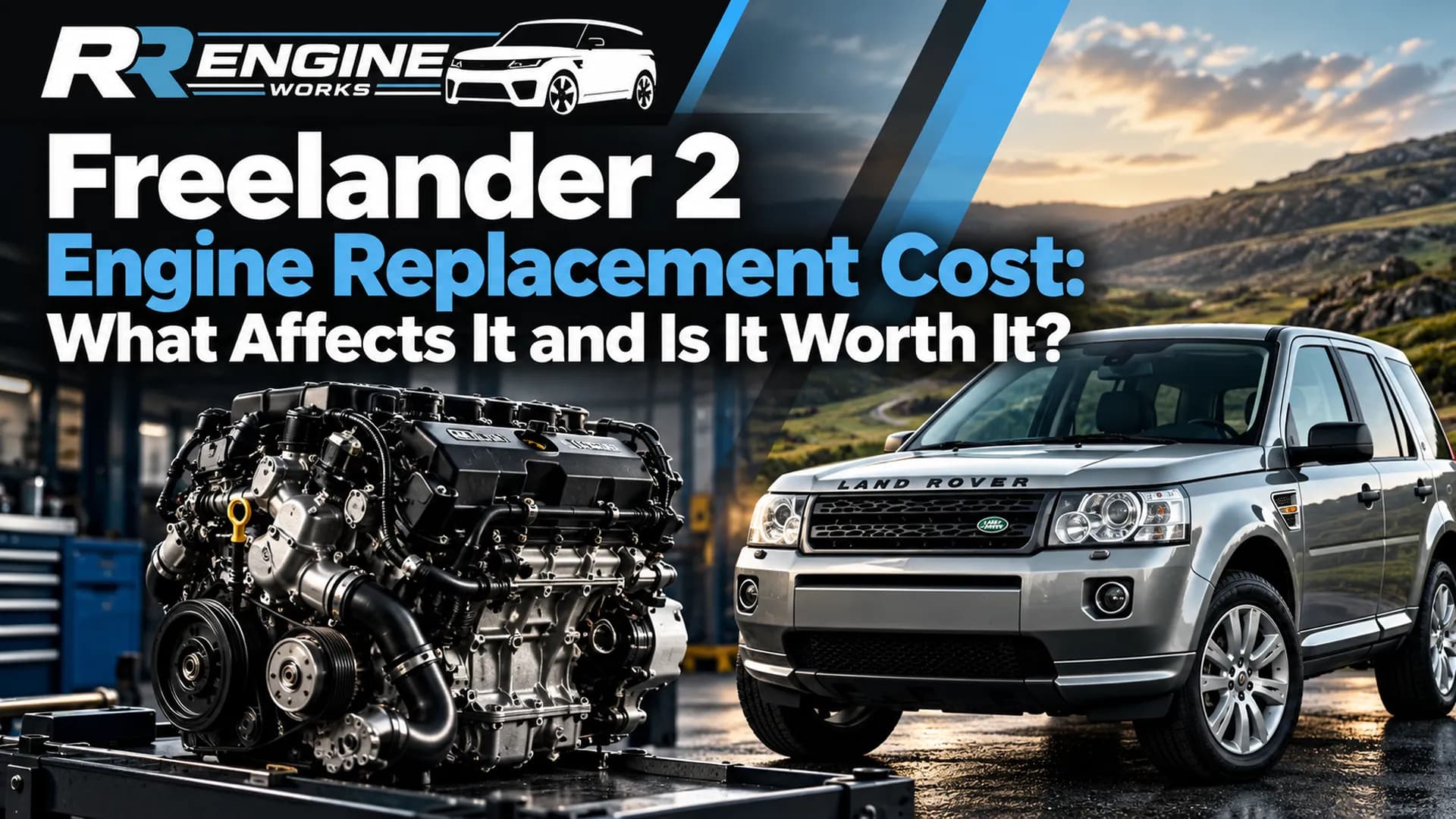
Freelander 2 engine replacement cost depends on which engine your car has, whether the replacement is used, reconditioned or rebuilt, the labour and parts involved, and the cause of the original failure. With every Freelander 2 now at least 12 years old, the car's overall value and condition matter as much as the engine. Sometimes a full replacement isn't needed at all. Valve damage after a timing belt failure, for example, can sometimes be repaired in the cylinder head. This guide explains how to decide, what moves the price and what an itemised written quote should include.
Your Engine and Why It Failed
Freelander 2 Engines
Engine | Fuel | Approx. years | Notes |
| 2.2 TD4 / SD4 / eD4 (224DT) | Diesel | 2006–2014 | By far the most common UK engine. Uses a timing belt |
| 3.2 i6 (SI6) | Petrol | 2006–2011 | Volvo-sourced straight-six. Less common |
| 2.0 Si4 | Petrol | 2012–2014 | Turbocharged four-cylinder. Rare in the UK |
The years are approximate. Our Land Rover 2.2 diesel engine page covers the 224DT in its 150 hp and 190 hp versions.
Common Reasons a Freelander 2 Engine Fails
Knowing why the engine failed tells you whether replacement is really necessary and what must be fixed so it doesn't happen again:
- Timing belt failure. The 2.2 diesel uses a timing belt. If it fails, the valves can hit the pistons. Depending on the damage, this can mean a cylinder head repair or a full replacement.
- Injector problems. Specialists report injector faults on the 224DT. Left untreated, a leaking injector can wash the oil off a cylinder bore and damage the engine.
- DPF and oil dilution. Short-trip use can block the DPF and dilute the oil with diesel, which weakens lubrication.
- Turbo failure. A failing turbo can send debris or oil into the engine.
- Overheating. Coolant leaks or a failed water pump can cause head or gasket damage.
One important check: specialists note that Haldex and rear differential wear on the Freelander 2 can be mistaken for engine trouble. Make sure the diagnosis confirms that the engine really is the problem before you pay for one.
What Decides the Cost
The Main Cost Factors
Factor | Why it changes the price |
| Engine type | The 2.2 diesel, 3.2 i6 and 2.0 Si4 use different units and parts |
| Unit type | Used engines are fitted as found, reconditioned units are prepared and tested, and a rebuild keeps your own engine |
| Damage extent | Head-only damage is very different from bottom-end damage |
| Labour | Removal, fitting and transfer of ancillaries |
| Timing belt kit and water pump | Usually renewed at fitting on the 2.2 diesel |
| Turbo, injectors and DPF | May need checking or replacing if they caused or were affected by the failure |
| Cooling system | Radiator, hoses and thermostat on an older car |
| Coding | Engine control matched to the car |
| Recovery | A non-running car has to reach the workshop |
Our engine replacement service confirms the engine has failed, then sources a unit and checks its compatibility, fits it, tests it and hands the car back with warranty documents.
Repair, Rebuild or Replace?
The right route depends on the damage and on the car:
- Repair. If the damage is limited, for example bent valves after a belt failure with the pistons and bottom end intact, a cylinder head repair may be enough. An inspection with photos and a written report should confirm this.
- Rebuild. If the block and crank are sound but internal parts are worn, rebuilding your own engine keeps its original number. See our engine rebuild service.
- Replace. This suits an engine damaged beyond economical repair, or a case where downtime matters.
Then compare the total with the car's value and condition. Check the body, gearbox, Haldex and rear differential, suspension and electrics. Also check for open recalls on the GOV.UK vehicle recall checker before you commit.
What Your Written Quote Should Show
- Diagnosis: what failed and why, with photos where possible
- Route: repair, rebuild or replacement, and the reason
- Engine: the exact engine code, and whether the unit is used, reconditioned or rebuilt
- Unit history: mileage and source, or the parts replaced
- Labour: removal, fitting and transfer of ancillaries
- Timing belt kit and water pump: included or not
- Turbo, injectors and DPF: checked, cleaned or replaced
- Cooling system and consumables: radiator, hoses, oil, filters and coolant
- Coding and testing: ECU matching and road test
- Extras: how further faults will be approved before any work goes ahead
- Warranty: the written terms, including mileage and conditions
For an inspection and an itemised quote, contact the team or call 01708 592377.
FAQs
Freelander 2 Engine Replacement FAQs
Is it worth replacing the engine in a Freelander 2?
It can be, if the body, gearbox, Haldex and suspension are sound and you plan to keep the car. Compare the full quote with the car's value before deciding.
Why don't you give a fixed price for a Freelander 2 engine replacement?
The cost depends on the engine, the replacement unit, the damage and the parts needed. An itemised quote after diagnosis is the reliable way to find your cost.
My Freelander 2 timing belt snapped. Do I need a new engine?
Not always. Bent valves can sometimes be repaired in the cylinder head if the pistons and bottom end are undamaged. An inspection decides it.
Can Haldex problems be mistaken for engine faults?
Yes. Specialists note that Haldex and rear differential wear can be misread as engine trouble. Make sure the diagnosis confirms the engine is at fault.
How long does a Freelander 2 engine replacement take?
It depends on sourcing the right unit and on what the inspection finds. Ask for an estimated timescale in your written quote.