

You're pulling away from a junction when the dash flashes a warning, the power drops off, and the car refuses to rev past a certain point. You plug in a reader and it shows P2263. Now you're wondering whether this is a ten-pound hose or a four-figure turbo.
The Range Rover P2263 fault code points to a turbo/supercharger boost system performance problem. In plain terms, the engine isn't getting the boost pressure the ECU expects. It shows up most often on diesel Evoque, Discovery 4 and Freelander 2 models, and it very often sends the car into limp mode.
At RR Engine Works in Grays, Essex, we see this code on Land Rover engines regularly. This guide explains what it means, what causes it, how to diagnose it in the right order, and how to fix it without paying for parts you don't need.
What Does the Range Rover P2263 Fault Code Mean and How Serious Is It?
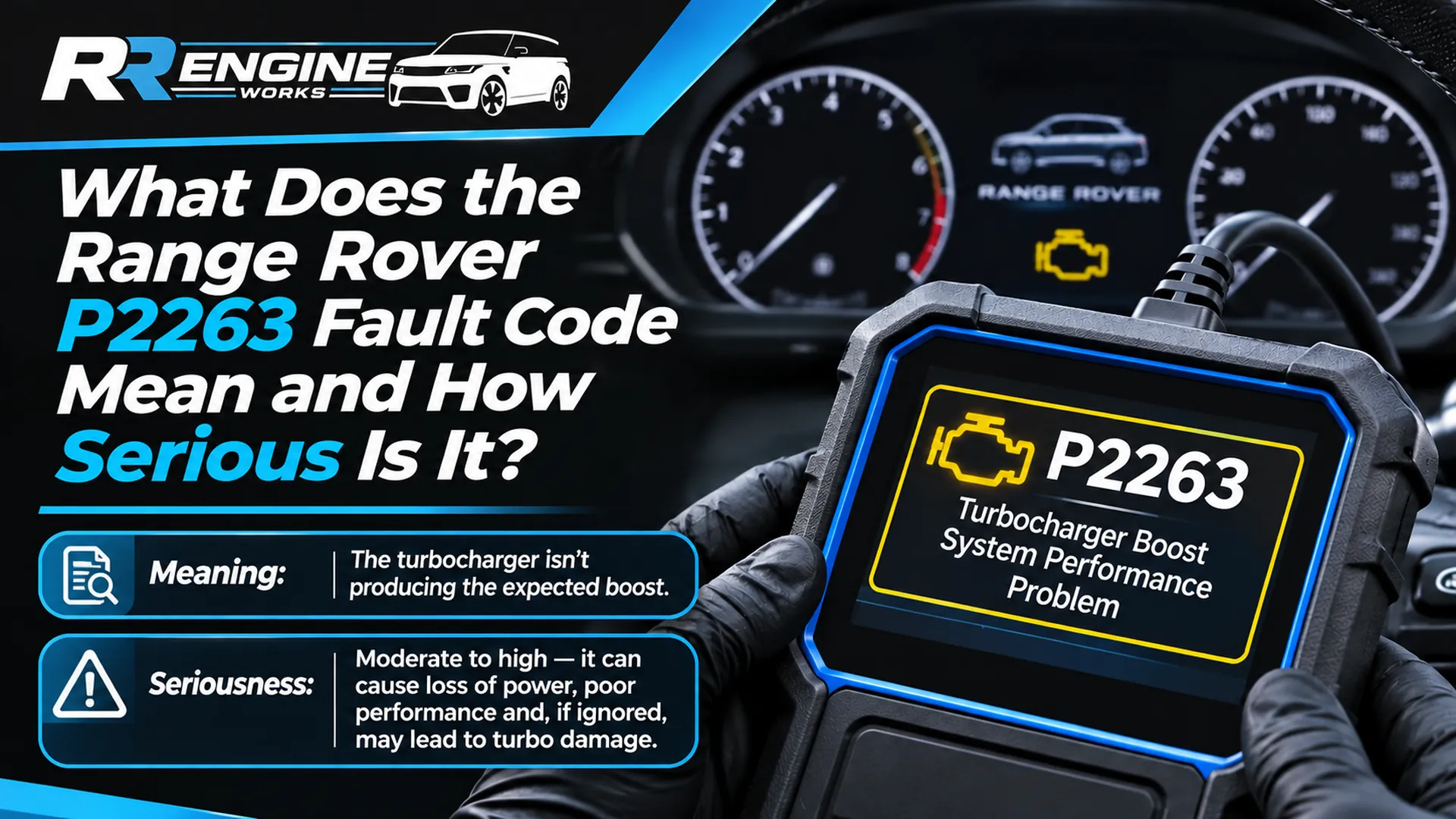
P2263 is defined as turbo/supercharger boost system performance. The ECU compares the boost pressure it asks for with the pressure the sensor reports. When the two don't match for long enough, it logs the code and cuts power to protect the engine.
The same Land Rover fault code P2263 is generic, so it isn't unique to Range Rover. It also appears on other makes. You'll find owners searching for fault code P2263 on a Ford Mondeo, for example, because the base definition is shared. The fix, though, depends entirely on the platform.
How serious is it? Treat it as urgent but not always an emergency. A small boost leak can let you limp home. A failing turbo can destroy itself, or send oil into the intake, if you keep driving. If the car is in limp mode, smoking, or making a loud whistling or grinding noise, stop and get it checked.
Common symptoms include:
- Limp mode or reduced power, often with an "engine performance reduced" message
- Sluggish acceleration, especially going uphill or overtaking
- Black or grey smoke from the exhaust
- Whistling, hissing or siren-like noise under load
- Engine warning light, sometimes with a DPF or EGR light as well
- Worse fuel economy than usual
Notice that the code describes a performance problem, not a named broken part. That's why the cause can be anything from a split hose to a worn turbo, and why guessing gets expensive.
Which Land Rover Models Show P2263-21 or P2263-22, and What Do the Suffixes Mean?
On Land Rover vehicles you'll often see the code with a two-digit suffix, such as P2263-21. That suffix is a sub-fault byte. It gives the ECU's extra detail about the type of failure behind the main code, so it's worth writing down exactly what your scanner displays.
Here's how it commonly appears across the range:
Model | Typical engine | Code you may see | What to know |
| Range Rover Evoque | 2.2 diesel | P2263-21 | Frequently linked to boost control, actuator or leak faults |
| Land Rover Discovery 4 | 3.0 diesel V6 | P2263-22 | Often seen alongside boost pressure or turbo control concerns |
| Freelander 2 | 2.2 diesel | P2263-21 | Common on high-mileage cars, with leaks and actuator faults high on the list |
| Range Rover Sport and Range Rover | 3.0 / 4.4 diesel | P2263 variants | Check for related turbo, sensor and air-system codes |
Treat this table as a guide, not a verdict. Suffix meanings can vary by software and model year, and the right answer always comes from live data on your own vehicle.
What Causes the P2263 Code on a Range Rover, and How Do You Diagnose It?
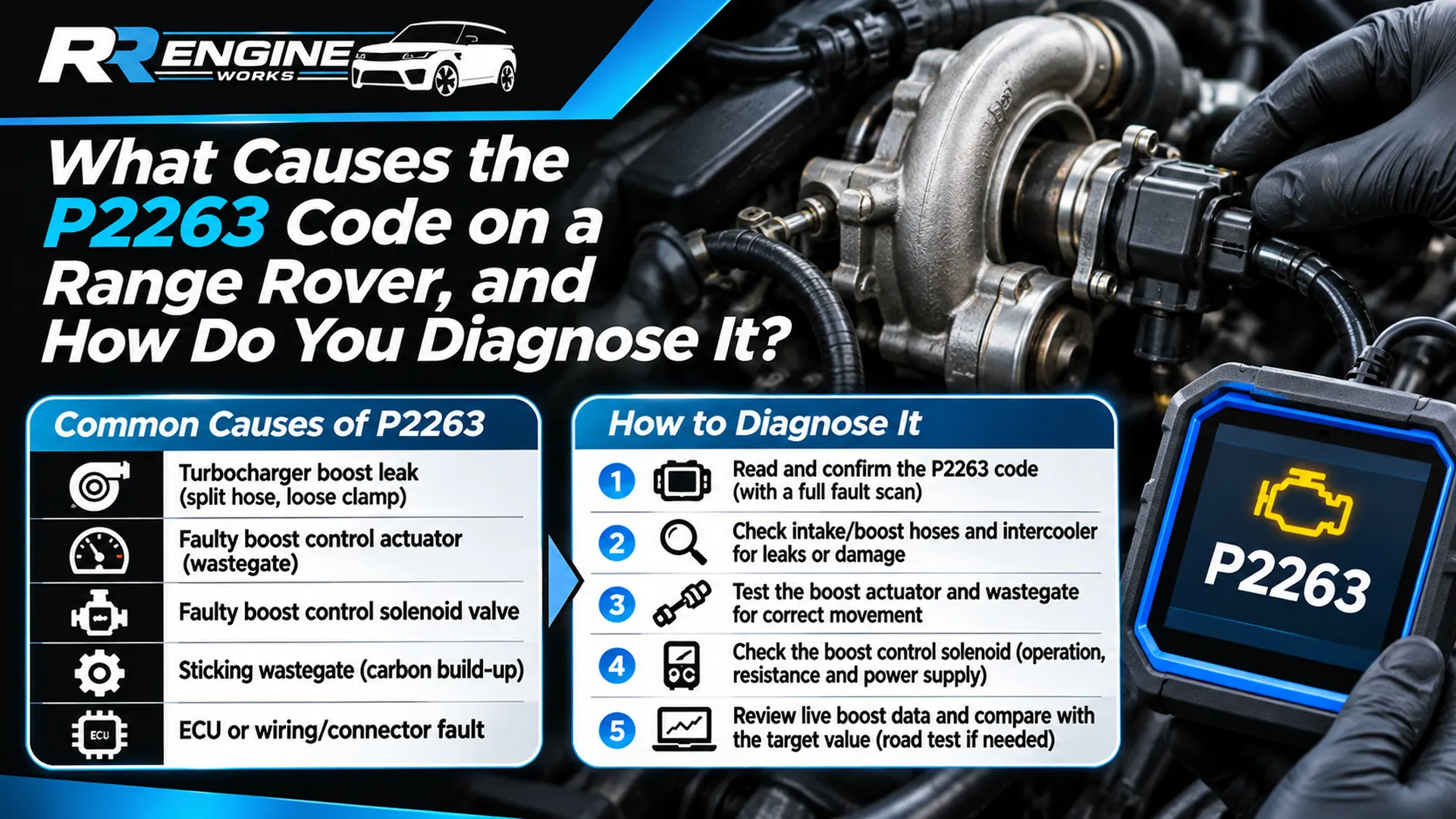
Based on what comes through our workshop, the causes tend to follow a predictable order of frequency. Start with the cheap and common, and work towards the expensive.
The most likely causes are:
- Boost leaks. Split intercooler hoses, cracked pipes and loose or perished clips are the single most common culprit.
- Turbo actuator or vane faults. On variable geometry turbos, sticking vanes or a failing actuator stop the turbo reaching target boost.
- Blocked DPF or restricted exhaust. Excess back pressure stops the turbo spooling properly.
- Sticking or clogged EGR valve. Carbon build-up upsets airflow and boost control.
- Faulty boost, MAF or intake sensors. The turbo may be fine, but the ECU is reading bad data.
- Vacuum line or solenoid faults. Cracked vacuum pipes or a failed control solenoid can prevent proper actuation.
- Worn or damaged turbo. Bearing wear, shaft play or damaged blades come last, and they're the most costly.
Because the first three or four causes are far cheaper than a new turbo, replacing the turbo first is one of the most common and most expensive mistakes we see.
How Do You Diagnose a Range Rover P2263 Fault Code Step by Step?
A basic code reader will tell you the code exists. It won't tell you why. A proper diagnosis follows a sequence from cheapest and quickest to most involved.
- Read all stored and pending codes. Look for related codes, not just P2263.
- Check live data. Compare requested boost against actual boost under load.
- Inspect all intake and intercooler pipework. Look for splits, oil residue, loose clips and damaged connectors.
- Smoke-test the intake. This finds leaks you can't see by eye.
- Test the turbo actuator and vacuum system. Check movement, response and supply.
- Check the EGR valve and DPF condition. Look at pressure readings and blockage.
- Inspect the turbo itself. Check for shaft play, oil in the pipes and visible damage.
Related codes worth checking alongside P2263 include other boost, MAF, EGR and DPF faults. If you're searching for a Range Rover fault codes list, treat any such list as a starting point. A code points to a system, and the real fault still needs confirming with live testing.
Is It the Turbo, or Something Cheaper? How Can You Tell?
Here's the key question owners ask us. The honest answer is that you can often tell with the right tests, and you shouldn't commit to a new turbo until you have.
Signs pointing to a leak or sensor fault:
- Hissing under acceleration
- Oily residue around hose joints
- Boost that builds, then drops
- A turbo that spins freely with no play
Signs pointing to the turbo itself:
- A loud siren-like whine or grinding
- Blue or heavy smoke with oil consumption
- Visible shaft play
- Oil in the intercooler pipework
A typical scenario: an Evoque arrives in limp mode with P2263-21 and the owner has been quoted for a new turbo. A smoke test finds a split in the intercooler hose. The repair takes a fraction of the cost and the car drives normally again. That's why diagnosis comes before parts.
How Do You Fix and Reset a Range Rover P2263 Fault Code?
The fix depends on the cause, so there's no single answer to how do I fix error code P2263. The right repair is whichever one the diagnosis supports.
Typical repairs include:
- Replacing split hoses and refitting or renewing clips
- Cleaning or replacing the EGR valve
- Repairing or replacing the turbo actuator
- Clearing a blocked DPF through regeneration or professional cleaning
- Replacing faulty sensors or vacuum components
- Repairing or replacing the turbo as a last step
Can You Reset a P2263 Code Yourself, and Will It Come Back?
You can clear the code with a compatible scan tool. For Range Rover P2263 fault code reset, the tool wipes the stored fault and the warning clears for a short time. But a reset doesn't fix anything. If the cause is still there, the code returns, often within a few miles.
There's another risk. Clearing the code and carrying on can hide a developing turbo problem and turn a small repair into a major one.
Here's how DIY compares with professional work:
Task | DIY realistic? | Professional recommended? |
| Tightening or replacing a visible hose clip | Often yes | Not always necessary |
| Replacing an accessible intercooler hose | Sometimes | If access is difficult |
| Smoke testing the intake | No, needs equipment | Yes |
| Reading live boost data | Only with a capable tool | Yes |
| EGR or DPF work | Rarely | Yes |
| Turbo repair or replacement | No | Yes |
As a rough guide, hose and clip repairs usually cost far less than actuator work, and turbo replacement costs the most. Always get a written quote after diagnosis, because the actual figure depends on the model and the fault.
For a Range Rover P2263 fault code fix that holds, the sequence is simple: diagnose, repair the confirmed cause, then clear the code and road test.
Who Can Fix a Range Rover P2263 Code Properly Near Me?
If you're searching for a specialist, look for someone who diagnoses before replacing parts, explains findings in plain language, and puts the quote in writing.
RR Engine Works is an independent engine specialist in Grays, Essex. We aren't Land Rover and we aren't a main dealer, which means our advice is based on what the vehicle needs, not on a parts-replacement policy.
What you get from us:
- Proper diagnostics that go beyond reading a code
- Experience across Land Rover models, including Evoque, Discovery 4, Freelander 2 and Range Rover Sport
- Clear written findings you can keep for your records
- Turbo repair and replacement options, with the trade-offs explained
- A quote before any work starts
You'll find us at Unit 1 Hedley Ave, Grays RM20 4EL, with easy access from Thurrock, Essex and the M25 corridor.
If your Range Rover is showing P2263 or going into limp mode, book a diagnostic check with RR Engine Works and get a clear answer before you spend on parts.
Range Rover P2263 Fault Code FAQs
Can I drive with a P2263 code?
Short, gentle trips may be possible if the car is running normally, but it's risky. In limp mode, or with smoke or noise, stop driving. Continued use can cause turbo damage.
How do I fix error code P2263?
Diagnose the cause first. Check for boost leaks, then the actuator, EGR, DPF and sensors, and only then the turbo. Clearing the code alone won't fix it.
What does P2263 mean on a Land Rover?
It means turbo/supercharger boost system performance. The ECU has detected that actual boost doesn't match the requested boost.
What does P2263-21 mean on an Evoque or Freelander 2?
The suffix gives the ECU's extra detail about the type of boost fault. Exact meaning varies by software and model, so confirm it with live data.
Will clearing the code fix the problem?
No. It clears the warning temporarily. If the underlying fault remains, the code comes back.
Is P2263 a turbo fault?
Not always. Leaks, sensors, vacuum faults, EGR and DPF issues are all more common than a failed turbo.
How much does it cost to fix P2263 on a Range Rover?
It ranges from a modest hose repair to a significant turbo replacement. A written quote after diagnosis is the only reliable figure.
Does P2263 appear on other cars, such as a Ford Mondeo?
Yes. It's a generic code, but the cause and fix are platform-specific.
Get Your Range Rover Back to Full Power
A Range Rover P2263 fault code is rarely as bad as the first quote suggests, and rarely as harmless as a quick reset implies. The right approach is to diagnose in order, fix the confirmed cause, and avoid replacing the turbo until it's proven to be the problem.
If your car is in limp mode or showing P2263, contact RR Engine Works in Grays, Essex for a proper diagnosis and a clear written quote.