
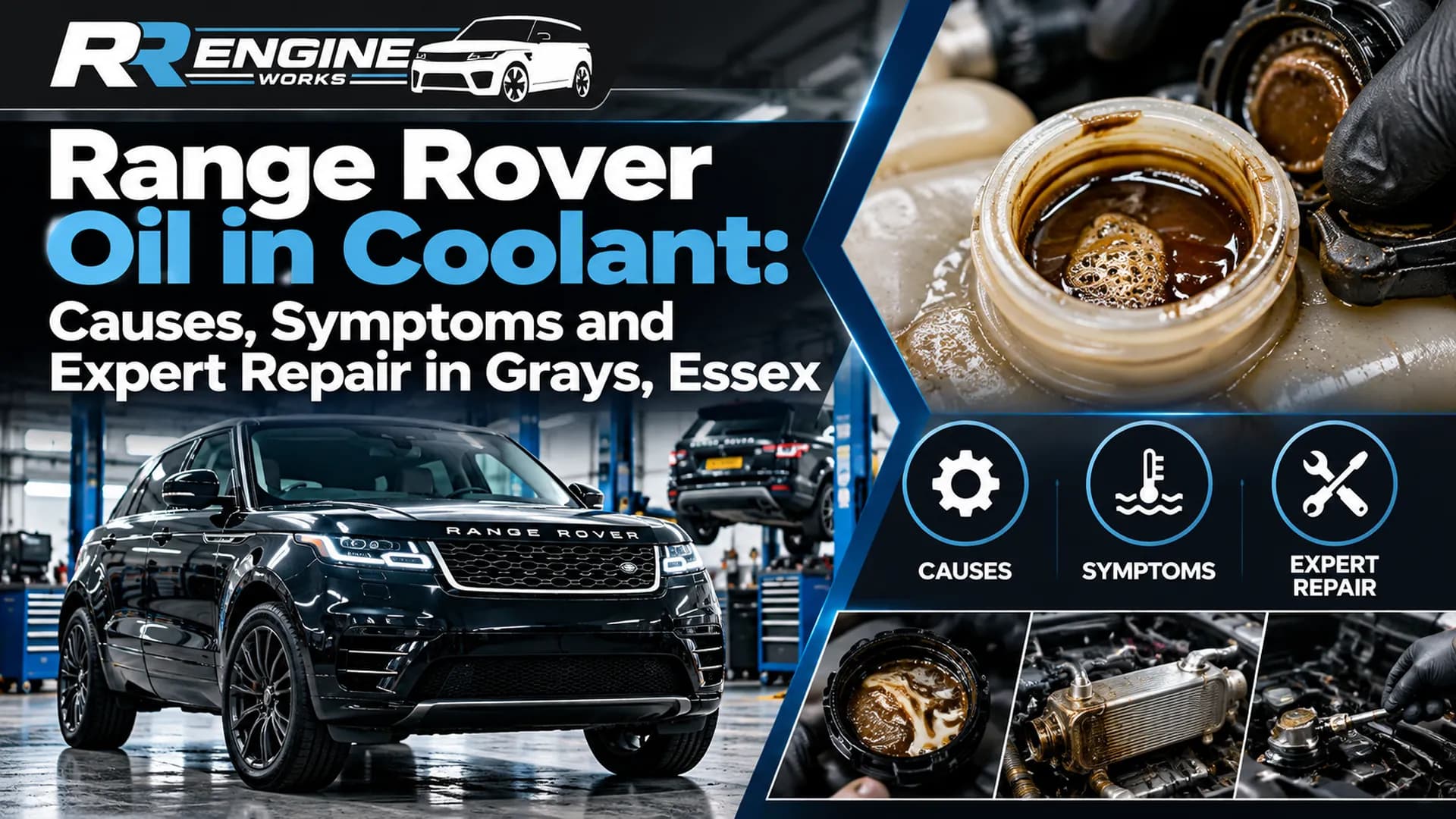
You open the bonnet, check the expansion tank, and the coolant looks wrong. It's brown, milky, or has a greasy film floating on top. That sinking feeling is justified.
Range Rover oil in coolant means oil and coolant are mixing somewhere inside the engine. It rarely fixes itself, and it usually gets more expensive the longer it's left. At RR Engine Works in Grays, Essex, we see this fault regularly on Range Rover, Range Rover Sport and Evoque engines. This guide explains what's happening, how serious it is, and what a proper repair involves.
Why Is There Oil in My Range Rover Coolant and What Does It Indicate?
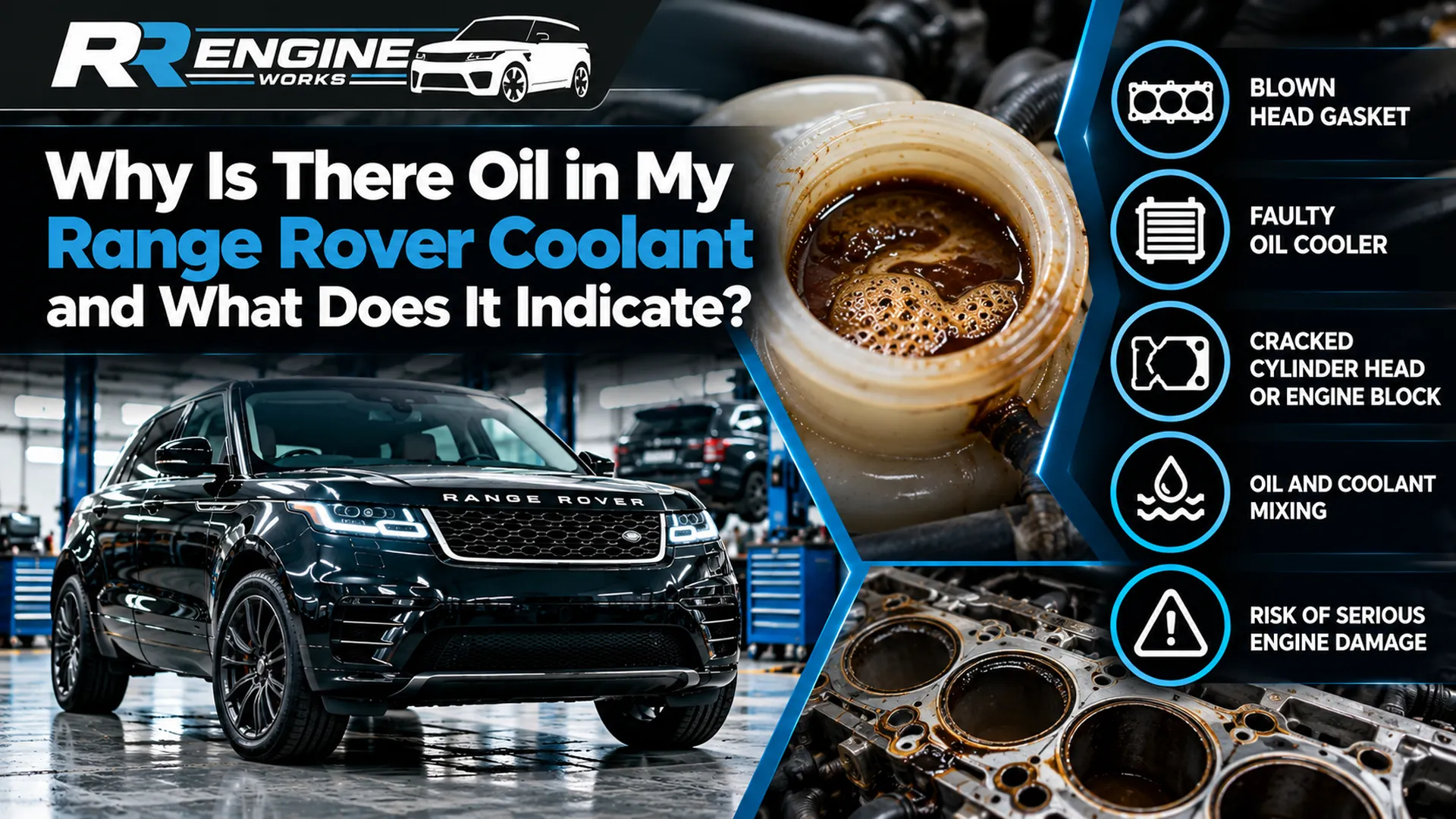
Oil and coolant run through separate passages and should never meet. When they do, a seal, gasket or component between them has failed. The key is finding out which one.
What Does Oil in Coolant Indicate on a Range Rover Sport, Evoque or 4.4 TDV8?
The usual culprits, from most to least common, are:
- A failed oil cooler or its seals. The oil cooler (heat exchanger) uses coolant to carry heat away from the engine oil. If the internal core or seals leak, oil moves into the coolant circuit.
- A blown head gasket. This lets oil, coolant and combustion pressure cross between passages.
- A cracked cylinder head, liner or block. This is less common but more serious, and it usually follows overheating.
Here is how this tends to look across popular models:
Model | Common cause we investigate first | Typical early clue |
| Range Rover Sport (diesel) | Oil cooler or seal leak | Oily film in expansion tank |
| Range Rover Evoque | Oil cooler, then head gasket | Slowly dropping coolant level |
| Range Rover 4.4 TDV8 | Oil cooler and heat exchanger area | Brown sludge under the filler cap |
Every engine is different, so treat this as a starting point rather than a diagnosis. A pressure test is the only way to confirm the real cause.
What Are the Range Rover Oil in Coolant Symptoms, and Can It Happen Without Overheating?
Yes, it can. This is where many owners get caught out. In the early stages, Range Rover oil in coolant but not overheating is quite common, because the cooling system still works well enough to keep temperatures normal.
Watch for these warning signs:
- Milky, tan or chocolate-coloured residue under the oil filler cap
- A dark, oily film on the coolant in the expansion tank
- Coolant level dropping with no visible external leak
- White smoke from the exhaust, especially on start-up
- Temperature warnings or heater output that fades
- Oil that looks thin, frothy or increasing in level
You may also see oil in radiator water, which is the same fault showing up at the radiator end of the system. If you spot even one of these, don't wait for the temperature gauge to react. By then the damage is usually well underway.
What Happens If You Keep Driving With Oil in Your Range Rover Coolant?
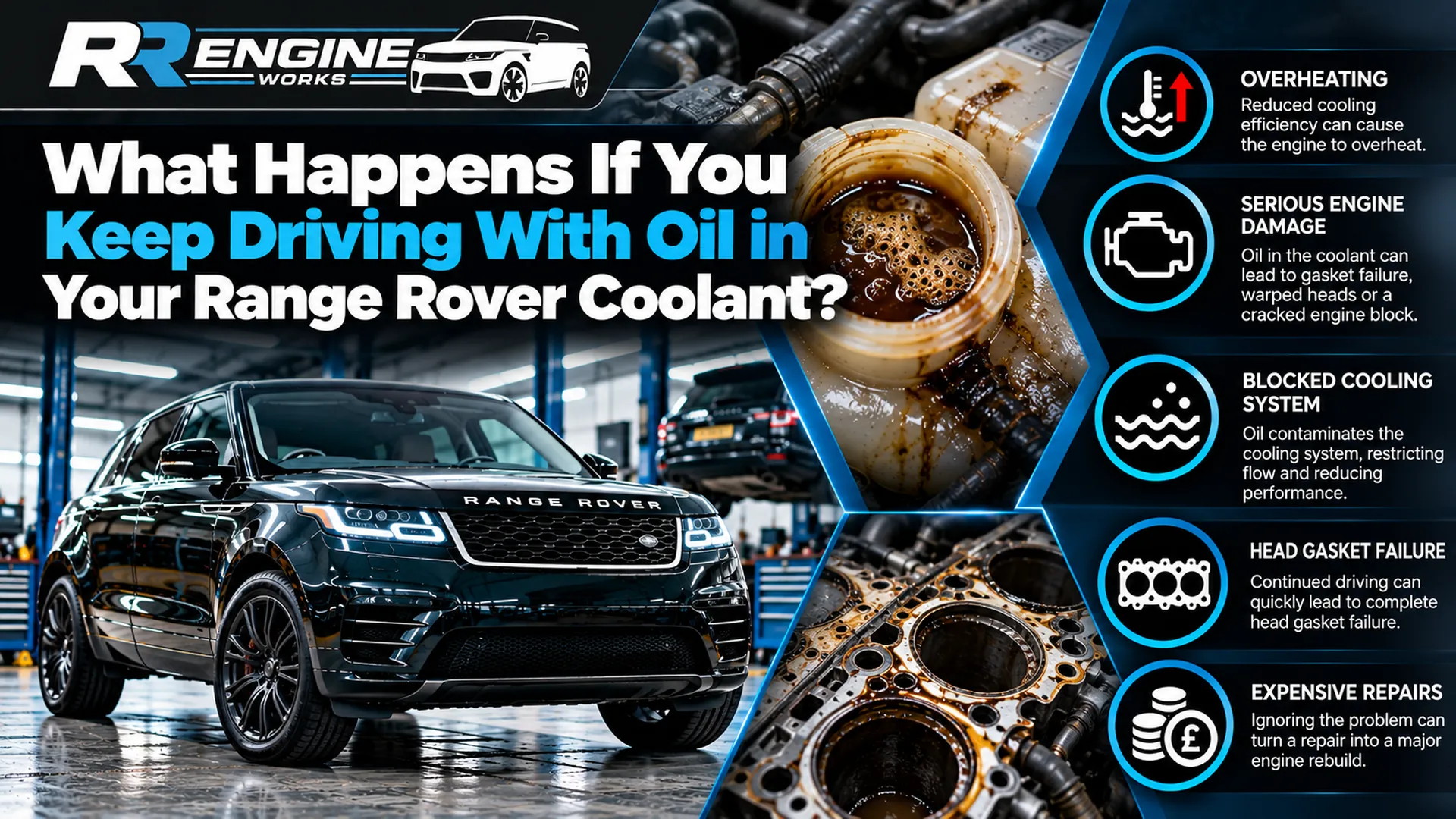
Short answer: it gets worse, and it gets expensive. Oil in the cooling system and coolant in the oil are two sides of the same problem, and both harm the engine.
How Long Can a Range Rover Run With Oil in the Coolant?
There's no safe mileage. Some cars cover a few hundred miles before showing symptoms. Others fail within days, and that's why we give a straight answer: don't keep driving it.
Stop and get it recovered if you see any of the following:
- The temperature gauge climbs or a warning light appears
- Oil pressure warnings show on the dash
- The coolant level drops sharply
- You notice a milky mixture on the dipstick
A common scenario: an owner notices a slightly oily expansion tank, tops it up and carries on for a few weeks. Eventually the coolant thins the oil, the bearings suffer, and a repair that would have meant replacing an oil cooler turns into an engine rebuild. Catching it early often decides which of those you pay for.
What Engine Problems Does Oil in Coolant Cause If Left Unrepaired?
Here's what range rover oil in coolant problems look like as they progress:
- Contaminated oil loses its lubrication. Coolant mixed into the oil breaks down its protective film.
- Bearings and turbo wear faster. Diluted oil can't protect fast-moving parts.
- The cooling system clogs. Oil sludge blocks the radiator, heater matrix and small passages.
- Overheating follows. Reduced cooling can warp the head or crack the block.
- Repair costs climb. What started as a single component becomes a major engine job.
Acting at step one is almost always the cheaper option.
How Do You Fix Oil in Coolant on a Range Rover, and Who Can Do It Near Grays?
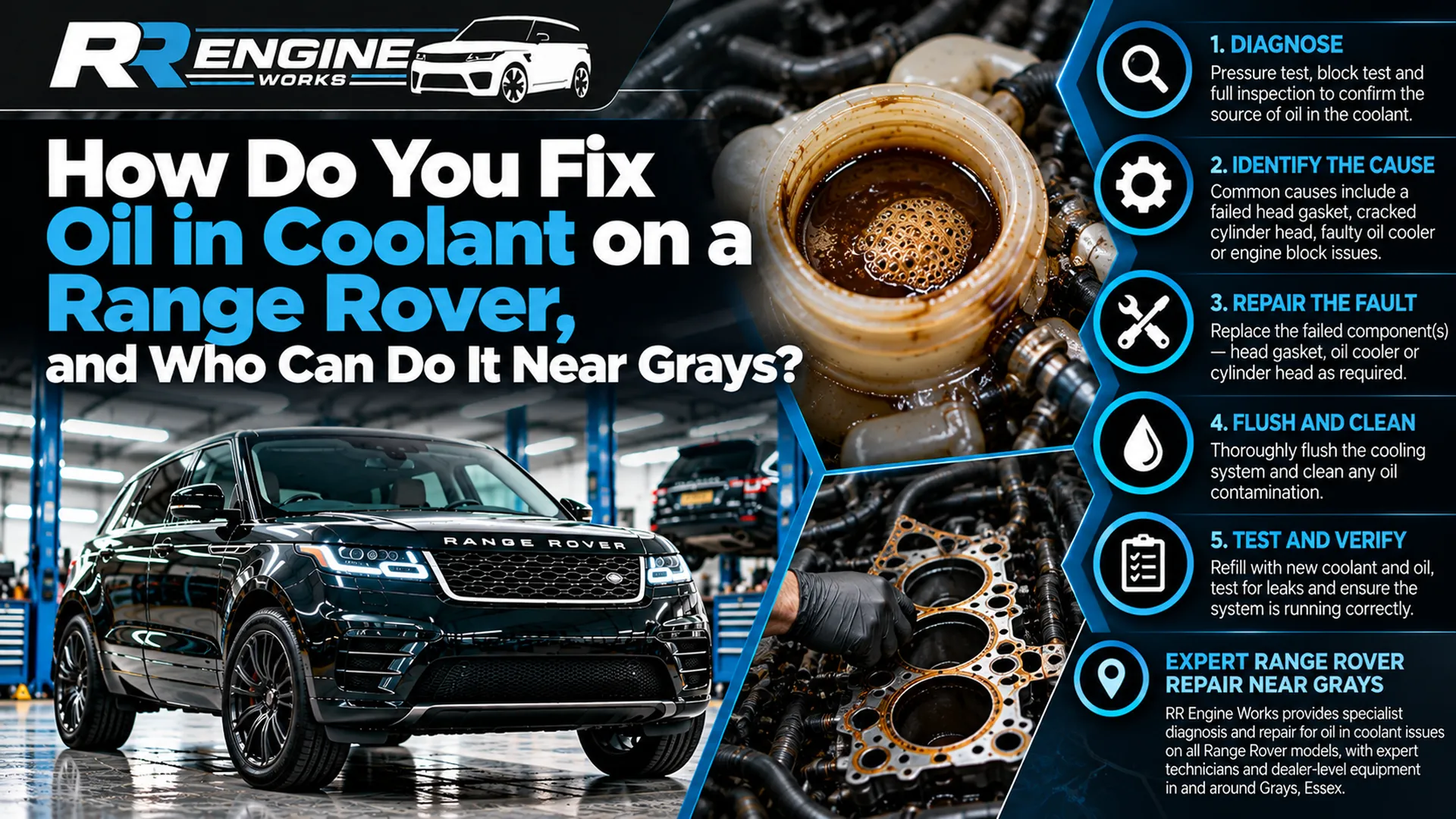
Fixing it properly means finding the true cause, not just clearing the symptom. Draining and refilling the coolant without a diagnosis is a common mistake, and the contamination returns within days.
How Does RR Engine Works Diagnose and Repair Oil in Coolant?
Our process for range rover coolant repair follows a clear order:
- Inspection and pressure test. We check the cooling system for leaks and pressure loss.
- Oil cooler and seal check. We test the oil cooler first, since it's the most common source.
- Further checks if needed. If the cooler is clean, we look at the head gasket, liners and cylinder head.
- Full system flush. We remove all oil residue from the radiator, hoses and heater matrix.
- Parts replacement. This usually means range rover oil cooler replacement, new seals and fresh fluids.
- Retest. We pressure test again and road test before handing the car back.
You'll get a clear explanation of what failed and a quote before any major work starts.
Based in Grays? You'll find us at Unit 1, Hedley Ave, Grays RM20 4EL, with easy access from the A13 and M25. Call or WhatsApp us to book a diagnostic, or send your model and year through our contact form for a quote.
What Kind of Coolant Goes in a Range Rover After the Repair?
Range Rovers use an OAT-type (organic acid technology) coolant, normally mixed with demineralised water. The exact specification can differ by model and year, so check your handbook or ask us before topping up.
Avoid mixing different coolant types. Doing so can cause gelling and sludge, which only creates new problems. If you're unsure, tell us your model and year and we'll confirm the correct coolant.
Frequently Asked Questions
Why is there oil in my coolant?
A seal, gasket or component separating oil and coolant has failed. On a Range Rover, the oil cooler is the first thing to check, followed by the head gasket.
What happens if you get oil in your coolant?
Oil clogs the cooling system and reduces its ability to cool the engine. If the oil is contaminated in return, bearings and other moving parts wear faster. Left alone, it can lead to engine failure.
What does oil in coolant indicate?
It points to an internal leak. The cause can be an oil cooler, a head gasket or a cracked component, and only testing will tell you which.
Can I drive a Range Rover with oil in the coolant?
We don't recommend it. Even if the car feels normal, damage can build up quickly.
How much does it cost to fix?
It depends on the cause. An oil cooler job costs far less than an engine rebuild, so early diagnosis matters. Contact us for a quote based on your model.
Do you work on the Range Rover Sport, Evoque and 4.4 TDV8?
Yes. We handle all of them, along with other Range Rover and Land Rover models.
Don't Let a Small Leak Become an Engine Rebuild
Range Rover oil in coolant is one of those faults where speed matters. A quick diagnosis can mean a straightforward oil cooler replacement. A long delay can mean a damaged engine.
If you've spotted oily coolant, milky residue or an unexplained drop in coolant level, get it checked. RR Engine Works, Unit 1, Hedley Ave, Grays RM20 4EL, can diagnose it properly, explain the options plainly and get you back on the road with confidence.