
If your Range Rover's engine warning light has just come on, or a garage has already delivered the dreaded news, "it needs a new engine", you're probably sitting there wondering two things: how much is this actually going to cost, and is it even worth doing.
You're not alone. Range Rover owners searching for engine replacement costs are usually in one of two situations: they've had a diagnostic come back grim, or they're trying to plan ahead before things get worse. Either way, you need real numbers, not vague ranges buried in a sales pitch.
This guide breaks down exactly what a Range Rover engine replacement costs in the UK, what affects that price, and how to work out whether replacement is genuinely your best option. We'll cover pricing by model, by engine type, by replacement method, and the extra costs that catch people out. No guesswork, no inflated dealer quotes disguised as "averages."
How Much Does a Range Rover Engine Replacement Cost in the UK?
There's no single honest answer to "how much does a Range Rover engine replacement cost", and any page that gives you one flat figure isn't being straight with you. The real cost depends on your model, your engine code, the age of the vehicle, and whether you're going with a used, reconditioned, rebuilt, or new OEM unit.
That said, here's what UK specialists are typically charging in 2026, fully fitted:
Replacement Type | Typical Fitted Cost | Notes |
| Used engine | £2,800 – £4,500 | Lowest upfront cost, shortest warranty, mileage/history unverified |
| Reconditioned engine | £3,500 – £6,500 | Most popular choice, tested, rebuilt to spec, decent warranty |
| Rebuilt engine (your own block) | £3,200 – £6,000 | Keeps your original engine number, good for provenance-sensitive owners |
| New OEM engine | £7,000 – £12,000+ | Dealer-sourced, full manufacturer warranty, highest cost |
These figures assume supply and fit together. If you're only buying the engine itself and arranging fitting separately, expect the engine cost alone to sit roughly 40-60% lower, but factor in labour, which we'll break down further on.
Average Range Rover Engine Replacement Cost by Model
Not every Range Rover costs the same to fix. Newer models with more complex electronics, tighter engine bays, and stricter ECU pairing requirements generally cost more in labour, even when the engine itself is similarly priced.
Range Rover Sport Engine Replacement Cost
The Range Rover Sport, particularly L494 and L461 generations, typically sits at the higher end of the pricing scale. Expect fitted costs of £4,000 to £8,500, depending on whether you're running a 3.0 SDV6, 4.4 SDV8, or the newer Ingenium units. The Sport's engine bay layout and additional electronics (air suspension linkages, terrain response sensors) tend to add labour hours compared with the standard Range Rover.
Range Rover Evoque Engine Replacement Cost
Evoque owners generally pay less, largely because the 2.0 Ingenium petrol and diesel engines are more compact and less labour-intensive to remove and refit. Fitted replacement costs usually range from £2,800 to £5,500. Early Evoques with the Ford-sourced 2.2 diesel can sometimes be cheaper still, though parts availability is starting to narrow.
Range Rover Velar Engine Replacement Cost
The Velar, built almost exclusively on Ingenium petrol and diesel platforms, sits in a similar bracket to the Evoque, typically £3,200 to £6,500 fitted. Velars fitted with the higher-output D300 or P400 variants tend to push toward the top of that range due to additional turbo and hybrid-assist components.
Range Rover Engine Replacement Cost by Engine Type (TDV6, SDV6, SDV8, Ingenium)
Engine family matters just as much as model when it comes to price. Here's roughly what to expect across the most common Range Rover engine codes:
- 3.0 TDV6, Fitted replacement typically £3,200–£6,000. One of the most commonly replaced engines due to well-documented crankshaft and timing chain failures on earlier units.
- 3.0 SDV6, Slightly higher, around £3,800–£7,000, reflecting more complex turbo and emissions hardware.
- 4.4 SDV8, £5,000–£9,000. A physically larger engine with more labour-intensive removal, common on Range Rover and Range Rover Sport Autobiography trims.
- 2.0 Ingenium (diesel and petrol), £2,800–£5,500. Cheaper to source but known for timing chain issues on early production runs (pre-2018), which increases replacement demand.
- 5.0 Supercharged V8, £8,000–£14,000+. The most expensive engine family to replace, largely restricted to specialist workshops due to complexity.
If you're unsure which engine your vehicle has, your engine code is usually stamped on the block itself or listed on your V5C alongside your VIN. Getting this right before requesting a quote saves a lot of back-and-forth.
Supply-Only vs Fully Fitted: What's the Real Cost Difference?
This is where a lot of quotes become confusing, and honestly, where some suppliers aren't fully transparent. "Supply-only" means you're buying just the engine, you (or your garage) handle removal, fitting, ancillary transfer, and ECU work separately.
"Supply and fit" (fully fitted) bundles everything together: the engine, labour, ancillary transfer, fluids, gaskets, diagnostics, and usually a road test.
As a rough guide:
- Supply-only reconditioned 3.0 TDV6 engine: £1,800 – £3,200
- Labour to fit (independent specialist): £1,200 – £2,800, depending on model complexity
- Ancillary parts, fluids, and consumables: £150 – £500
Adding those together usually lands close to, or slightly above, the fully fitted quotes specialists advertise. The advantage of going supply-and-fit through one provider is accountability: if something goes wrong post-installation, there's no argument between the engine supplier and the fitting garage about whose fault it is.
What's Included in a Range Rover Engine Replacement?
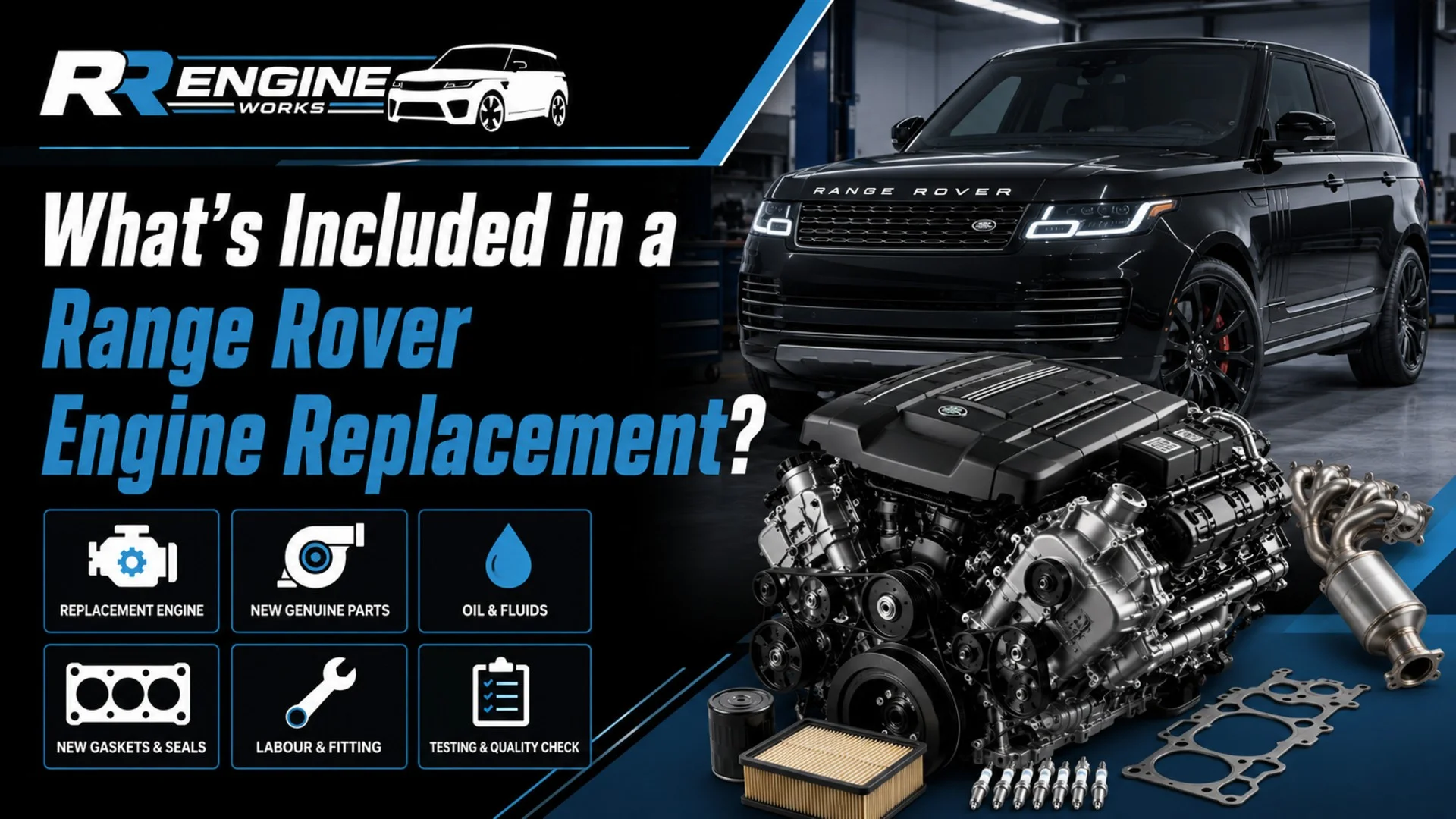
A proper engine replacement isn't just unbolting the old one and dropping in a new block. It's a multi-stage process involving diagnostics, ancillary transfer, and recalibration, and understanding what should be included helps you spot a corner-cutting quote before you commit to it.
Used vs Reconditioned vs Rebuilt vs New OEM Engines, Which Should You Choose?
This is probably the single most important decision in the whole process, and it's one competitors rarely explain clearly. Here's how the four options actually compare:
Option | What It Means | Best For | Typical Warranty |
| Used | Sourced from a donor vehicle, tested but not rebuilt | Budget-conscious owners, older vehicles nearing end of economic life | 3–6 months |
| Reconditioned | Stripped, worn parts replaced, rebuilt to OEM tolerances, tested on a rig | Most owners, best balance of cost, reliability, and warranty | 12–24 months |
| Rebuilt (your engine) | Your original block is stripped and rebuilt rather than swapped | Owners who want to retain the original engine number/provenance | 12–24 months |
| New OEM | Brand new unit sourced through Jaguar Land Rover's supply chain | Owners planning long-term ownership, or vehicles under finance requiring OEM parts | Full manufacturer warranty |
For most owners, a reconditioned engine hits the sweet spot. You get a tested, rebuilt unit with a meaningful warranty, without paying new-OEM prices on a vehicle that's already depreciated significantly. Used engines are tempting on price, but without knowing the donor vehicle's history, you're taking on real risk, especially with TDV6 and early Ingenium units, which have known failure points that may already be present in a "working" used engine.
How Much Does Range Rover Engine Replacement Labour Cost?
Labour rates for Range Rover engine work vary depending on whether you go to a main dealer or an independent specialist. Dealer labour rates in the UK typically run £120–£180 per hour, while independent Range Rover specialists usually charge £70–£110 per hour.
A full engine replacement typically takes 12–20 labour hours, depending on the model and whether ancillaries need transferring across from the old engine. That puts independent specialist labour costs at roughly £900–£2,200, compared with £1,500–£3,600 at a main dealer for the same job.
Additional Costs to Budget For (Ancillaries, ECU Programming, Diagnostics)
This is where quotes can quietly balloon if you're not asking the right questions upfront. Beyond the engine itself and core labour, budget for:
- ECU programming and pairing, most replacement engines need the vehicle's ECU reprogrammed or paired to the new unit. Expect £150–£400.
- Diagnostics (pre and post-fit), confirming the fault before work starts, and clearing/verifying fault codes afterward. Often £80–£150, sometimes bundled into fitted quotes.
- Timing chain kit, tensioners, and gaskets, even with a "complete" engine, these are frequently replaced as standard practice. £200–£600.
- Fluids and filters, oil, coolant, and filters aren't always included in engine price alone. £80–£150.
- Turbocharger inspection or replacement, if your original turbo is worn, reusing it on a new engine is a false economy. £600–£1,500 if replacement is needed.
- DPF and EGR checks (diesel models), a new engine won't fix an already-failing DPF or EGR system, and these are worth checking at the same time. £150–£800 if remedial work is needed.
A trustworthy quote should itemise these rather than burying them in a single "engine replacement" line. If a quote looks unusually cheap compared with everything above, ask exactly what's included before booking anything in.
Signs Your Range Rover Engine Actually Needs Replacing
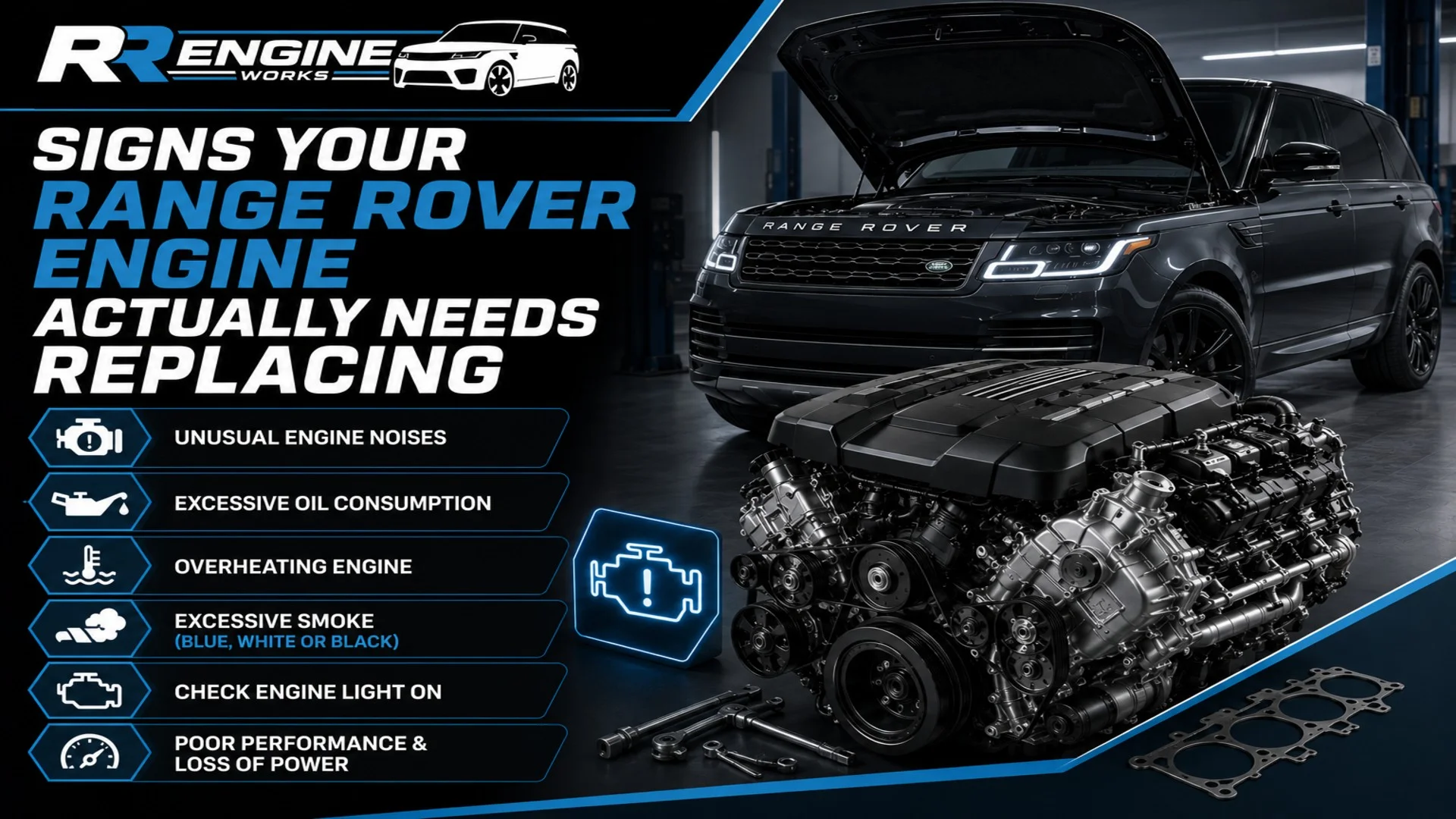
Not every engine problem means full replacement. Before you commit to the cost, it's worth understanding what actually causes failure, and whether a cheaper repair route might still be on the table.
What Causes Range Rover Engine Failure?
The most common causes we see across TDV6, SDV6, SDV8, and Ingenium engines include:
- Timing chain failure, particularly on early Ingenium and TDV6 units, where chain stretch or tensioner failure can lead to catastrophic internal damage if not caught early.
- Crankshaft failure, a well-documented issue on certain 3.0 TDV6 engines, often linked to manufacturing tolerances rather than driver error.
- Oil starvation, caused by blocked oil pickups, failed oil pumps, or infrequent oil changes, leading to bearing wear and eventual seizure.
- Turbocharger failure feeding debris into the engine, a failing turbo can send metal particles through the oil system, causing secondary internal damage.
- Overheating from coolant loss, head gasket failure or a cracked cooling component can lead to warped cylinder heads or seized pistons if driven on.
- EGR and DPF-related issues (diesel models), excessive EGR carbon build-up can contribute to poor combustion and, over time, mechanical strain.
Early Warning Symptoms You Shouldn't Ignore
Catching a problem early is often the difference between a repair costing a few hundred pounds and a replacement costing several thousand. Watch for:
- A persistent or intermittent engine warning light, especially alongside a loss of power
- Unusual knocking or rattling noises, particularly on cold start
- Excessive smoke from the exhaust, blue smoke suggests oil burning, while white smoke can indicate coolant entering the combustion chamber
- A noticeable drop in oil pressure on the dashboard gauge or warning system
- Coolant loss with no visible external leak, which often points to internal head gasket failure
- Rough idling or a loss of power that develops gradually over weeks
If you're noticing any combination of these, it's worth getting a proper diagnostic rather than waiting for the engine to fail completely, driving on a developing fault is usually what turns a repairable issue into a full replacement job.
Repair vs Rebuild vs Replacement, How Do You Know Which One You Need?
This decision should always follow a proper diagnostic, not guesswork. As a general framework:
- Repair makes sense when the issue is isolated, a single failed component like a water pump, turbo, or EGR valve, with no evidence of internal engine damage.
- Rebuild makes sense when there's internal wear or damage, but the engine block itself is sound and worth preserving, common with high-mileage but well-maintained vehicles.
- Full replacement makes sense when there's confirmed internal damage (crankshaft, bearings, or block cracking), or when repair costs start approaching 50-60% of a replacement engine's price.
As a real-world example: a Range Rover Sport with a failed turbo sending debris into the oil system might only need a turbo replacement and an oil flush if caught within a short window. Left too long, that same debris can score bearings and the crankshaft, turning a £1,200 repair into a £6,000 replacement. This is exactly why early diagnostics matter so much.
Why Choose RR Engine Works for Your Range Rover Engine Replacement?
Everything above gives you the numbers and the reasoning to make an informed decision. What it doesn't do is fit the engine, and that's where the right specialist makes the difference between a job that's done properly and one you'll be revisiting in six months.
Our Engine Replacement Process, Step by Step
At RR Engine Works, every replacement follows the same structured process, regardless of model or engine type:
- Full diagnostic assessment to confirm the fault and rule out cheaper repair alternatives first
- Engine sourcing matched precisely to your vehicle's engine code, not just the model name
- Ancillary inspection, turbo, timing components, and cooling system checked before refitting, not just reused blindly
- Careful removal and installation by technicians who work on Range Rover and Land Rover vehicles specifically, not general mechanics
- ECU programming and pairing to make sure the new engine communicates correctly with the vehicle's systems
- Full road test and diagnostic verification before the vehicle goes back to you
Warranty & Aftercare on Every Replacement Engine
Every engine we supply and fit comes with a warranty appropriate to the option you choose, with reconditioned and rebuilt units backed for up to 24 months. We also provide clear guidance on running-in your new engine correctly during the first few hundred miles, which genuinely does affect long-term reliability.
Get a Free, No-Obligation Quote Today
If your Range Rover's engine has failed, or you're seeing early warning signs and want to plan ahead, get in touch for a written quote based on your exact model and engine code. We're based at Unit 1 Hedley Ave, Grays, RM20 4EL, and work with Range Rover, Range Rover Sport, Evoque, and Velar owners across the UK.
Frequently Asked Questions
How much does a Range Rover engine replacement cost?
Fully fitted, most Range Rover engine replacements in the UK cost between £2,800 and £12,000+, depending on the model, engine type, and whether you choose a used, reconditioned, rebuilt, or new OEM engine. Reconditioned engines typically offer the best balance of cost and reliability.
Is it worth replacing a Range Rover engine?
In most cases, yes, particularly if the rest of the vehicle is in good condition and the repair cost is close to or exceeds the value of a reconditioned engine. It's usually only not worth it when the vehicle has other significant mechanical or bodywork issues on top of the engine fault.
How long does a Range Rover engine replacement take?
A typical replacement takes between 2 and 5 working days, factoring in diagnostics, engine sourcing (if not already in stock), removal, fitting, ECU programming, and a final road test.
Is a reconditioned Range Rover engine reliable?
Yes, provided it's sourced from a reputable specialist. A properly reconditioned engine is stripped, inspected, and rebuilt to OEM tolerances, then tested before fitting, making it considerably more reliable than a used engine of unknown history.
Should I repair or replace my Range Rover engine?
This depends entirely on the diagnostic findings. Isolated component failures (turbo, water pump, EGR valve) are usually worth repairing. Confirmed internal damage, crankshaft, bearings, or block issues, almost always makes full replacement the more sensible long-term option.
What's the difference between a used and reconditioned Range Rover engine?
A used engine is taken from a donor vehicle and tested but not rebuilt, making it cheaper but riskier. A reconditioned engine has been stripped down, had worn components replaced, and rebuilt to proper tolerances, offering a longer warranty and greater reliability.
Final Thoughts
A Range Rover engine replacement is a significant expense, but it doesn't have to be a confusing one. Once you know your model, your exact engine code, and which replacement option fits your budget and expectations, the pricing becomes far more predictable than the vague "£3,000 to £9,000" ranges you'll see elsewhere.
The most important step is getting a proper diagnostic before assuming replacement is your only option, and working with a specialist who'll tell you honestly when a repair or rebuild is the smarter route, rather than upselling a full replacement by default.
If you're ready for a clear, itemised quote based on your specific Range Rover, get in touch with RR Engine Works today. We'll talk you through your options, no pressure, no vague estimates, just straight answers based on your exact vehicle.