
Your Range Rover was built to dominate both motorways and mountain trails. But even the most capable engine in the world has limits and when years of hard driving, deferred servicing, or a single catastrophic failure catch up with it, the consequences can be expensive, frustrating, and stressful.
The good news? A Range Rover engine rebuild does not have to mean the end of the road for your vehicle. In fact, for many owners, it is the smartest, most cost-effective decision they can make.
At RR Engine Works, based in Grays, Essex, we have rebuilt hundreds of Range Rover engines across every model and generation. This guide covers everything you need to know, from spotting the early warning signs to understanding exactly what a full rebuild involves, what it costs, and why choosing the right specialist makes all the difference.
Is Your Range Rover Telling You It Needs an Engine Rebuild?
Most engine failures do not happen overnight. They announce themselves, quietly at first, then louder, through a series of symptoms that are easy to dismiss until suddenly they are impossible to ignore.
Catching these signs early can be the difference between a manageable rebuild and a complete engine write-off.
Warning Signs You Should Never Ignore
Range Rover engines are sophisticated, complex units. When something goes wrong internally, the symptoms often overlap with minor issues, which is exactly why so many owners delay acting. Here are the red flags that warrant immediate professional attention:
- Persistent engine knock or ticking: A deep, rhythmic knocking sound under load is one of the clearest signs of bearing wear or oil starvation. It is not a sound that resolves itself.
- Blue or white exhaust smoke: Blue smoke indicates burning oil; white smoke (especially under load) often points to coolant entering the combustion chamber through a failing head gasket.
- Sudden or progressive power loss: If your Range Rover feels sluggish, hesitant, or noticeably down on power compared to how it used to perform, internal wear is a likely culprit.
- Oil warning light combined with unusual noise: Low oil pressure is a serious mechanical emergency. If this light appears alongside knocking or rattling, stop driving immediately.
- Coolant loss with no visible external leak: If your coolant reservoir keeps dropping but there is no puddle under the car, that coolant is going somewhere inside the engine.
These are not minor inconveniences. Each one is a symptom of something deeper, and each one gets worse and more expensive the longer it is left.
What Does Engine Knock Mean for Your Range Rover?
Engine knock, sometimes described as a deep "thud" or rhythmic "clatter" is the sound of metal-on-metal contact where there should be a cushion of pressurised oil. In most cases it points to worn or damaged main bearings or rod bearings, which are components that support the crankshaft as it rotates at high speed.
On high-mileage Range Rovers, bearing failure is often connected to years of slightly delayed oil changes, oil pressure drops, or the use of incorrect oil grades. Once the bearing surfaces are damaged, the damage accelerates rapidly. A bearing rebuild at the right time costs a fraction of what a full crankshaft replacement or block replacement demands.
Low Compression, Misfires and Excessive Oil Consumption Explained
Low compression is typically caused by worn piston rings, damaged pistons, or a failing cylinder head. When compression drops, the combustion process becomes inefficient, leading to misfires, increased fuel consumption, and significant power loss.
A leak down test and compression test will confirm which cylinders are affected and to what degree. This diagnostic step is critical before any rebuild work begins, because it shapes the entire scope of what needs to be done.
Excessive oil consumption needing to top up between services, is almost always tied to worn piston rings or valve stem seals. It is a slow drain on your engine's health and, left unchecked, accelerates wear across every other internal component.
Common Causes of Range Rover Engine Failure
Understanding why Range Rover engines fail helps you make informed decisions about rebuilding, prevention, and future maintenance. These are the most common root causes we see at our Essex workshop.
Timing Chain Failure in TDV6 and SDV6 Engines
The TDV6 and SDV6 diesel engines fitted across the Range Rover Sport, Vogue, and L405 generation, have a well-documented history of timing chain stretch and tensioner failure. These engines use a complex multi-stage timing chain system, and when the tensioner weakens, the chain develops slack.
The result? Timing retardation, rough running, poor cold starts, and in severe cases catastrophic engine failure if the chain jumps a tooth or snaps entirely.
A Range Rover timing chain rebuild carried out at the right time preserves the entire engine. Ignored, it can destroy it.
Crankshaft and Bearing Failure in High-Mileage Range Rovers
Crankshaft failure is most commonly seen in high-mileage SDV6 and TDV8 engines and is frequently linked to oil starvation events, either from neglected servicing, oil cooler failure, or a blocked oil feed. The crankshaft journals score and wear, and rod bearings collapse.
We also see this pattern in Range Rover L322 models and early L405 vehicles where service intervals were stretched or where the wrong specification oil was used over an extended period.
Head Gasket Failure and Overheating Damage
The head gasket seals the boundary between the cylinder head and the engine block. When it fails, typically due to overheating, age, or a cooling system fault, combustion gases contaminate the coolant, oil contaminates the combustion chamber, and the engine's internal environment becomes destructive very quickly.
A classic sign is a cracked cylinder head or warped head surface, both of which require precision machining or outright replacement. Overheating damage is one of the most common reasons Range Rover owners come to us for a full engine rebuild, often after an original problem, a faulty thermostat, a cracked hose, or a failing water pump, was left too long without repair.
What Does a Range Rover Engine Rebuild Actually Involve?
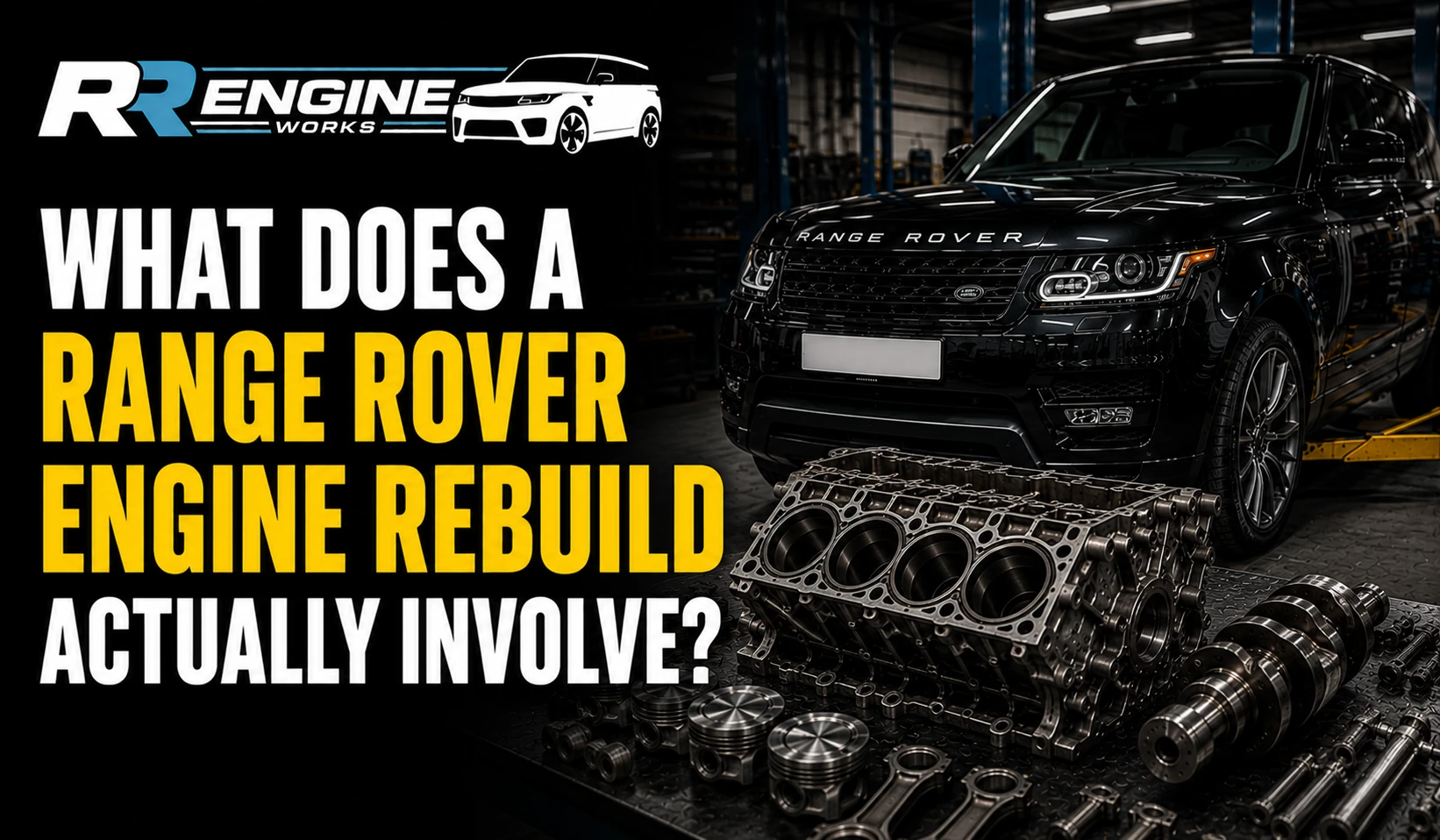
There is a significant difference between an engine repair and an engine rebuild. A repair addresses a specific failure. A rebuild is a comprehensive, systematic restoration of the entire engine to factory specification or beyond.
Here is exactly how we approach every Range Rover engine rebuild at RR Engine Works.
Full Diagnostic and Strip-Down Process
Before a single component is removed, we carry out a thorough diagnostic assessment. This is not optional it is essential.
Compression Testing, Leak Down Test and ECU Diagnostics
We begin with a compression test across all cylinders to establish baseline health, followed by a leak down test to identify where pressure is being lost — whether through the piston rings, valves, or head gasket.
Alongside mechanical testing, we perform a full ECU diagnostic scan to capture fault codes, fuelling data, and any historical fault patterns. This gives us a complete picture of what the engine has experienced and where the damage is most concentrated.
Only once this process is complete do we strip the engine down and at that point, we know exactly what we are going to find.
Engine-Specific Rebuild Considerations
Not all Range Rover engines are the same. Each engine family has its own architecture, its own known weaknesses, and its own rebuild requirements. This is why working with a Range Rover engine specialist, rather than a general mechanic, matters enormously.
Range Rover TDV6 and SDV6 Diesel Engine Rebuild
The TDV6 and SDV6 are among the most common engines we rebuild. These units power the Range Rover Sport from 2005 through to the L405 generation and are known for timing chain issues, injector seal failures, EGR valve carbon accumulation, and in SDV6 form crankshaft and bearing failure.
A full SDV6 crankshaft failure rebuild involves precision crankshaft grinding, new main and rod bearings, piston replacement, a full timing chain kit, and thorough cleaning of oil galleries to remove any metal shavings or sludge accumulation before reassembly.
Range Rover AJ133 V8 Supercharged Petrol Engine Rebuild
The AJ133 supercharged V8 fitted in Range Rover Autobiography and top-specification Vogue models, is a powerful, complex engine that demands expert hands. Common issues include carbon buildup on intake valves, supercharger bearing wear, and timing chain stretch across the multi-cam system.
A Range Rover supercharged V8 rebuild at our workshop covers full valve train inspection and reconditioning, cylinder head resurfacing, new piston rings, bearing replacement, and supercharger assessment, all carried out to OEM specification.
Range Rover Ingenium Engine Reconditioning
The Ingenium engine family, used in the Range Rover Evoque, Velar, and later Sport models, is Land Rover's modern modular unit. While more recent in design, high-mileage Ingenium engines do develop issues including oil consumption, timing system wear, and in some cases, internal damage following coolant system failures.
Ingenium reconditioning requires specialist tooling and up-to-date technical knowledge, both of which our team at Grays, Essex maintains as standard.
OEM Parts vs Aftermarket — What Gets Replaced?
One of the most important decisions in any engine rebuild is the quality of replacement components. At RR Engine Works, we use genuine Land Rover parts and OEM-specification components wherever possible and we will always advise you on the quality tier of every part before it goes into your engine.
Here is what typically gets replaced during a comprehensive Range Rover engine rebuild:
- Pistons and piston rings: restored to factory tolerances to re-establish correct compression
- Main and rod bearings: new bearings fitted to specification after crankshaft inspection and grinding if required
- Timing chain, tensioners, and guides: a full kit replacement, not individual components
- Oil pump: inspected and replaced as standard to guarantee correct oil pressure post-rebuild
- Water pump: replaced to eliminate a common point of future failure
- Head gasket: always replaced during any rebuild involving cylinder head removal
- Camshaft and valve train components: inspected, reconditioned, or replaced as required
- Fuel injectors and seals: assessed for diesel engines where injector condition affects combustion quality
Pistons, Piston Rings, Crankshaft and Connecting Rods
These are the core reciprocating components of any engine. During a rebuild, each one is measured against factory specification using precision tooling. Pistons are inspected for cylinder scoring, rings are replaced as a set, and connecting rods are checked for straightness and weight-matched if being reused.
The crankshaft is measured for journal wear and either reground to an undersize specification or replaced outright if damage is beyond acceptable tolerance.
Timing Chain, Oil Pump, Water Pump and Head Gasket
These four components are what we call the "never compromise" list. Even if a timing chain looks serviceable, it gets replaced. The same applies to the oil pump and water pump, the cost of fitting new components is minimal compared to the cost of a post-rebuild failure caused by a marginal component.
The head gasket is replaced every time, full stop.
Why Genuine Land Rover Parts Matter for Long-Term Reliability
Aftermarket parts vary enormously in quality and with Range Rover engines, the difference between an OEM-specification component and a budget alternative can be the difference between an engine that lasts another 150,000 miles and one that fails within 20,000.
Genuine Land Rover parts are manufactured to the exact tolerances the engine was designed around. They fit correctly, they perform correctly, and they carry a manufacturer's warranty. For a vehicle of this calibre, there is no logical reason to compromise on this.
Range Rover Engine Rebuild Cost — Is It Worth It?
This is the question every Range Rover owner asks, and it deserves a straight, honest answer.
A Range Rover engine rebuild cost in the UK typically ranges from £3,500 to £8,500+, depending on the engine type, the extent of the damage, and the quality of parts used. A TDV6 timing chain rebuild at the lower end of the damage spectrum will cost less than a full SDV6 crankshaft failure rebuild or a supercharged V8 complete restoration.
What matters is the comparison and that comparison almost always favours rebuilding.
Rebuild vs Replacement — Which Makes More Sense?
Here is a direct comparison to help Range Rover owners make an informed decision:
Factor | Engine Rebuild | Engine Replacement |
| Cost (typical UK range) | £3,500 – £8,500 | £5,000 – £14,000+ |
| Component quality control | Full inspection & spec rebuild | Unknown history (used units) |
| Warranty | Yes — workshop-backed | Variable or none (used) |
| Vehicle downtime | 5–10 working days | 3–7 days (if unit available) |
| Long-term reliability | High — new internals | Unknown — depends on donor engine |
| Resale value impact | Positive — documented rebuild | Neutral to positive |
| Environmental impact | Lower — existing block reused | Higher — additional engine unit used |
A remanufactured or reconditioned engine from an unknown source carries significant risk you simply do not know its history, its condition before removal, or how it was stored. A rebuild carried out by specialists gives you complete transparency and control over every component that goes back into your vehicle.
Long-Term Cost Comparison for Range Rover Owners
Consider a Range Rover Sport TDV6 with 130,000 miles and confirmed bearing failure. A replacement engine from a breaker might cost £1,800, but add labour, ancillaries, and the risk of fitting another worn unit, and the total cost climbs quickly, with no guarantee of reliability.
A specialist rebuild of the existing engine, using new bearings, a fresh timing chain kit, and reconditioned heads, delivers a mechanically fresh engine with documented history and a workshop warranty, for a total investment that is often comparable or only modestly higher.
Over the next 50,000 to 100,000 miles, the rebuilt engine wins on every metric.
Does a Rebuilt Engine Increase Resale Value?
Yes, when documented correctly. A Range Rover with a fully rebuilt engine, accompanied by a detailed service record and workshop invoice, is a significantly more attractive proposition to a potential buyer than one with an undocumented engine swap or a tired original unit.
Buyers for premium Land Rover vehicles are often well-informed. A receipted specialist rebuild from a reputable workshop like RR Engine Works adds tangible, demonstrable value to your vehicle.
What Affects the Cost of a Range Rover Engine Rebuild?
Several variables influence the final price of any rebuild. Being transparent about these from the outset is something we consider a professional obligation:
- Engine model and complexity: A supercharged V8 rebuild is inherently more involved than an Ingenium four-cylinder recondition
- Extent of internal damage: Bearing failure caught early costs less to address than crankshaft damage requiring grinding or block damage requiring line boring
- Parts specification: Genuine OEM components cost more than pattern parts but deliver significantly better outcomes
- Ancillary work required: Turbocharger condition, DPF system status, intercooler assessment, and cooling system work can all add to the final scope
- Cylinder head condition: A cracked or severely warped head requires specialist machining or replacement, adding to cost and time
How to Get an Accurate Engine Rebuild Quote
The only way to get a genuinely accurate quote is through a proper strip-down and inspection. Any workshop, including ours that provides a firm fixed price before seeing the internal condition of the engine is making assumptions that could leave you with unexpected costs later.
At RR Engine Works, we carry out a full diagnostic and initial assessment before providing a detailed, itemised quotation. You know exactly what work is being done, what parts are being used, and what the total investment will be before we proceed.
Why Choose RR Engine Works for Your Range Rover Engine Rebuild in Essex and Across the UK?
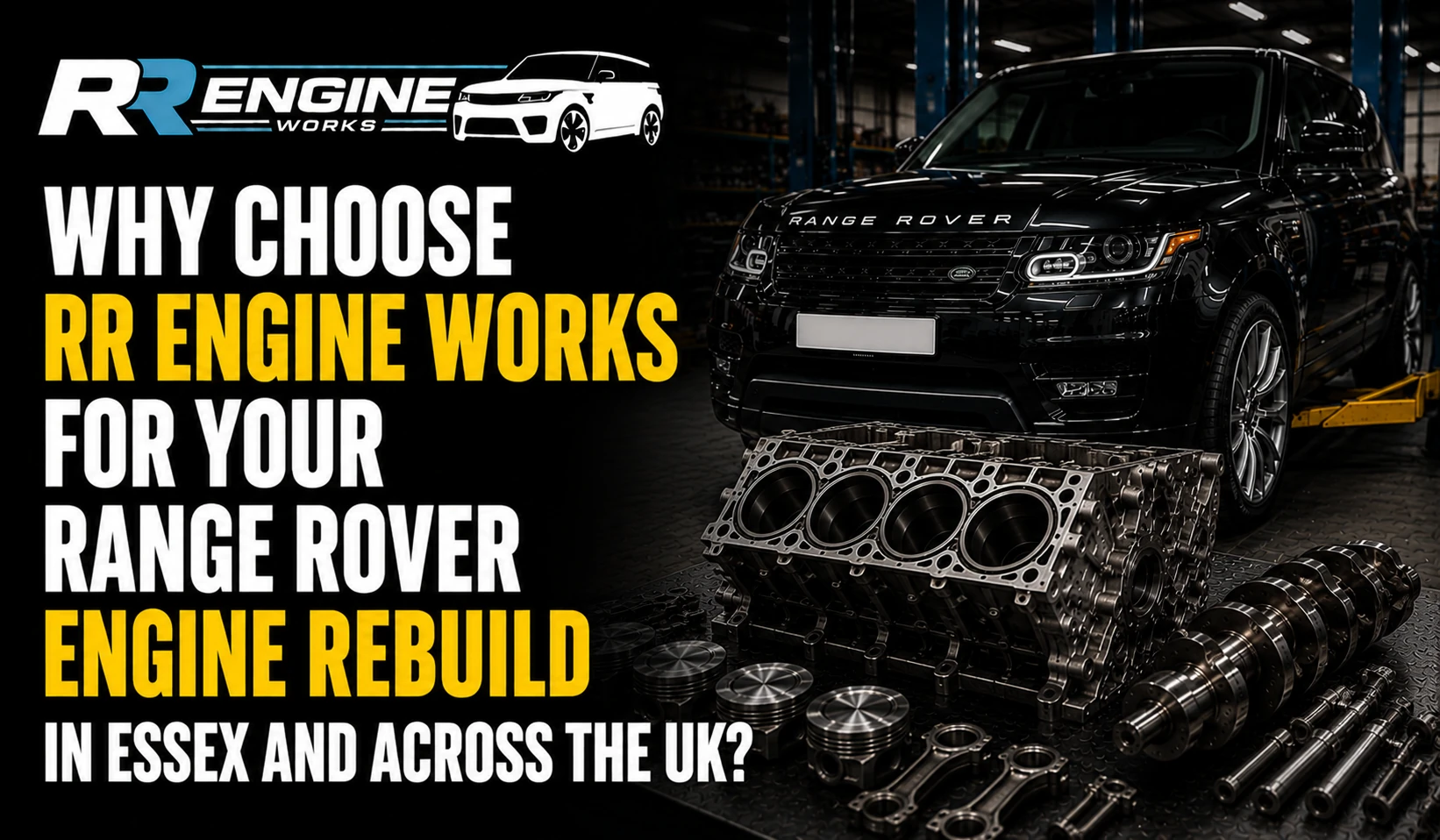
There is no shortage of garages willing to work on a Range Rover. There is, however, a much smaller number of workshops with the specific expertise, tooling, and experience to rebuild one properly.
Specialist Experience Across All Range Rover Engine Families
Our team has hands-on experience rebuilding every significant Range Rover engine family TDV6, SDV6, TDV8, AJ133 V8 Supercharged, AJ126 V6, and the modern Ingenium range. We understand the specific failure patterns, the known engineering challenges, and the correct repair procedures for each unit.
This is not general mechanical knowledge. It is deep, model-specific expertise built over years of dedicated Range Rover work.
Warranty-Backed Engine Rebuilds Using OEM-Grade Components
Every engine rebuild we carry out is backed by a workshop warranty, giving you confidence in both the quality of the work and the components used. We document every stage of the rebuild process and provide a full parts and labour record with every completed engine.
We use genuine Land Rover parts and OEM-specification components as standard, not as an upgrade option.
Serving Grays, Essex and Range Rover Owners Nationwide
Our workshop is based in Grays, Essex, making us conveniently accessible for Range Rover owners across London, the South East, and the wider Home Counties. We also work with owners from across the UK who transport their vehicles to us for specialist rebuild work.
Whether you drive a Range Rover Classic, P38, L322, L405, or the current L460, we have the knowledge and capability to restore your engine to the standard it deserves.
Book Your Engine Diagnostic or Rebuild Consultation Today
If your Range Rover is showing any of the symptoms described in this guide or if you simply want a professional second opinion on its engine health, the right time to act is now.
Contact RR Engine Works in Grays, Essex to book your engine diagnostic, discuss your rebuild options, or request a detailed quotation. The sooner a problem is assessed, the more options you have and the less it is likely to cost.
Call us, email us, or use our online booking form to get started. Your Range Rover deserves specialists who know it inside out, quite literally.
Frequently Asked Questions
How much does a Range Rover engine rebuild cost in the UK?
Costs typically range from £3,500 to £8,500 or more, depending on the engine type and extent of damage. A TDV6 timing chain rebuild will sit at the lower end; a full SDV6 crankshaft rebuild or supercharged V8 restoration will sit higher. The only way to get an accurate figure is through a proper strip-down assessment.
Is it worth rebuilding a Range Rover engine?
In most cases, yes. A specialist rebuild delivers a mechanically fresh engine with documented history and a warranty, often at a comparable or lower total cost than sourcing and fitting a replacement engine of unknown history. It also preserves your vehicle's existing service record and identity.
How long does a Range Rover engine rebuild take?
Most rebuilds are completed within 5 to 10 working days, depending on parts availability and the complexity of the work involved. We provide a realistic timeframe before work begins and keep you updated throughout.
What causes Range Rover TDV6 and SDV6 engine failure?
The most common causes are timing chain wear and tensioner failure, crankshaft and bearing failure (particularly in SDV6 engines), head gasket failure following overheating, and oil starvation events caused by neglected servicing or oil system faults.
Can a seized Range Rover engine be repaired?
It depends on the extent of the seizure and the resulting damage. In many cases, a seized engine can be successfully rebuilt once the damage has been fully assessed but this requires stripping the engine and evaluating every major component individually. Some seizures result in irreparable block damage; many do not.
What warranty comes with an engine rebuild at RR Engine Works?
We provide a workshop-backed warranty on all engine rebuild work. Full details are discussed and confirmed before work begins. Every rebuild is documented with a complete parts and labour record.
Does a rebuilt Range Rover engine affect insurance?
You should inform your insurer of any significant mechanical work, including an engine rebuild, as a matter of good practice. A documented specialist rebuild from a reputable workshop is generally straightforward to declare and rarely affects premiums significantly.
How long will a rebuilt Range Rover engine last?
A properly rebuilt engine using quality OEM-specification parts and carried out by experienced specialists, should deliver 100,000 miles or more of reliable service, provided it is maintained correctly. Many rebuilt engines outlast the vehicles they are fitted in.
RR Engine Works — Range Rover Engine Rebuild Specialists, Grays, Essex. Serving Range Rover owners across the UK.