
The temperature needle is climbing, a warning flashes across the dash, and the bonnet is starting to smell sweet and hot. Whether you're stuck in traffic on the A13 or pulling off the M25, Range Rover engine overheating is a moment that tests your nerve.
Here's the short answer: pull over safely, switch the engine off and don't keep driving. Every extra mile on an overheating engine raises the odds of a warped head, a blown gasket or worse.
At RR Engine Works in Grays, Essex, we deal with overheating on Range Rover, Range Rover Sport, Evoque and Velar models. This guide covers what's causing it, what the warnings mean, how far you can go, and how a proper repair works.
Why Is My Range Rover Overheating, and What Causes It?
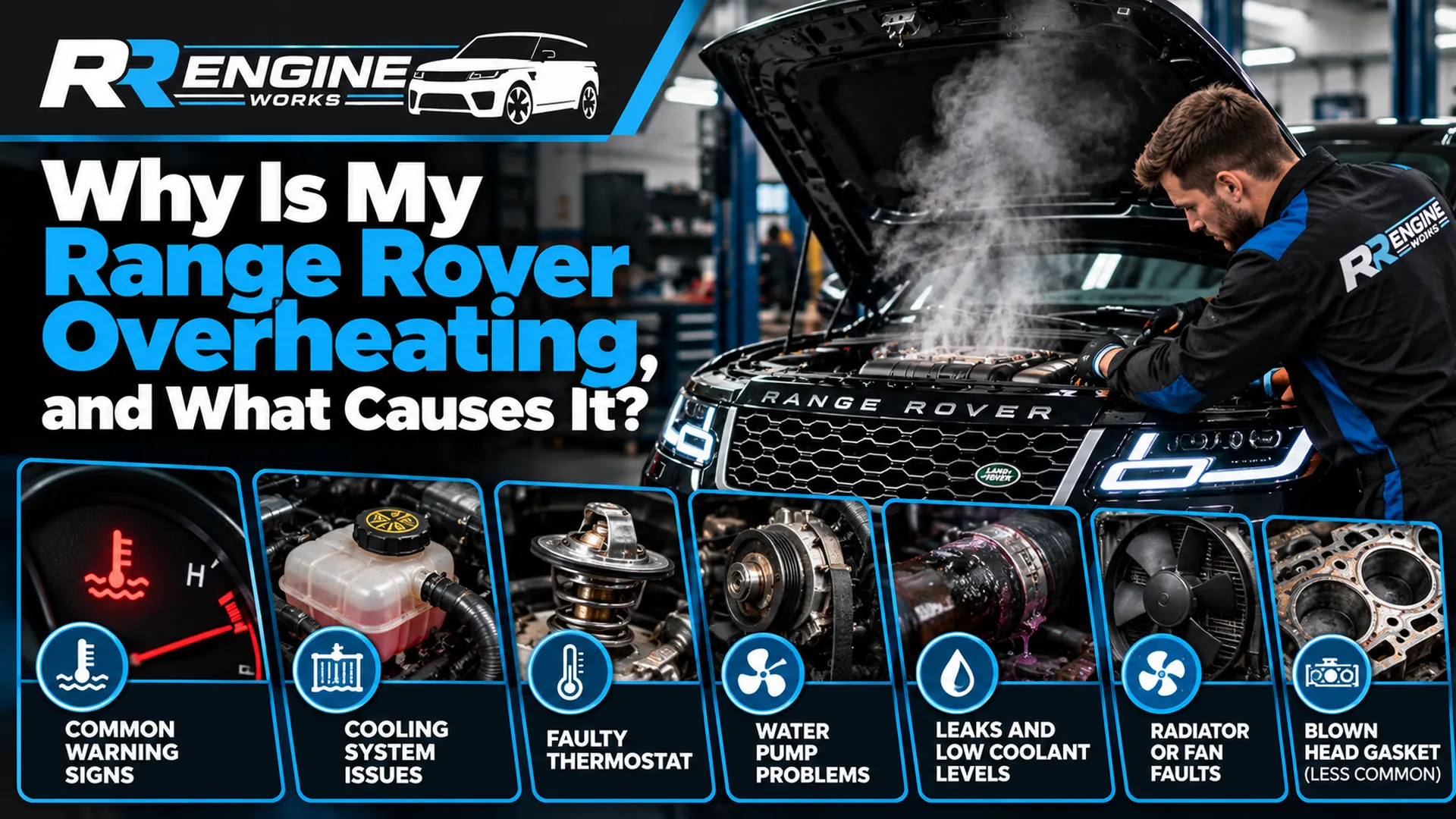
Your engine produces enormous heat. The cooling system's job is to carry that heat away through coolant, the water pump, the thermostat, the radiator and the fans. When any link fails, temperatures rise quickly.
What Causes a Range Rover to Overheat on the Evoque, Sport and Velar?
Most range rover overheating issues trace back to a short list of faults:
- Low coolant or a leak. Hoses, joints, the radiator and the expansion tank can all weep, sometimes without leaving a puddle.
- A faulty thermostat. If it sticks closed, coolant can't reach the radiator and the engine heats up fast.
- Water pump failure. A worn pump or bearing stops coolant circulating properly.
- Radiator restriction or damage. Blockages and corrosion reduce how much heat the radiator sheds.
- Cooling fan faults. The engine may run fine at speed but overheat in traffic when the fans don't kick in.
- Air locks after servicing. Trapped air creates hot spots and false readings.
- Head gasket failure. Combustion pressure forces into the cooling system and drives temperatures up.
Different models tend to show different patterns. Treat this as a starting point, not a diagnosis:
Model | Common area we check first | Typical early clue |
| Range Rover Evoque | Coolant leaks, thermostat and plastic cooling components | Slowly dropping coolant, temperature spikes in traffic |
| Range Rover Sport | Water pump, fans and radiator | Overheating under load or when towing |
| Range Rover Velar | Coolant level, thermostat and cooling circuit leaks | Warning message after a short run |
If your Range Rover Evoque engine overheating problem only appears in stop-start traffic, suspect the fans or airflow first. If a Range Rover Sport engine overheating fault shows up on motorway climbs, look at circulation and radiator flow. A Range Rover Velar engine overheating warning right after a service often points to an air lock. And if your Range Rover Evoque engine overheat warning keeps returning after a top-up, there's a leak you haven't found yet.
What Are the Range Rover Engine Overheating Symptoms and Problems to Watch For?
The fault rarely arrives without warning. Catching it early often saves the engine.
- A rising temperature gauge. This is the most obvious sign, but it's often the last one before damage starts.
- Steam from under the bonnet. This usually means coolant is escaping under pressure.
- A sweet smell. That's coolant burning on hot metal.
- A heater that blows cold. This can mean low coolant or an air pocket.
- A falling coolant level. If you're topping up regularly, something is leaking.
- Loss of power or rough running. The engine may cut output to protect itself.
Each symptom points somewhere different. A cold heater with a hot engine suggests low coolant or poor circulation. Steam and a sweet smell suggest an external leak. White smoke with a rising temperature raises the possibility of a head gasket. Matching symptoms to causes is how range rover engine overheating problems get diagnosed quickly instead of by guesswork.
What Does the Range Rover Engine Overheating Warning Light Mean?
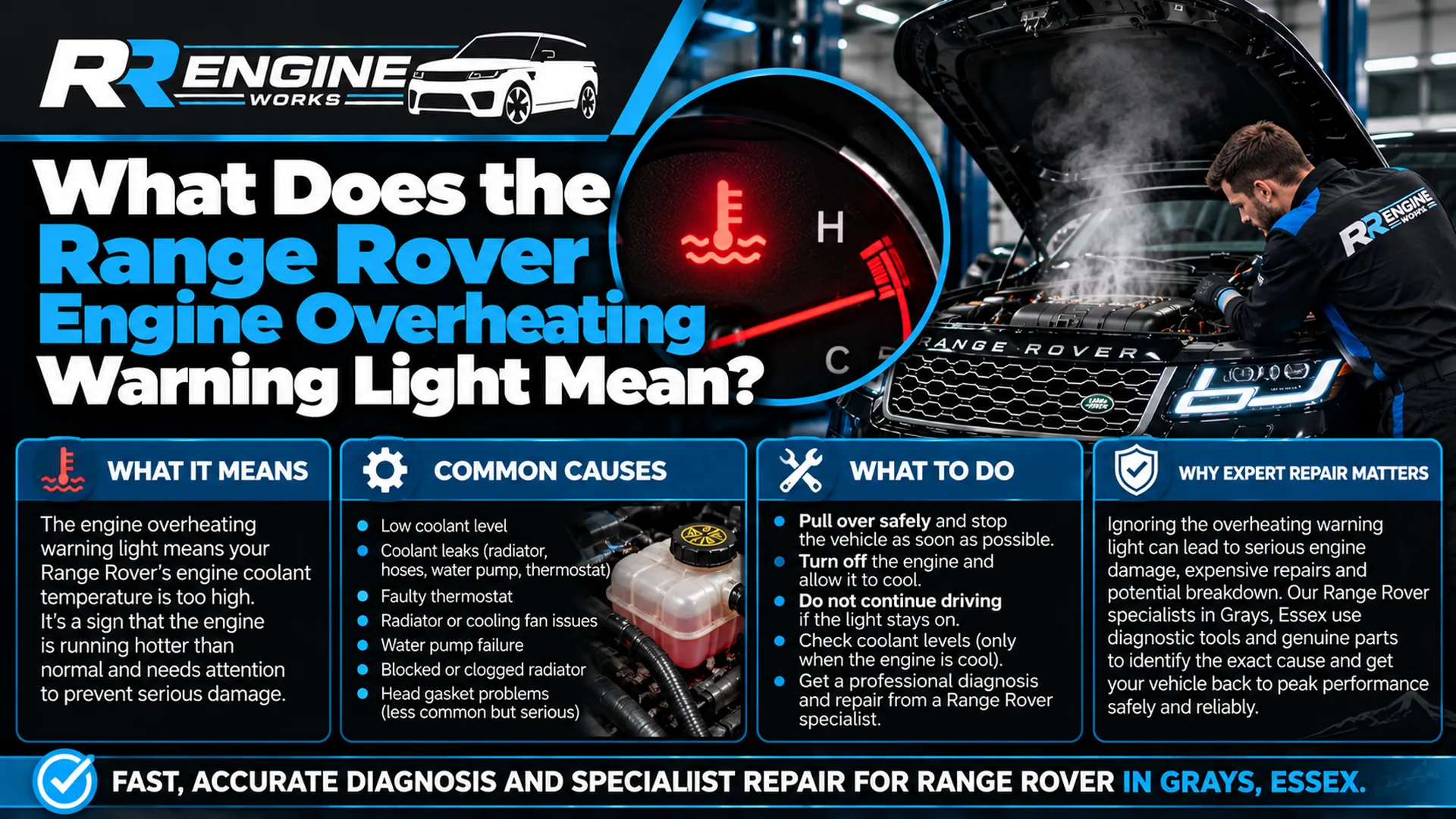
A warning on the dash is the car telling you the cooling system can no longer cope. How you respond depends on how urgent the message is.
What Does the Range Rover Engine Overheating Light Mean, and Is a Charging System Fault Related?
A range rover engine overheating warning usually appears in two stages. An amber message means temperatures are climbing and you should reduce load and find somewhere safe to stop. A red message means stop now. Check your handbook for the exact wording on your model, because the display varies between Evoque, Sport and Velar.
The range rover engine overheating light isn't always the whole story. Some owners also see a charging system fault range rover engine overheating message at the same time. That combination often points to the drive belt system. On some engines, the belt that drives the alternator also drives the water pump or sits close to it. If the belt, tensioner or a pulley fails, the battery stops charging and coolant stops circulating together.
If both messages appear at once:
- Pull over as soon as it's safe.
- Switch off the engine.
- Don't restart it to "see if it clears".
- Call for recovery.
Can You Reset the Range Rover Engine Overheating Warning?
You can clear the message, but a reset doesn't fix anything. The range rover engine overheating reset is only appropriate after the cause has been found and repaired. Clearing the warning and driving on hides the symptom while the fault keeps working on your engine.
If the warning returns after a reset, treat it as confirmation that the fault is still there and have it diagnosed properly.
How Far Can You Drive With an Overheating Engine, and What Happens If You Keep Going?
Many owners ask this because they're miles from home and hoping to limp to the nearest garage. The honest answer isn't comfortable.
How Far Can I Drive With the Engine Overheating?
Not far, and ideally not at all. An engine that's genuinely overheating can be damaged in a matter of minutes. There's no safe distance, and the car may feel normal until the damage is done.
If the warning appears:
- Find a safe place to stop, then switch off.
- Leave the bonnet closed for a few minutes, then open it carefully.
- Never open the expansion tank cap while hot. The system is under pressure and can scald.
- Don't pour cold water into a hot engine. The sudden temperature change can crack metal.
- Call for recovery. It costs far less than an engine rebuild.
Picture a common scenario. A driver sees the gauge climb on a motorway, pushes on to the next exit, and tops up with tap water. The engine then runs hot again within a mile and the head gasket gives way. A recovery call would have saved thousands.
What Happens When an Engine Overheats and Is Left Unrepaired?
When people ask what happens when you engine overheats, this is the sequence we see:
- Coolant boils and circulation drops. The engine loses its ability to shed heat.
- The head gasket fails. Pressure and heat push it past its limits.
- The cylinder head warps or cracks. Aluminium heads are particularly vulnerable.
- Oil breaks down. Excess heat thins the oil and reduces protection.
- The turbo and bearings suffer. Heat-damaged oil can't protect fast-moving parts.
- The block may crack. At this point repair often means a rebuilt or replacement engine.
Compare typical outcomes:
Action taken | Likely result |
| Stop immediately, recover the car | Often a hose, thermostat, fan or pump repair |
| Drive a few more miles | Possible head gasket or head damage |
| Keep driving or ignore warnings | Engine rebuild or replacement |
Early action is the cheapest repair you'll ever make.
How Do You Fix Range Rover Engine Overheating, and Who Can Repair It Near Grays?
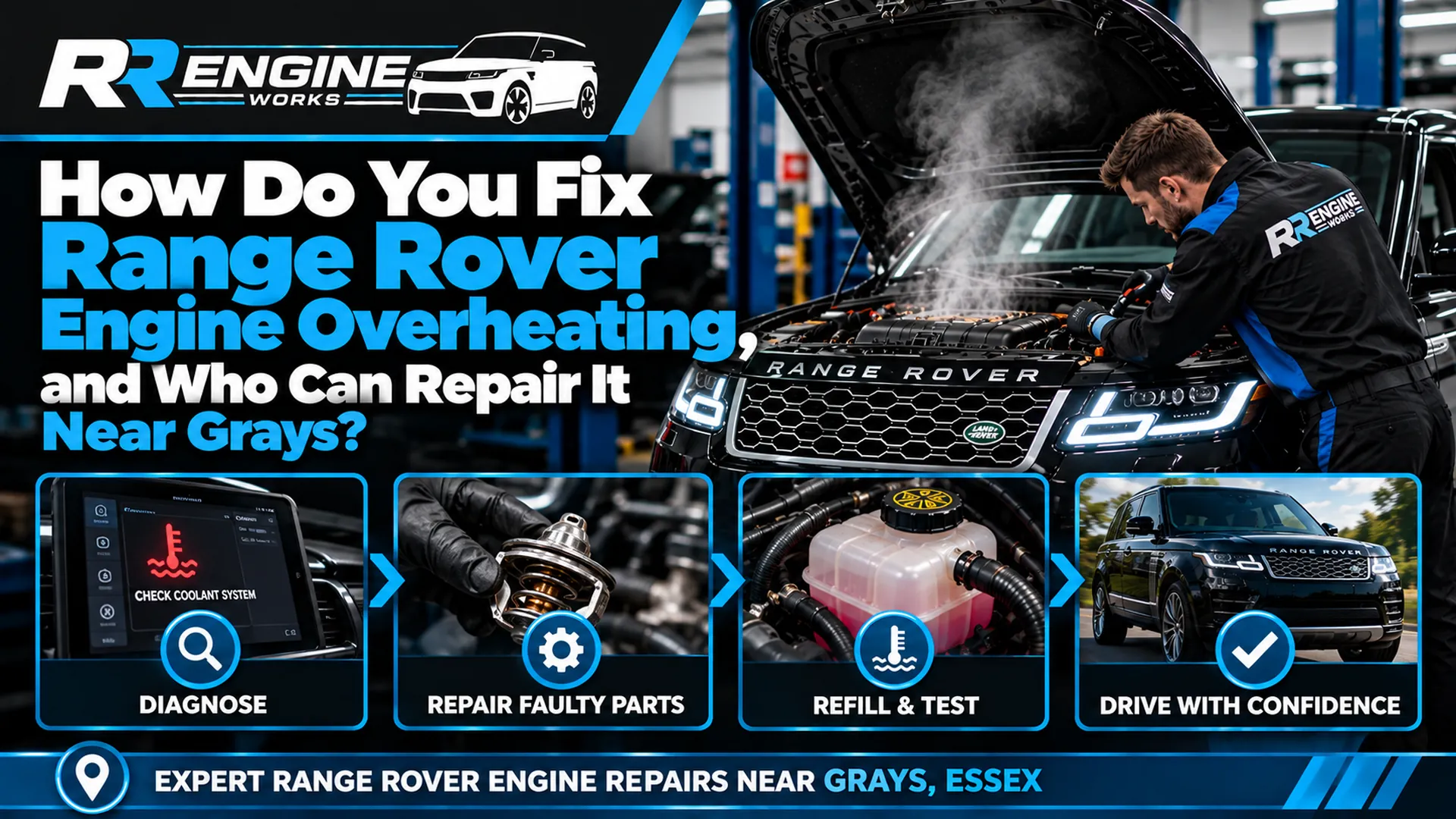
Fixing overheating properly means finding the root cause. Topping up coolant and clearing the message doesn't solve what causes a range rover to overheat. It only buys you a few more miles.
How Does RR Engine Works Diagnose and Fix Range Rover Engine Overheating?
If you're wondering range rover engine overheating how to fix, our process follows a clear order:
- Cooling system pressure test. We find leaks and pressure loss, including ones that don't show on the ground.
- Thermostat and water pump check. We confirm coolant is flowing and the thermostat opens correctly.
- Fan and radiator inspection. We test fan operation and check the radiator for blockages and damage.
- Air-lock bleeding. We remove trapped air so the system fills properly.
- Head gasket test. If other components pass, we test for combustion gases in the coolant.
- Repair and road test. We replace the failed part, refill with the correct coolant and test under real conditions.
You'll get a plain explanation of what failed and a quote before any major work begins. If the fault is simple, you'll hear that too.
Not sure of your coolant type? Use the correct specification for your model and don't mix types. If in doubt, ask us before topping up.
Based in or near Grays? You'll find us at Unit 1, Hedley Ave, Grays RM20 4EL, with easy access from the A13 and M25. Call or message us to arrange recovery or book a diagnostic.
Frequently Asked Questions
Why is my Range Rover overheating?
The usual causes are low coolant, a leak, a stuck thermostat, a failing water pump, a blocked radiator, faulty fans or a head gasket fault. A pressure test shows which one it is.
What causes a Range Rover to overheat in traffic?
Fans and airflow are the first suspects. At speed, air passes through the radiator naturally. In traffic, the fans do that work, and a faulty fan lets temperatures climb.
How far can I drive with the engine overheating?
Don't. Stop safely and switch off. Even a short distance can cause serious damage.
What happens when an engine overheats?
Coolant boils, the head gasket can fail, the cylinder head can warp and oil loses its protection. Left unchecked, the engine may need a rebuild.
What do the Range Rover overheating warning and light mean?
The cooling system is struggling. Amber means act quickly. Red means stop immediately.
Can I reset the overheating warning myself?
You can clear the message, but it will return unless the cause is repaired.
Do you work on the Evoque, Sport and Velar?
Yes, we handle all three, plus other Range Rover and Land Rover models.
Don't Gamble With an Overheating Range Rover
Range Rover engine overheating is a fault where speed decides the bill. Stop early and you're likely looking at a hose, thermostat or fan. Wait and the same fault can become an engine rebuild.
If your temperature gauge is climbing, a warning has appeared or your coolant keeps disappearing, get it checked. RR Engine Works, Unit 1, Hedley Ave, Grays RM20 4EL, will diagnose it properly, explain your options clearly and get you back on the road with confidence.