

Your Range Rover feels different the moment the clutch starts to go. The bite point creeps higher up the pedal, gear changes feel vague, and there's a nagging worry every time you pull away from a junction that the car might not respond the way it should. If that sounds familiar, you're not imagining things, and you're not alone. Clutch wear is one of the most common mechanical issues Range Rover owners bring to us, and it rarely fixes itself.
This guide walks you through everything you need to know about a Range Rover clutch replacement, from spotting the early warning signs to understanding what the job actually involves, what it costs, and why getting it done properly the first time matters far more than getting it done cheaply.
How Do You Know If Your Range Rover Needs a Clutch Replacement?
Clutch problems rarely appear out of nowhere. They build gradually, which is exactly why so many drivers miss the early signs until the car starts struggling to perform basic tasks like pulling away or changing gear smoothly.
Here's what tends to show up first, and what each symptom usually means:
- The car struggles to accelerate despite high revs, a classic sign of clutch slipping, where the clutch disc can no longer grip the flywheel properly.
- Gear changes feel notchy or resistant, often linked to a worn clutch disc, a failing pressure plate, or hydraulic clutch problems.
- A burning smell after hill starts or heavy traffic, usually caused by excessive clutch slip generating friction heat.
- Vibration through the pedal or floor when pulling away, frequently points to a worn dual mass flywheel rather than the clutch itself.
- The clutch pedal feels unusually soft or sinks to the floor, a strong indicator of a hydraulic issue in the master cylinder or slave cylinder.
What Are the Signs of a Slipping Clutch?
A slipping clutch is the most common reason Range Rover owners book a clutch replacement. You'll notice the engine revs climbing faster than the car actually accelerates, particularly under load, towing, overtaking, or driving uphill. This happens because the friction disc has worn down and can no longer maintain full contact with the flywheel, so power from the engine isn't being transferred efficiently to the wheels.
Left unaddressed, a slipping clutch gets progressively worse. What starts as an occasional issue under heavy acceleration can quickly become a daily problem, and continuing to drive on a badly slipping clutch increases the risk of damage to the flywheel and gearbox.
Why Does My Clutch Pedal Feel Soft or Hard to Press?
Pedal feel tells you a lot about what's actually failing.
A soft or spongy clutch pedal usually points to a hydraulic clutch problem, air in the system, a failing master cylinder, or a leaking slave cylinder. In these cases, the clutch disc itself might still have life left in it, but the hydraulic system isn't applying enough pressure to disengage it properly.
A hard or heavy clutch pedal, on the other hand, often signals a mechanical issue with the clutch fork, release bearing, or pressure plate. Some drivers describe it as feeling like the pedal is fighting back.
Either way, pedal feel changes are rarely something to ignore. A proper diagnostic check will tell you whether you're looking at a full clutch and flywheel replacement or a smaller hydraulic repair.
What Causes a Burning Smell or Judder When Changing Gear?
A burning smell, often compared to burning toast or hot brakes, is caused by friction material overheating as the clutch slips against the flywheel. This tends to happen most during hill starts, stop-start traffic, or when towing, situations where the clutch is asked to work hardest.
Judder, meanwhile, is a shuddering sensation felt through the car as you pull away, and it can have a few different causes:
- Worn or contaminated clutch friction material
- Oil or grease contamination on the clutch disc, often from a leaking rear main seal
- A worn dual mass flywheel that's no longer absorbing engine vibrations properly
- Loose or worn engine and transmission mounts
Because judder can stem from several different components, an accurate diagnosis is essential before any parts get ordered.
Can a Worn Clutch Damage Your Range Rover's Gearbox?
Yes, and this is one of the most important reasons not to delay a clutch replacement once symptoms appear. A badly slipping clutch generates excess heat, and that heat doesn't stay contained to the clutch assembly. Over time, it can affect the flywheel surface, the input shaft, and in more severe cases, contribute to premature gearbox wear.
Continuing to drive on a failing clutch doesn't just risk being stranded, it risks turning a clutch replacement into a much more expensive gearbox repair. If you're noticing any combination of the symptoms above, it's worth booking a diagnostic check sooner rather than later.
What Does a Range Rover Clutch Replacement Involve?
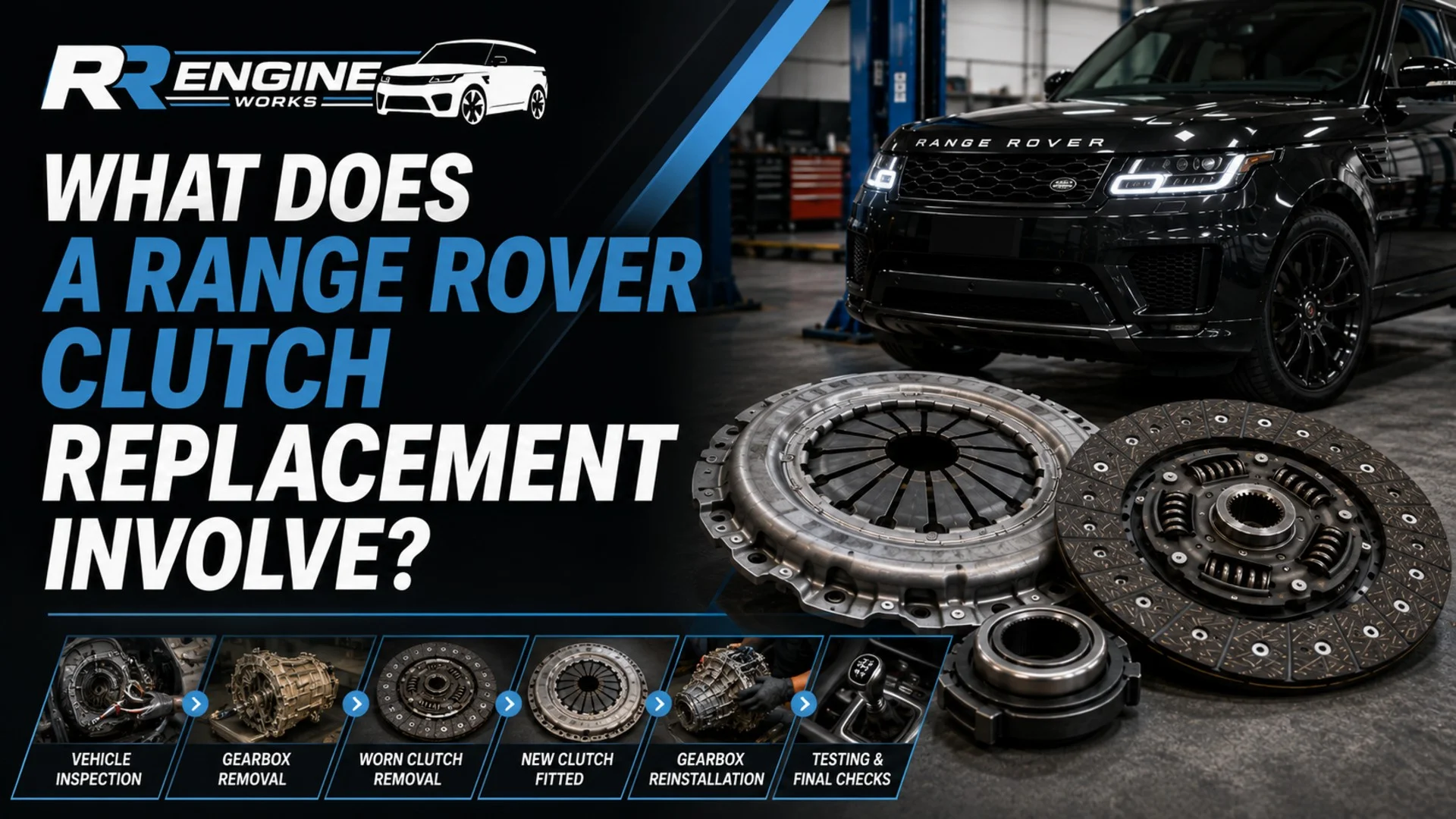
A clutch replacement is a bigger job than most people expect. On most Range Rover models, the gearbox has to come out to access the clutch assembly, which is why this isn't a job to hand over to just anyone with a torque wrench.
What's Included in a Clutch and Flywheel Replacement?
A full clutch replacement typically includes:
- Removal of the gearbox to access the clutch assembly
- Clutch disc (friction plate) replacement, which transfers engine power to the gearbox
- Pressure plate replacement, which clamps the disc against the flywheel
- Release bearing replacement, since it's already exposed and prone to wear
- Flywheel inspection, and replacement if it's a dual mass flywheel showing wear
- Clutch alignment and torque checks to manufacturer specification
- Gearbox oil top-up or replacement where required
- Road test to confirm smooth engagement, bite point, and gear selection
Because the gearbox has to come out regardless of whether just the clutch disc is worn, most reputable garages, including ours, recommend replacing the full clutch kit and inspecting the flywheel at the same time. Going back in a year later to replace a flywheel that could have been swapped out during the original job means paying for the same labour twice.
Genuine vs Aftermarket Clutch Kits, LUK, Sachs & Valeo Compared
One of the biggest decisions in any clutch replacement is which parts to fit. Range Rover clutch kits generally come from a small handful of trusted manufacturers, each with a slightly different reputation.
Brand | Known For | Typical Use Case |
| LUK | OE-quality kits, often the original equipment supplier for Land Rover | Best for owners wanting factory-matched performance and feel |
| Sachs | Strong reputation for durability and smooth engagement | Popular choice for daily drivers and towing use |
| Valeo | Competitive pricing with solid mid-range reliability | Good balance of cost and performance |
| Borg & Beck | Budget-friendly, aftermarket standard | Suitable for older or lower-mileage vehicles |
| Genuine Land Rover Parts | Manufacturer-specified components | Ideal for warranty-conscious owners or newer vehicles |
Genuine and OEM-matched kits (like LUK, which supplies Land Rover directly) tend to offer the closest match to original driving feel and are generally the safer long-term choice for a vehicle you plan to keep. Aftermarket alternatives can be a reasonable option for older vehicles where cost is the priority, but quality varies significantly between brands, which is why we only fit parts from manufacturers with a proven track record on Range Rover applications.
Do You Need a Dual Mass Flywheel Replacement Too?
Not always, but it's worth checking every time. A dual mass flywheel (DMF) is designed to absorb engine vibrations before they reach the gearbox, and it has a limited lifespan of its own.
Signs your DMF may need replacing alongside the clutch include:
- Rattling noise at idle, particularly noticeable in neutral
- Vibration through the pedal or gear lever
- Judder on take-off even after a fresh clutch has been fitted
Skipping a worn flywheel to save money on a clutch job is a false economy. A tired flywheel paired with a brand-new clutch disc can wear the new clutch prematurely, meaning you end up paying for another repair sooner than you should.
How Long Does a Range Rover Clutch Replacement Take?
Most Range Rover clutch replacements take between one and two full working days, depending on the model and whether any complications arise during the gearbox removal. Models with more complex drivetrain layouts, such as four-wheel-drive Evoque and Sport variants, can take slightly longer due to the additional components that need to be removed to access the gearbox.
As a general guide:
- Straightforward clutch and flywheel replacement: around 6–8 hours of labour
- Jobs involving additional flywheel resurfacing, seal replacement, or mount replacement: can extend to a full day or more
We'll always give you a realistic timeframe once we've had a chance to inspect the vehicle, rather than a generic estimate that doesn't account for your specific model or mileage.
How Much Does a Range Rover Clutch Replacement Cost?
Clutch replacement costs vary more than most owners expect, largely because of the labour-intensive nature of removing the gearbox, combined with the difference in parts pricing between models.
Clutch Replacement Cost by Model
While exact pricing depends on the specific vehicle, age, and parts chosen, here's a general sense of how costs typically compare across the range:
Model | Relative Cost Level | Notes |
| Range Rover Evoque | Lower-to-mid range | Compact drivetrain, generally more accessible |
| Range Rover Sport | Mid-to-higher range | Larger transmission, more labour-intensive |
| Range Rover Velar | Mid-to-higher range | Similar complexity to the Sport |
| Land Rover Discovery / Discovery Sport | Mid range | Comparable to Evoque in most cases |
| Land Rover Defender | Varies by generation | Older manual Defenders often cost less than newer models |
Because so many variables affect the final price, engine size, drivetrain configuration, part quality selected, and whether a dual mass flywheel needs replacing, we'd always recommend getting a specific quote for your vehicle rather than relying on a generic average.
What Affects Labour and Parts Pricing?
A few key factors influence the final cost of your clutch replacement:
- Gearbox complexity, four-wheel-drive systems and larger transmissions take longer to remove and refit
- Flywheel condition, a worn dual mass flywheel adds parts cost but saves you paying for labour twice down the line
- Parts brand chosen, genuine and premium OEM-matched kits cost more upfront than budget aftermarket options
- Additional wear items found during inspection, such as leaking seals, worn mounts, or hydraulic components that make sense to replace while the gearbox is already out
- Vehicle age and mileage, older vehicles sometimes have seized fasteners or corrosion that adds time to the job
Get an Instant Clutch Replacement Quote
The most accurate way to know what your Range Rover clutch replacementengine repair specialists will cost is to get it assessed directly. Every vehicle is different, and a proper quote should reflect your specific model, mileage, and the parts that make the most sense for how you use the car. Get in touch with RR Engine works for a no-obligation quote tailored to your Range Rover.
Why Choose RR Engine works for Your Range Rover Clutch Replacement?
Not every garage is equipped to handle Range Rover drivetrain work properly. Clutch and gearbox jobs on these vehicles demand specific tools, genuine diagnostic knowledge, and familiarity with the quirks of each model, and getting it wrong can be a costly mistake.
Specialist Land Rover & Range Rover Mechanics in Grays, Essex
At RR Engine works, Range Rover and Land Rover repairs are what we focus on day in, day out. That means our technicians are already familiar with the common failure points on models like the Evoque, Sport, Velar, Defender, and Discovery, rather than treating your vehicle as a one-off learning exercise.
We're based at Unit 1 Hedley Ave, Grays, RM20 4EL, serving Range Rover owners across Grays, Essex, and the wider Thames Estuary area who want their vehicle handled by people who genuinely understand the marque.
Genuine Parts & Warranty-Backed Repairs
Every clutch replacement we carry out uses parts sourced from trusted manufacturers, including LUK, Sachs, and Valeo, matched to your specific model and driving needs. We'll always talk you through the parts options available, so you can decide what's right for your budget and how you use your vehicle, rather than being sold whatever's sitting on the shelf.
All clutch replacement work carried out at RR Engine works is backed by a workmanship warranty, giving you confidence that if anything isn't right, it gets sorted without a fight.
What Our Customers Say About Us
Range Rover owners come to us because clutch and gearbox work isn't something they want to gamble on. If you'd like to hear directly from customers who've had clutch and drivetrain work carried out with us, we're always happy to share references and recent feedback, just ask when you get in touch.
Frequently Asked Questions
Is Clutch Replacement Covered Under Warranty?
It depends on the age and warranty terms of your vehicle. Manufacturer warranties on newer Range Rovers may cover clutch failure if it's due to a manufacturing defect, but general wear and tear is typically excluded from most standard warranties. Extended or aftermarket warranties vary significantly, so it's worth checking your specific policy documents or asking us to help clarify what's covered before booking any work.
Can I Drive My Range Rover With a Slipping Clutch?
Technically, yes, for a short period. But it's not advisable. Driving on a slipping clutch generates excess heat, accelerates wear on the flywheel, and increases the risk of sudden clutch failure, potentially leaving you stranded. If you're noticing symptoms, it's far better to get the vehicle assessed promptly than to keep driving and risk more expensive damage.
Will a Worn Clutch Fail an MOT?
A clutch itself isn't a specific MOT test item, but symptoms of clutch failure, such as the car failing to move under power, or unsafe gear selection, can result in a fail if they affect the vehicle's ability to be tested safely or if related components (like worn mounts) create broader safety concerns. It's best not to wait until MOT time to address clutch symptoms.
How Do I Know If It's the Clutch or the Gearbox That's Faulty?
This is one of the most common questions we get, and it's genuinely difficult to diagnose without a proper inspection. Slipping, burning smells, and difficulty engaging gears often point to the clutch, while grinding noises, gears popping out on their own, or difficulty selecting gears even with the clutch fully depressed can indicate a gearbox issue. A road test combined with a hands-on inspection is the only reliable way to know for certain, guessing based on symptoms alone can lead to unnecessary parts being replaced.
Book Your Range Rover Clutch Replacement Today
A slipping clutch doesn't get better on its own, and the longer it's left, the more likely it is to turn into a bigger and more expensive repair. If you've noticed any of the symptoms covered in this guide, slipping, judder, a burning smell, or a pedal that doesn't feel right, it's worth getting your Range Rover looked at properly.
Visit Us at Unit 1 Hedley Ave, Grays RM20 4EL
RR Engineworks specialises in Range Rover and Land Rover clutch, flywheel, and gearbox repairs, using genuine and OEM-matched parts fitted by technicians who know these vehicles inside and out. Get in touch today for a straightforward, no-pressure quote on your Range Rover clutch replacement, and get back to driving with confidence.