
You're either thinking of buying a Range Rover with the 4.4 V8 diesel, or you already own one and the warning lights, oil smells or repair quotes are making you nervous. Both situations come down to the same question: is this engine a good one, and what will it cost you to keep it healthy?
Short answer: the 4.4 V8 diesel is a strong, refined engine with serious pulling power, but it punishes neglect. Service it on time and it can cover big mileage. Skip the oil changes and the repair bills get ugly.
This guide covers the specs, the differences between the TDV8 and SDV8, the faults we see at our Grays workshop, and what repair or replacement realistically costs in the UK. If you want a straight answer on your own engine, request a free quote or diagnostic from RR Engine Works.
What Are the Range Rover 4.4 V8 Diesel Engine Specs, and What Separates the TDV8 from the SDV8?
Owners often use "TDV8" and "SDV8" as if they were one engine. They're related, but they aren't identical, and the difference matters when you're comparing cars, ordering parts or checking a quote.
What Are the Range Rover 4.4 V8 Diesel Specs, Horsepower, Oil Capacity and MPG?
The 4.4-litre diesel is a twin-turbo V8 with a compacted graphite iron block, aluminium cylinder heads and sequential turbocharging. It's a close relative of the Ford and PSA "Lion" diesel family. It powered the Range Rover (L322 and L405) and the Range Rover Sport, which is why searches for the Range Rover Vogue 4.4 V8 diesel engine and Range Rover Sport 4.4 V8 diesel engine overlap so heavily.
Here are the Range Rover 4.4 V8 diesel engine specs by generation. Figures are approximate and vary slightly by model year and market.
Spec | 4.4 TDV8 (368DT) | 4.4 SDV8 (448DT) early | 4.4 SDV8 (448DT) later |
| Typical years | 2007–2009 | 2010–2012 | 2013 onwards |
| Capacity | 4,367cc | 4,367cc | 4,367cc |
| Layout | V8, twin sequential turbo | V8, twin sequential turbo | V8, twin sequential turbo |
| Horsepower | ~268 bhp (271 PS) | ~308 bhp (313 PS) | ~334 bhp (339 PS) |
| Torque | ~640 Nm | ~700 Nm | ~740 Nm |
| Official combined mpg | High 20s | Around 30 | Mid to high 30s (older test cycle) |
| Realistic mpg | 22–27 | 24–29 | 26–32 |
A few practical notes on the numbers people search for most:
- Range Rover 4.4 V8 diesel engine horsepower: from roughly 268 bhp on the early TDV8 up to about 334 bhp on later SDV8s.
- Range Rover 4.4 V8 diesel engine fuel consumption and mpg: expect the high 20s on a mixed run, a little better on a steady motorway cruise, and noticeably worse towing or doing short school-run trips.
- Range Rover 4.4 V8 diesel engine oil capacity: roughly 8 litres with a filter change. Always confirm the exact figure for your model year and VIN against the handbook or workshop manual before you drain anything.
- Who makes it? The engine was developed for Land Rover from the Ford and PSA diesel V-engine programme and built in the UK.
What Is the Difference Between the 4.4 TDV8 and SDV8 Engine?
The 4.4 TDV8 was the first version, found in the 2007–2009 Range Rover and Range Rover Sport. The SDV8 arrived around 2010 with more power and torque, and Land Rover refined it again in later years.
Here's how they compare in practice:
- Power and torque: the SDV8 produces noticeably more, especially in later cars.
- Refinement: later SDV8s feel smoother and quieter under load.
- Maintenance sensitivity: both punish stretched oil intervals, and later cars with particulate filters add oil dilution to the list of risks.
- Parts: many components are not interchangeable between versions, so always quote against your engine code (368DT or 448DT), not just "4.4 diesel".
If you're weighing up an SDV8 vs TDV8 reliability question, there's no clear winner on design alone. A well-serviced TDV8 beats a neglected SDV8 every time. Service history matters more than the badge.
Is the 4.4 V8 Diesel Engine Reliable, and What Are the Most Common Problems?
Reliability is the question behind most searches for a Range Rover 4.4 V8 diesel engine review. Here's our honest view from the workshop floor.
Is the Range Rover 4.4 TDV8 a Good Engine, and How Reliable Is It Long-Term?
Yes, it's a good engine, with a condition attached. The 4.4 delivers effortless torque, tows heavy loads and cruises quietly. Owners love it for good reason.
The condition is maintenance. These engines run tight tolerances, hot oil and a lot of heat. When oil changes are done on the factory interval (or stretched further), problems appear earlier and cost more. When they're done more often, the same engines run for a very long time.
A scenario we see regularly: a buyer picks up a cheap, high-mileage Range Rover with "full service history" that turns out to be two stamps and a stack of receipts. Six months later the oil cooler weeps, the timing chain starts rattling at the back of the engine, and the car is off the road. Under the surface, the real cost wasn't the purchase price. It was the missing maintenance.
If you're asking is the Range Rover 4.4 a good engine before buying, the answer is yes if you can verify its history and budget for proper servicing. If you can't, walk away or have a specialist inspect it first.
What Are the Common Engine Problems with the Range Rover 4.4 SDV8?
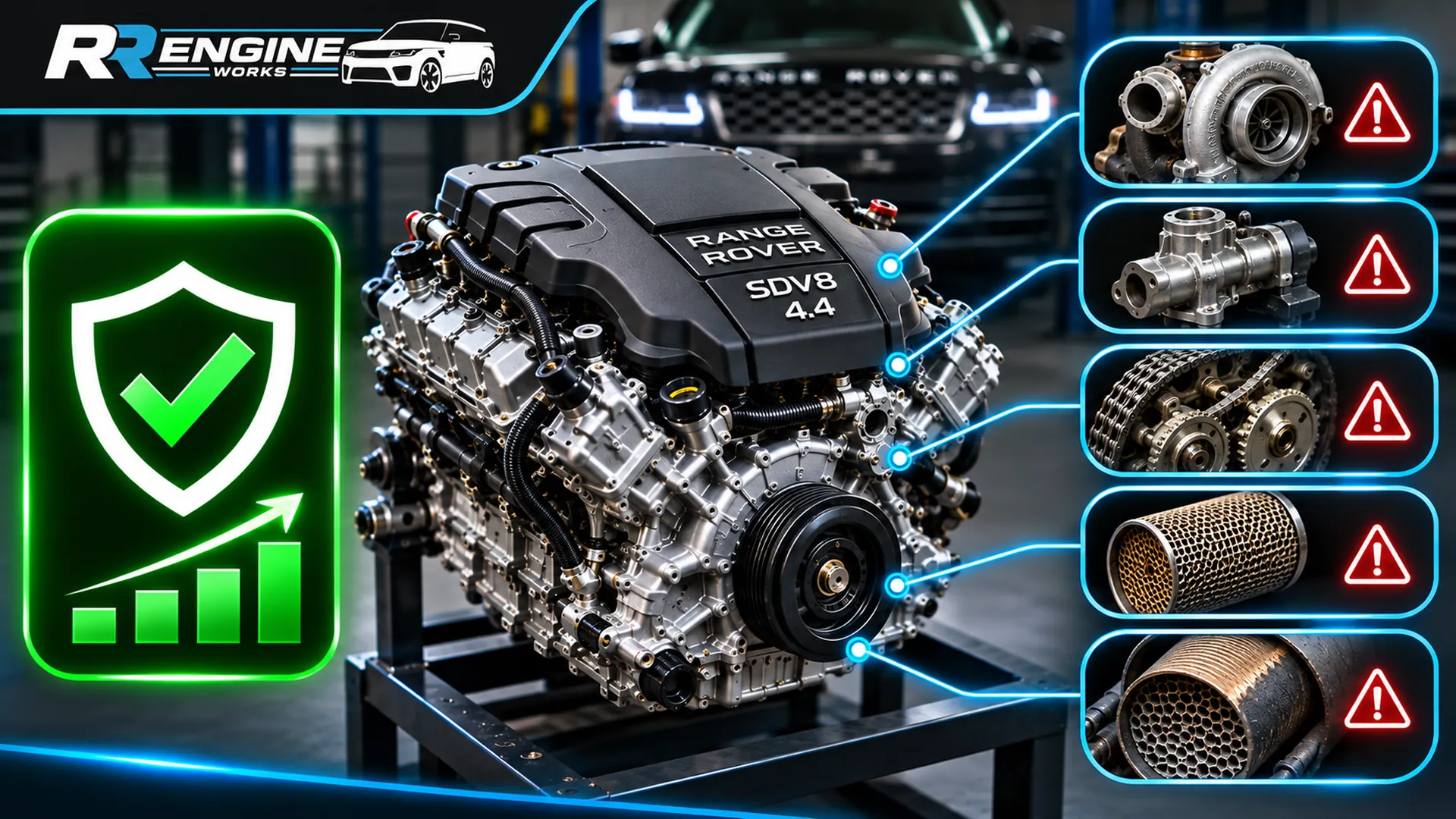
These are the Range Rover 4.4 SDV8 common problems we see most often. Knowing them helps you spot trouble early, which is the biggest factor in keeping repair costs down.
Problem | What you notice | Why it happens | What to do |
| Timing chain wear (rear of engine) | Rattle or whine on start-up, then fault codes | Chains and guides wear, especially with long oil intervals. The rear location makes the job labour-heavy. | Get it checked early. Delay can lead to serious engine damage. |
| Oil cooler leaks | Oil on or around the engine valley, coolant and oil mixing, low coolant | Seals and the cooler itself age and fail | Replace the cooler and seals together, and check for contamination |
| Turbo, boost hose and VGT actuator faults | Loss of power, limp mode, whistling, boost fault codes | Wear, split hoses, sticking or failing actuators | Diagnose first. A split hose is far cheaper than a turbo. |
| EGR and inlet carbon build-up | Rough running, smoke, reduced power | Soot and oil vapour clog the intake and EGR system | Clean or replace affected parts, and address the cause |
| Oil dilution from DPF regeneration | Rising oil level, thin oil, fuel smell in the oil | Regeneration cycles push fuel into the sump, especially on short journeys | Shorten oil change intervals and avoid constant short trips |
| Big-end and main bearing wear | Knocking, low oil pressure, metal in the oil | Usually follows poor lubrication or heavy neglect | Stop driving. This typically means a rebuild or replacement. |
Three points to take from this:
- Most of these faults start small. A damp seal, a faint rattle or a small power dip rarely announces a catastrophe. It signals one that's coming.
- They often cascade. Oil dilution accelerates bearing wear, which in turn leads to a much bigger repair bill.
- Diagnosis beats guesswork. Replacing parts without finding the root cause is how people end up paying twice.
If your car shows any of these symptoms, book an inspection at RR Engine Works. We'll find the cause and give you a clear, written recommendation before any work starts.
Where Can You Find a 4.4 V8 Diesel Engine for Sale in the UK, and What Does Repair Cost?
When an engine fails badly, you have three realistic options: repair it, replace it with a reconditioned unit, or fit a used one. Searches for a Range Rover 4.4 V8 diesel engine for sale (and its UK variant) usually come from owners facing that exact decision.
Should You Repair, Recondition or Replace? Range Rover 4.4 V8 Diesel Engine for Sale in the UK
The right choice depends on what has failed, the car's value and how long you plan to keep it. Here's the comparison, with indicative UK figures for independent specialist work. Treat them as guides, not quotes.
Option | Best for | Typical UK cost | Warranty | Risk level |
| Targeted repair (oil cooler, turbo, EGR, hoses) | Single-component faults, healthy bottom end | £500 – £3,000 | Usually workmanship-based | Low, if diagnosed correctly |
| Timing chain repair | Early-stage chain wear | £2,500 – £5,000 | Workmanship and parts | Medium. It depends on how early it's caught. |
| Reconditioned engine fitted | Bearing failure, major damage, long-term ownership | £6,000 – £10,000+ | Often longer than used | Low to medium |
| Used engine fitted | Tight budgets, lower-value cars | £3,500 – £7,000 | Limited | Higher. History and provenance vary. |
If you're considering a 4.4 SDV8 engine for sale, use this checklist before you pay:
- Ask for proof of provenance, including where it came from and the donor car's mileage.
- Check service history for the donor vehicle, if available.
- Confirm the engine code (368DT or 448DT) matches your car.
- Ask what's included. Turbos, ancillaries and sensors are often sold separately.
- Get warranty terms in writing, including labour cover.
A cheap used engine with an unknown past can turn out to be the most expensive option. If you're also looking for a petrol alternative, we cover the older 4.6 Rover V8 engine for sale options on our 4.6 Rover V8 engine repair page.
Why Choose RR Engine Works for Range Rover 4.4 V8 Diesel Engine Repair in Grays, Essex?
You want a workshop that diagnoses before it quotes, and tells you the truth even when the truth is "don't spend that money".
RR Engine Works is based at Unit 1, Hedley Ave, Grays RM20 4EL, serving owners across Essex, London and the surrounding area.
Here's what you can expect:
- Diagnosis first. We identify the cause before recommending a fix.
- Itemised, written quotes that separate labour, parts and machining.
- Honest advice on repairing, reconditioning or replacing, including when not to proceed.
- Specialist knowledge across diesel and petrol Land Rover engines, from the 4.4 TDV8 and SDV8 to the classic Rover V8.
- Straightforward communication on turnaround and any new findings once the engine is open.
Whether you need a pre-purchase inspection, a timing chain assessment or a full engine solution, get in touch with our team for a free quote.
Frequently Asked Questions
What is the most common 4.4 SDV8 problem?
Timing chain wear at the rear of the engine and oil cooler leaks are among the most common. Oil dilution from particulate filter regeneration is also frequent, especially on cars that mostly do short trips.
Does the 4.4 SDV8 have a timing belt or a timing chain?
It uses timing chains, not a belt. The chains sit at the rear of the engine, which is why replacing them is labour-intensive and can be expensive if left too late.
What is the oil capacity of the Range Rover 4.4 V8 diesel engine?
Roughly 8 litres with an oil filter change. Check the exact figure for your model year in the handbook or workshop manual before servicing.
How many miles will a 4.4 SDV8 last?
A well-maintained engine can pass 150,000 miles and often much more. Longevity depends mainly on oil change frequency, driving pattern and how early faults were dealt with.
Should I buy a 4.4 SDV8 with no service history?
Be very careful. Missing history raises the risk of hidden timing chain, oil cooler and bearing problems. If you do consider one, budget for a specialist inspection and factor in potential repair costs when negotiating the price.
Who makes the Range Rover 4.4 TDV8 engine?
The engine was developed for Land Rover from the Ford and PSA diesel V-engine programme and built in the UK.
Is the Range Rover 4.4 V8 diesel engine good on fuel?
For its size and output, it's reasonable. Expect the high 20s mpg in mixed driving. Towing, heavy loads and short journeys will reduce that.
Keep Your Range Rover 4.4 V8 Diesel Engine Reliable and Out of the Bill Queue
The 4.4 V8 diesel earns its reputation for power and refinement, but it rewards owners who stay ahead of problems. Pay attention to oil changes, listen for new noises and act on the early symptoms, and this engine can serve you for years.
If something already feels wrong, or you're about to buy one, don't guess. A proper inspection costs a fraction of what a missed fault will.
Visit RR Engine Works at Unit 1, Hedley Ave, Grays RM20 4EL, or request your free quote online today.