
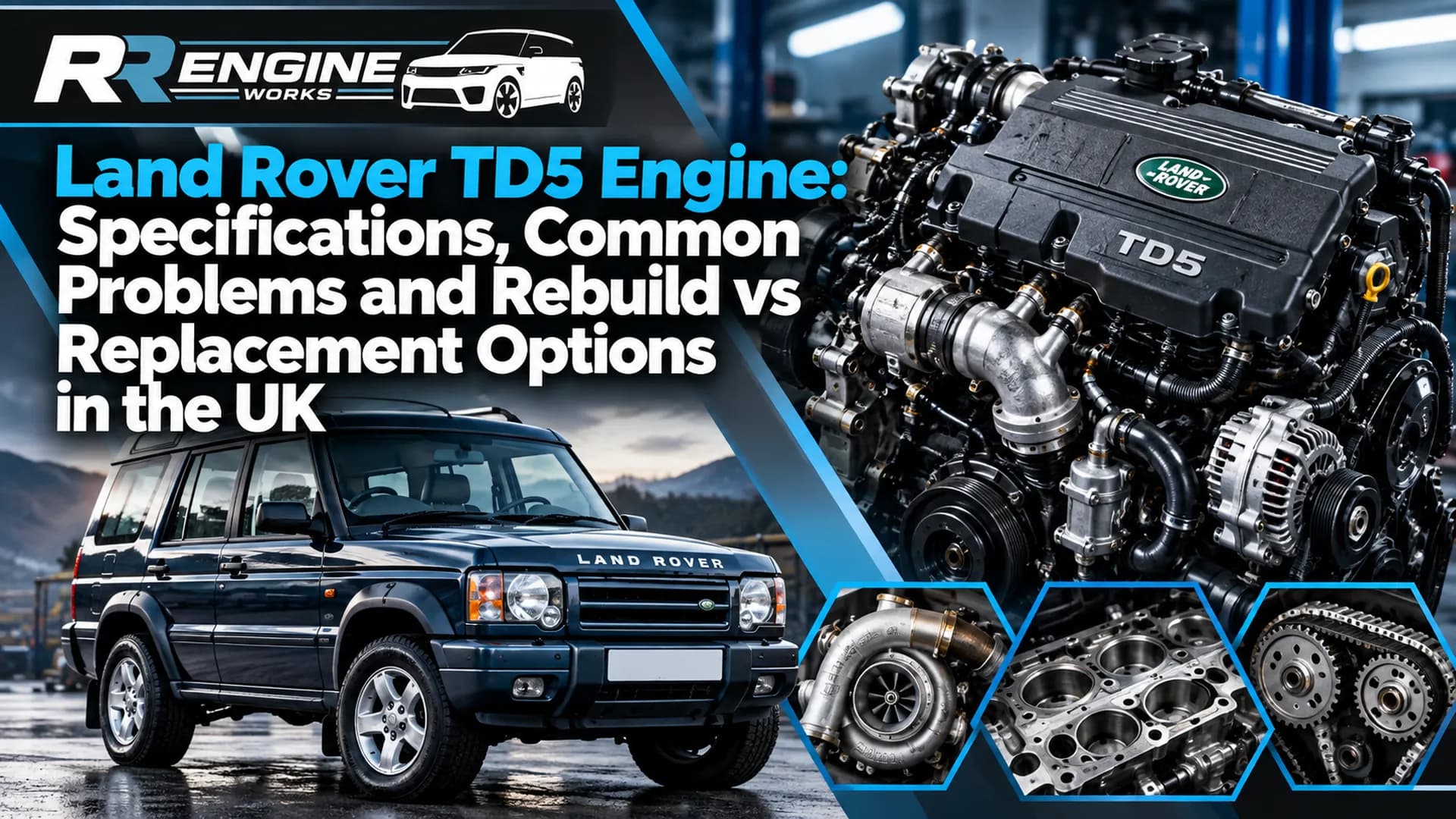
Your Defender is running rough, your Discovery 2 is dropping coolant, or a garage has just told you the engine is "on its way out." Now you have a choice to make, and it will cost real money whichever way you go.
The Land Rover TD5 engine deserves its reputation. It is simple to work on, strong when looked after, and still pulls a trailer or climbs a green lane the way few modern diesels can. It also has a short list of known weak points, and knowing them early is the difference between a cheap fix and a full engine replacement.
This guide covers what the TD5 is, how to identify yours, what tends to go wrong, and how to decide between repairing, rebuilding or replacing it. If you are already at the decision stage, jump straight to the cost section and send RR Engine Works your engine code for a quote.
What Is the Land Rover TD5 Engine and Which Vehicles Use It?

The TD5 is a 2.5-litre, five-cylinder, turbocharged diesel built by Land Rover (part of the Rover Group at the time, developed as "Project Storm"). It replaced the older 200Tdi and 300Tdi engines and brought electronic engine management to the Land Rover diesel range for the first time.
In practical terms, that means an ECU controlling electronic unit injectors, a turbocharger sized for low-down pull, and a sturdier bottom end than the engines before it. You will find it in the Defender 90, 110 and 130, and in the Discovery 2 (Series II).
What Are the Land Rover TD5 Engine Specifications, Power and Torque?
Here are the core specifications at a glance:
Feature | Detail |
| Configuration | Inline five-cylinder (inline-5) |
| Capacity | 2.5 litres (around 2,495 cc) |
| Fuel | Diesel, electronic unit injection (EUI) |
| Aspiration | Turbocharged, with intercooler |
| Block and head | Cast iron cylinder block, aluminium cylinder head |
| Timing | Timing chain |
| Power | Around 122 bhp in most Defenders, up to about 136 bhp in later Discovery 2 versions |
| Torque | Roughly 300 Nm in Defender form; higher in later Discovery 2 outputs |
Figures vary by year and vehicle, so always confirm against your own documentation.
Numbers only tell part of the story. What owners actually value is low-end torque. The TD5 pulls cleanly from low revs, which is why it suits towing, loaded expedition work and slow off-road driving so well.
Which Defender and Discovery 2 Models Have a TD5, and What Do 10P, 15P and 16P Mean?
Land Rover used three engine codes across the TD5 family: 10P, 15P and 16P. Broadly, 10P covers the earlier engines, while 15P and 16P are later revisions with changes to the engine management and running gear.
Why does this matter? Because when you replace an engine, the code decides which ECU, wiring loom and ancillary parts you need. Fit the wrong combination and you end up with warning lights, a car that will not start, or worse.
To identify yours:
- Check the engine number stamped on the block, and read the code prefix.
- Cross-check it against the vehicle's build year and V5C.
- Photograph the number before you ring any engine supplier. It saves time and avoids the wrong quote.
If you are unsure, send us the number and we will confirm compatibility before anything is ordered.
What Are the Most Common Land Rover TD5 Engine Problems and How Are They Fixed?
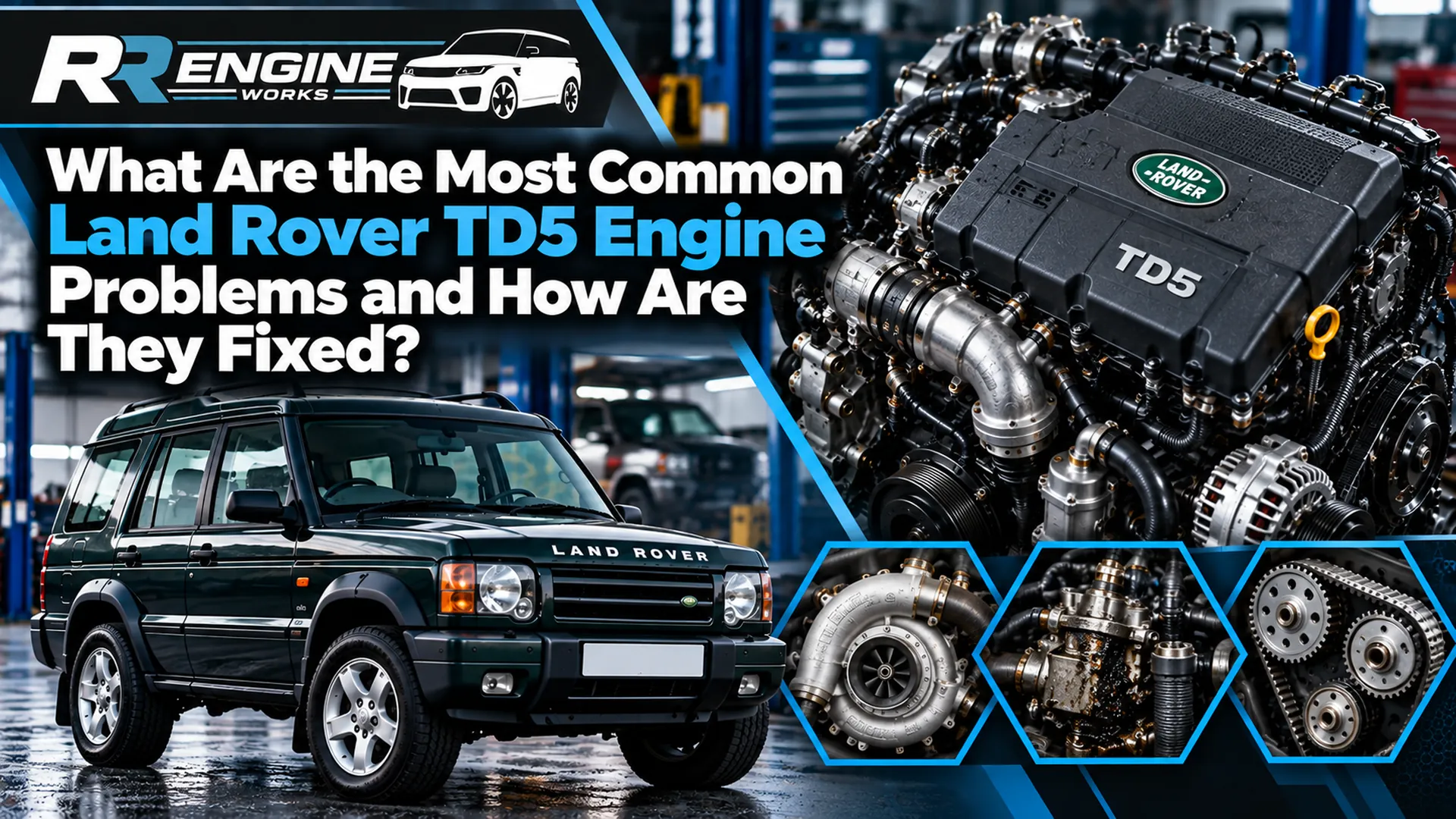
The TD5 is not fragile. But it has a handful of well-documented faults, and most of them give you warning signs before they become expensive. The trick is catching them early.
Why Is There Oil in the TD5 Injector Loom and ECU Connector?
This is the classic TD5 fault. Engine oil creeps along the injector wiring by capillary action, works its way through the loom and ends up in the ECU connector, often called the red plug.
Once oil contaminates the connector, the injector signals get disrupted. You will notice:
- Rough idle that comes and goes
- Misfiring under load
- Hard starting or intermittent no-start
- The engine cutting out unexpectedly
The fix depends on how far it has gone. In the best case, a new injector loom, new injector seals and a clean ECU connector put things right. If the contamination has been left for years, the ECU itself may be affected. Either way, fixing the leak at the source matters. Cleaning the plug without replacing a leaking loom just takes a few weeks.
Can a TD5 Oil Pump Bolt or Head Gasket Failure Cause Engine Damage?
Yes, and these two are the ones that turn a repair into a rebuild.
The oil pump bolt. The bolt securing the oil pump can work loose. If it does, oil pressure drops and the bearings can suffer very quickly. It is a cheap part to inspect and secure properly with a thread locker, so many specialists check it as a matter of routine. If your engine has never had this looked at, put it on the list.
The head gasket and cylinder head. Head gasket failure usually shows up as unexplained coolant loss, white smoke, overheating, or coolant pressure in the system. On some engines, the original dowel arrangement and previous poor rebuilds have contributed to the problem. A pressure test of the cylinder head, a skim, and a fresh gasket set often solve it when caught early. If the engine has been driven while overheating, the head can crack and the cost climbs.
Here is a simple rule of thumb from workshop experience. If the engine has lost oil pressure, been badly overheated, or shows metal in the oil, stop repairing symptoms. Get the bottom end inspected before you spend another pound on the top end.
Which TD5 Symptoms Point to Which Fault?
Use this table as a first-pass guide. It does not replace a proper diagnostic scan, but it will help you describe the problem accurately.
Symptom | Likely area | Sensible next step |
| Rough idle | Injector loom, injector seals | Inspect loom and ECU plug for oil |
| Misfire | Injector or electrical fault | Read fault codes, check loom |
| Hard starting | Fuel system, glow plugs, loom | Check fuel pressure and glow plugs |
| Loss of power | MAF sensor, turbo, fuel supply | Scan for codes, check boost pressure |
| Coolant loss | Head gasket, cooling system | Pressure test cooling system |
| Overheating | Head gasket, radiator, thermostat, water pump | Check coolant flow before driving further |
| Oil in ECU plug | Injector loom | Replace loom, clean or check ECU |
| Cutting out | Fuel, ECU or wiring | Diagnostic scan and wiring check |
Other faults worth knowing about include fuel pressure regulator leaks, turbocharger overboost or wastegate problems, and MAF or MAP sensor faults that trigger the engine management light. None of these usually mean the engine is finished, but each is much cheaper to fix early.
Should You Rebuild, Replace or Buy a Reconditioned Land Rover TD5 Engine in the UK?
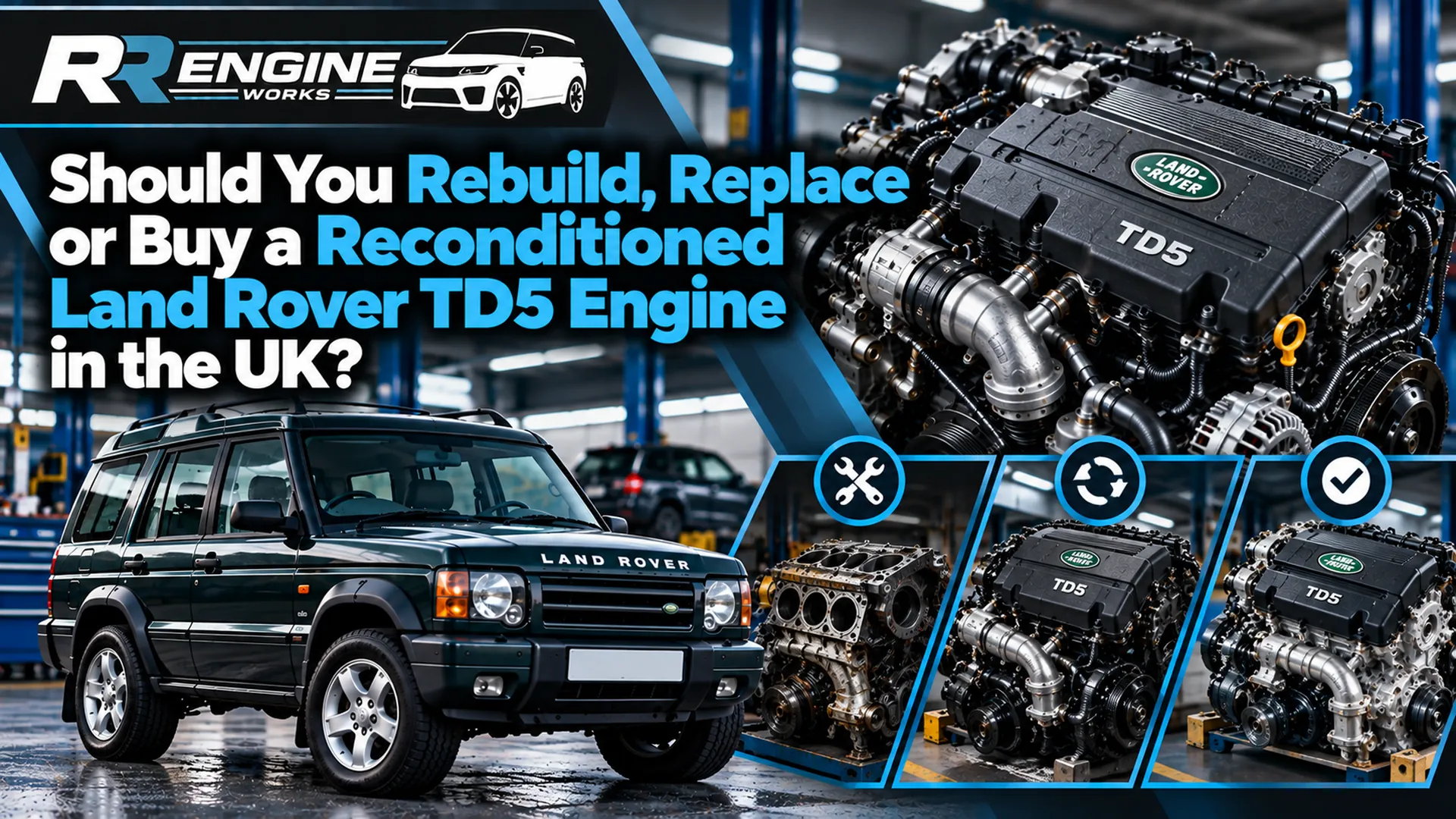
If the bottom end is sound, repair. If it is not, you have three routes: a used engine, a reconditioned engine, or a full rebuild. Each has a place, and the right one depends on your budget, how you use the vehicle, and how long you plan to keep it.
How Much Does a TD5 Engine Replacement Cost, and How Do You Get a Quote from RR Engine Works?
Prices for a TD5 engine replacement vary with the engine condition, whether you want supply only or supply and fit, and what else needs doing at the same time (clutch, turbo, cooling parts, injector loom). Anyone quoting a flat price without asking for your engine code and vehicle details is guessing. We would rather give you a figure that holds.
Here is how the three options compare:
Factor | Used engine | Reconditioned engine | Rebuilt engine |
| Upfront price | Lowest | Mid-range | Highest |
| Known history | Often patchy | Inspected and documented | Usually thoroughly documented |
| Internal components | Original, unchecked | Inspected, worn parts replaced | Stripped, machined and rebuilt |
| Warranty | Limited or none | Generally stronger | Generally strongest |
| Risk | Highest | Moderate | Lowest when done by a specialist |
| Best for | Short-term or budget repairs | Most daily and weekend owners | Long-term keepers and heavy use |
Here is how that plays out in practice.
Scenario one: You have a 15P Discovery 2 with 160,000 miles that has lost its head gasket but has good oil pressure. A cylinder head repair and gasket set may be all it needs, and replacing the whole engine would be overkill.
Scenario two: You have a Defender 110 that used to tow every weekend and now has a knocking noise at idle. That points to bottom end wear. A reconditioned or rebuilt engine is the sensible route, because repairing around worn bearings only delays the bill.
Scenario three: You are buying a "cheap used TD5" from a private seller with no history. You are also buying every previous owner's neglect. If you go that way, check the cold start, smoke colour, coolant condition, oil condition, ECU plug and engine number before paying a penny.
When you contact RR Engine Works, have these ready:
- Your vehicle model and year
- The engine number and code (10P, 15P or 16P)
- The symptoms and any fault codes
- Whether you want supply only, or supply and fit
We will confirm what fits, explain the options honestly, and give you a clear quote. If a repair will do the job, we will tell you that too. Ask us about current warranty terms and UK delivery when you enquire.
Frequently Asked Questions About the Land Rover TD5 Engine
Is the Land Rover TD5 engine reliable?
Yes, when maintained. The TD5's known faults, mainly the injector loom, oil pump bolt and head gasket, are well understood and can be dealt with before they cause major damage. Regular oil changes, a healthy cooling system and prompt attention to warning signs go a long way.
How long does a TD5 engine last?
Many TD5 engines pass 150,000 miles, and well-kept examples go well beyond that. Lifespan depends far more on servicing history and how any overheating or oil pressure problem was handled than on mileage alone.
What is the most common TD5 problem?
Oil contamination in the injector loom and ECU connector is the one most owners meet first. It causes rough running, misfires and starting trouble.
What is the difference between a 10P, 15P and 16P TD5?
They are engine codes marking different production revisions. The code affects which ECU, loom and ancillaries are compatible, so it matters when buying a replacement engine.
Is a reconditioned TD5 engine worth it?
For most owners, yes. It costs less than a full rebuild, has been inspected and repaired, and normally comes with a stronger warranty than a used unit.
Should I rebuild or replace my TD5 engine?
If the block and crankshaft are sound and the fault is limited to the top end, a rebuild or head repair can be enough. If the bottom end is worn or damaged, replacement with a reconditioned or rebuilt engine is usually the better long-term choice.
Can I remap a TD5 for more power?
Yes, and it is a popular upgrade. But a remap puts extra load on an engine, so it is best done on a healthy TD5 with the injector loom, cooling system and oil pump bolt already checked.
Ready to Fix or Replace Your TD5?
A TD5 that is running badly is not a lost cause, and a big bill is not always the answer. What you need is an honest diagnosis, the right engine for your vehicle, and a supplier who will tell you when a smaller repair is enough.
That is what RR Engine Works offers UK owners of Defenders and Discovery 2s. Send us your engine code, model, year and symptoms, and we will come back with clear options and a quote you can plan around.