
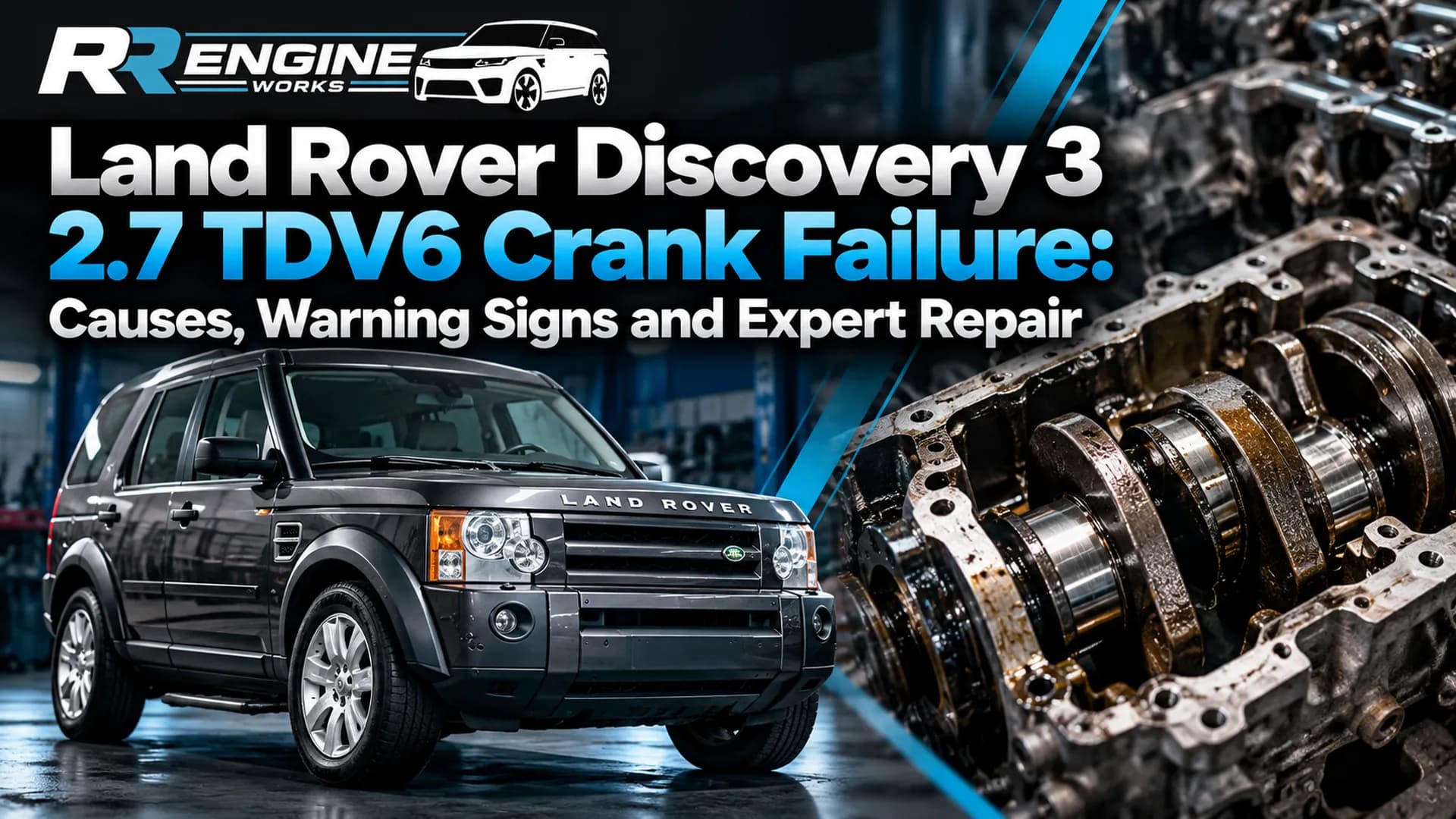
A knock from the bottom end of your Discovery 3, an oil pressure warning that flickers on at idle, then a sudden loss of power. If that sounds familiar, you may be dealing with a land rover discovery 3 2.7 TDV6 crank failure, and every extra mile you drive can turn a repairable engine into a scrap one.
The good news is that a failed crankshaft does not always mean the end of the vehicle. Knowing what went wrong, what your options are, and what each one costs puts you in control of the decision.
This guide explains why the 2.7 TDV6 suffers crankshaft problems, how to spot the early signs, and how specialists repair it. It comes from the engine builders at RR Engine Works, based in Grays, Essex, who work on these engines regularly.
Why Does the Land Rover Discovery 3 2.7 TDV6 Engine Suffer Crankshaft Failure?
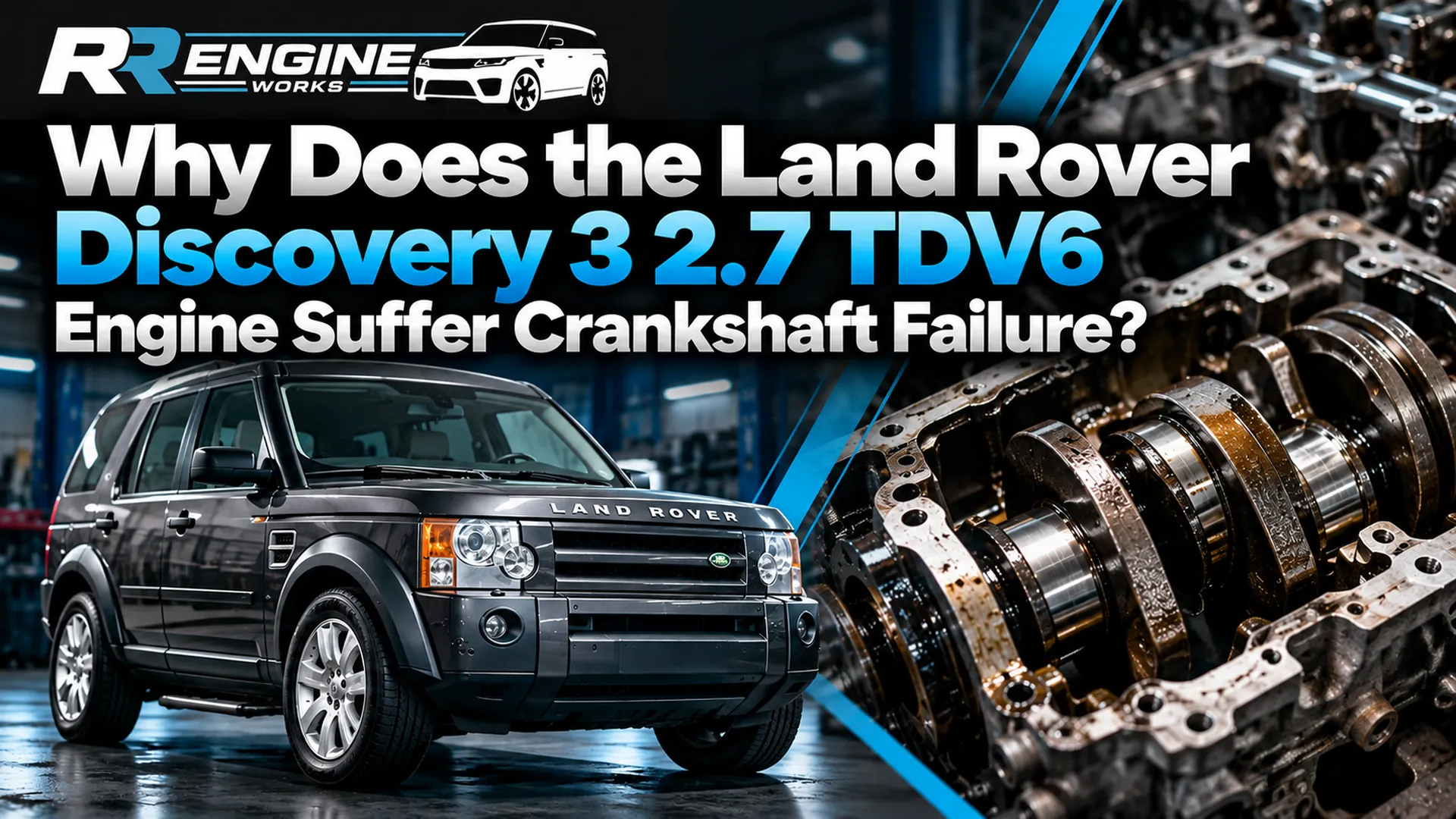
The 2.7-litre twin-turbo diesel V6 (often called the Lion engine) powered the Discovery 3 from 2004 and also appeared in the Range Rover Sport and several Jaguar and Peugeot/Citroën models. It is smooth, torquey and well suited to towing, but its bottom end is its known weak spot.
Crank failure on this engine is rarely a single bad part. It is usually a chain of events, and understanding that chain is the key to both repair and prevention.
What Are the Most Common Discovery 3 2.7 TDV6 Problems Owners Report?
If you have searched for discovery 3 2 7 tdv6 problems, you have probably seen the same list repeated across owner forums. The crankshaft gets the most attention because it costs the most, but it is not the only issue.
The faults we see most often are:
- Oil pump and casing failure, which can drop oil pressure suddenly.
- Crankshaft and bearing damage, including spun big-end or main bearings.
- EGR valve sticking or clogging, causing smoke, poor running and limp mode.
- Turbocharger wear, especially where oil quality has been neglected.
- Plastic coolant manifold cracks, leading to coolant loss and overheating.
These faults are linked. Poor lubrication damages the turbo and the bearings. Overheating adds stress to everything else. A single neglected issue often sets up the next one, which is why a proper diagnosis looks at the whole engine and not just the part that failed.
What Causes Crankshaft Failure in a Discovery 3 TDV6?
There is no single cause, and anyone who claims otherwise is oversimplifying. In practice, most discovery 3 crankshaft failure cases trace back to lubrication, wear, or a combination of the two.
How Does Oil Starvation and the Oil Pump Affect the Crank?
The crankshaft spins on a thin film of pressurised oil. If that film breaks down, even briefly, metal touches metal. Bearings overheat, spin in their housings, and score the crank journals. In worse cases, the crank itself can fracture.
Oil starvation on a TDV6 usually starts in one of these places:
- A worn or cracked oil pump housing that cannot hold pressure
- Blocked oil pick-up or galleries from sludge
- Old oil that has lost its protective properties
- Low oil level between services
Once a bearing starts to spin, the damage spreads quickly. That is why early diagnosis matters so much.
Does Engine Oil Capacity and Service Interval Matter for TDV6 Reliability?
It matters a great deal. The land rover discovery 3 2 7 tdv6 engine oil capacity is roughly 7 litres including the filter, though you should always confirm the exact figure in your handbook and fill to the correct dipstick mark. Overfilling is as harmful as underfilling, because it can aerate the oil and reduce pressure.
Land Rover's official service intervals are long. Many independent specialists, ourselves included, recommend changing the oil and filter far more often, typically every 5,000 to 6,000 miles or at least once a year, using the correct Land Rover-approved low-ash 5W-30 specification. A TDV6 works hard, and fresh oil is the cheapest protection the bottom end has.
Is the Land Rover Discovery 3 2.7 TDV6 Engine Reliable?
Here is the honest answer on land rover discovery 3 2 7 tdv6 reliability: it depends almost entirely on how the vehicle has been maintained.
A well-serviced example, with regular oil changes, a timing belt replaced on schedule and no history of overheating, can run for a very long time. A neglected one, or one with unknown history, is a gamble.
If you are buying a used Discovery 3, ask for the full service history. Look for evidence of oil changes at sensible intervals and listen to the engine from cold. A knock, a rattle or a low oil pressure reading is a reason to walk away or to negotiate hard.
How Can You Tell If Your Discovery 3 Has a Failing Crankshaft?
Crankshaft damage rarely arrives without warning. The challenge is that the early signs are easy to dismiss.
What Are the Early Warning Signs of Discovery 3 Crankshaft Failure?
Watch for these symptoms, particularly if more than one appears together:
- A deep knocking or rumbling from the lower engine, often louder on a cold start or under load
- An oil pressure warning light, even if it only flickers at idle
- Metallic particles or glitter in the oil, visible on the dipstick or at the drain plug
- Rough running, vibration or a sudden loss of power
- Unusual noise that changes with engine speed, not with road speed
None of these automatically means the crank has failed. Each one means the engine needs a proper inspection before it is driven any further.
What Should You Do Immediately If You Suspect Crank Failure?
Stop driving. It sounds blunt, but it is the single most useful piece of advice we can give.
Is It Safe to Keep Driving With a Knocking TDV6 Engine?
No. Continuing to drive with a bottom-end knock can turn a bearing and crank repair into a complete engine replacement. A bearing that has just started to spin can destroy a crank journal in minutes.
If a warning light comes on, pull over safely, switch off and have the vehicle recovered. A recovery bill is small compared with the cost of a destroyed engine.
What Gets Misdiagnosed as Crank Failure on the 2.7 TDV6?
Not every knock is a crank problem, and we would rather tell you that than sell you an engine you do not need. Common look-alikes include:
Symptom | Possible Crank Failure | Other Possible Causes |
| Knocking noise | Bearing or journal damage | Injector fault, loose heat shield, failed dual-mass flywheel |
| Low oil pressure light | Worn bearings, pump failure | Faulty sensor, low oil level, blocked filter |
| Loss of power | Severe internal damage | Turbo fault, EGR blockage, boost leak |
| Rough running | Internal failure | Injector, glow plug or sensor faults |
A correct diagnosis means checking oil pressure with a gauge, inspecting the oil for debris, and, where needed, opening the engine. Guessing can cost you far more than the inspection.
What Are Your Repair Options for a Discovery 3 2.7 TDV6 Crank Failure?

Once failure is confirmed, you generally have three routes. The right one depends on the extent of the damage, your budget and what the vehicle is worth to you.
Should You Repair, Recondition or Replace the Engine?
Option | Best For | Main Advantage | Main Drawback |
| Crank and bearing repair | Localised damage caught early | Keeps your original engine and usually costs less | Depends on the condition of the block and other components |
| Reconditioned or rebuilt engine | Wider internal damage | Fresh internals and tested components | Higher upfront cost |
| Used replacement engine | Tight budgets | Lowest initial price | Unknown history and the same weaknesses may remain |
A used engine looks cheap on paper, but you inherit someone else's maintenance history and the same design weaknesses. For owners who plan to keep the vehicle, a proper repair or rebuild with upgraded parts tends to be the better long-term investment.
What Does a Crankshaft Repair Involve at RR Engine Works?
Every job is different, but a typical repair follows a clear sequence:
- Diagnosis and inspection to confirm the failure and check for related damage.
- Engine removal and strip-down to assess the block, crank, bearings, pistons and oil pump.
- Root-cause identification, so the same failure does not repeat.
- Machining or replacement of the crankshaft and bearings as required.
- Replacement of the oil pump and related lubrication components where needed.
- Reassembly with quality parts, correct torque specifications and fresh seals.
- Testing and a final check, including oil pressure.
Finding and fixing the root cause is the step that separates a lasting repair from a short-term fix.
How Much Does a Discovery 3 TDV6 Crank Repair Cost?
The honest answer is that it varies. Cost depends on the extent of the damage, whether the block is reusable, which parts are replaced and how much related work is needed, such as the oil pump, timing components and ancillaries.
As a general guide, a crank and bearing repair costs significantly less than a full replacement engine fitted by a main dealer. We provide a written quote after inspection, itemised so you can see what you are paying for. Call us on [phone number] for a no-obligation estimate.
Is a TDV6 Crankshaft Upgrade Worth It?
If you are already paying for labour, an upgrade is often the smartest money you will spend. A tdv6 crankshaft upgrade typically means pairing a freshly machined or replacement crank with improved bearings and an upgraded lubrication setup, rather than simply swapping like for like.
The reasons to consider it:
- It addresses the original weak points instead of repeating them.
- Fitting everything during one repair saves duplicated labour.
- A properly rebuilt bottom end gives you far more confidence for towing and long journeys.
Ask any workshop what exactly is being upgraded and what warranty comes with it. Vague answers are a warning sign.
Is It Worth Repairing a Discovery 3 After Engine Failure?
For most owners, yes, provided the rest of the vehicle is sound. A Discovery 3 with a good body, solid chassis and working air suspension is worth far more than its scrap value, and a proper engine repair costs less than replacing the vehicle with something equally capable.
It is less clear-cut if the vehicle also needs major suspension work, has serious corrosion or has high mileage with multiple faults. In that case, we will tell you honestly if repair does not make financial sense. Our aim is the right outcome for you, not the biggest invoice.
Why Choose RR Engine Works for Your Land Rover 2.7 TDV6 Engine Repair?
Choosing who works on your engine is as important as the repair itself. Here is what we think you should look for, and what we do.
What Makes RR Engine Works a Specialist in Land Rover TDV6 Engines?
We focus on engine repair and rebuilds, including the land rover 2 7 tdv6 engine and its common failure points. That focus means we recognise the patterns quickly, from the first listen to the final oil pressure test.
What Parts, Warranty and Repair Standards Do We Offer?
- Quality parts, using OEM or equivalent-quality components appropriate to the job
- A clear, itemised quote before work begins
- Honest advice, including when repair is not the right option
- A warranty on completed work: [insert your warranty terms]
- Testing before handover, so you collect a vehicle we are confident in.
Frequently Asked Questions About Discovery 3 TDV6 Crank Failure
What is the most common engine fault on a Land Rover Discovery 3?
On the 2.7 TDV6, the most serious and most discussed fault is bottom-end failure involving the crankshaft and bearings, often linked to lubrication problems. EGR, turbo and coolant manifold issues are also common.
What causes crankshaft failure in Discovery 3 engines?
Usually a combination of oil starvation, oil pump or casing problems, long oil change intervals and wear. Overheating and neglected maintenance make it more likely.
How long does a TDV6 crankshaft repair take?
It depends on the damage and parts availability. As a rough guide, allow several working days from strip-down to testing. We will give you a realistic timeframe with your quote.
Can the engine be saved without a full replacement?
Often, yes, if the failure is caught early and the block is undamaged. Continuing to drive after the first symptoms is what usually turns a repair into a replacement.
How can I prevent crankshaft failure on my TDV6?
Change the oil and filter at shorter intervals than the official schedule, use the correct specification, check the dipstick regularly, replace the timing belt on time and never ignore an oil pressure warning.
Is the Discovery 3 TDV6 engine reliable?
It can be, with disciplined maintenance. Neglect is what exposes its weak points.
What is the oil capacity of the Discovery 3 2.7 TDV6?
Roughly 7 litres with a filter change. Always confirm against your owner's handbook and the dipstick.
Where is your workshop?
We are at Unit 1, Hedley Ave, Grays RM20 4EL.
Final Thoughts: Act Early to Save Your Engine
A land rover discovery 3 2.7 TDV6 crank failure is serious, but it does not have to be the end of your vehicle. The earlier you act, the more options you keep. Stop driving at the first sign of a bottom-end knock or oil pressure warning, and get a proper diagnosis before making any decisions.
If your Discovery 3 is showing any of the symptoms above, contact RR Engine Works today for an honest assessment and a clear quote. Call [phone number] or visit us at Unit 1, Hedley Ave, Grays RM20 4EL.