

If your Land Rover or Range Rover has thrown up a DPF warning light, you're probably asking two things right now: is this actually serious, and how much is this going to cost me? You're not alone. It's one of the most common faults we see on Ingenium, SDV6 and SDV8 diesel engines, and it rarely happens at a convenient time.
Here's the thing most guides won't tell you upfront: not every DPF warning means you need a full replacement. Sometimes it's a blocked filter that just needs proper regeneration. Sometimes it's a sensor fault mimicking a DPF problem. And sometimes, yes, the filter itself has failed and needs replacing. The trick is knowing which one you're actually dealing with before anyone starts quoting you for parts and labour.
This guide walks you through exactly that — what drives the cost, how pricing differs across Range Rover and Land Rover models, and how a proper diagnostic process tells you whether you need cleaning, regeneration, or full replacement.
What Determines the Cost of Land Rover & Range Rover DPF Replacement?
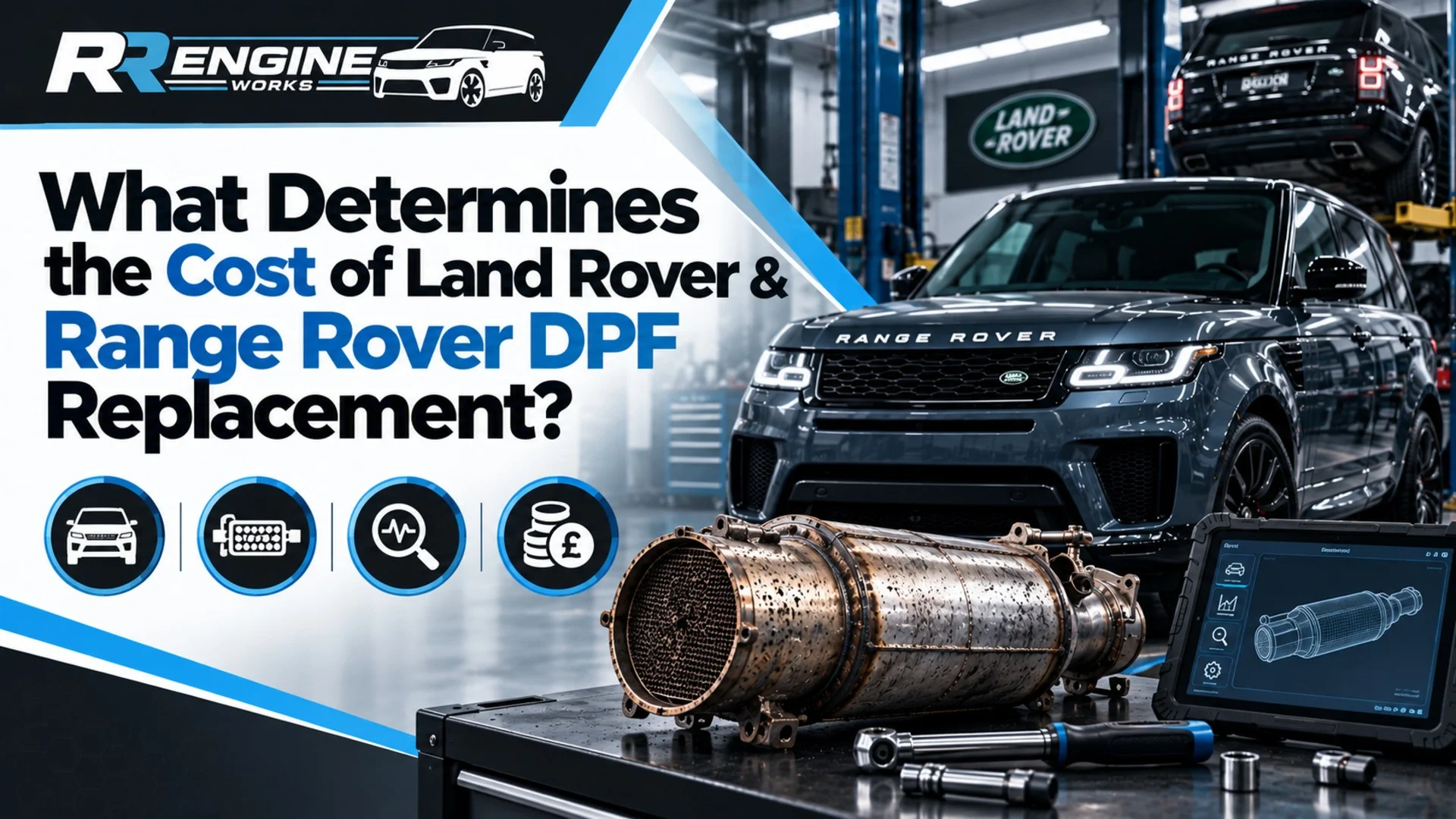
There's no single "correct" figure for DPF replacement, and anyone who quotes you one number without seeing your vehicle first is skipping a few steps. The final price depends on a combination of parts, labour, and diagnostic work — and each of those varies significantly by model and condition.
Genuine (OEM) vs Aftermarket DPF – Which Costs More?
This is usually the biggest single factor in your final bill.
Why OEM parts command a premium Genuine Jaguar Land Rover parts are manufactured to exact factory tolerances, which matters more with a DPF than most people realise. The filter has to handle precise exhaust flow, back pressure, and regeneration temperatures. A slightly wrong tolerance can trigger repeated fault codes even after replacement — which is exactly the outcome you're trying to avoid.
When aftermarket is a safe alternative Aftermarket DPFs from reputable manufacturers can be a legitimate cost-saving option, particularly on older Discovery and Freelander models where OEM part availability is limited or the vehicle's resale value doesn't justify a full genuine part. The key is sourcing from a manufacturer with a proven fitment record for your specific engine — not just the cheapest listing you can find.
Labour, Access & Exhaust Component Factors
On paper, a DPF sits in one spot on the exhaust. In practice, getting to it is often the harder part of the job.
- Seized fixings: Exhaust bolts and clamps on vehicles that have covered serious motorway mileage, or spent years in wetter UK climates, often seize solid. Removing them without damaging surrounding components takes time and the right equipment.
- Gasket replacement: Once the DPF housing is disturbed, gaskets typically need replacing regardless of their current condition, since reusing a compressed gasket risks an exhaust leak.
- Component removal order: On some Range Rover Sport and Vogue models, other exhaust or underbody components need removing first just to get workable access to the DPF housing.
None of this is padding on an invoice — it's genuinely part of the job, and it's why two vehicles with the "same" fault can end up with different labour times.
Sensors, ECU Programming & Diagnostic Work
DPF pressure sensor & temperature sensor replacement The differential pressure sensor and exhaust temperature sensor work alongside the DPF to monitor soot load and regeneration temperature. If either has failed, it can present as a DPF fault even when the filter itself is fine. A proper diagnostic check should always rule these out before parts are ordered.
Does a new DPF need ECU/PCM coding? Yes, in most cases. After a physical DPF replacement, the ECU or PCM typically needs to be adapted or reset so the vehicle recognises the new filter's baseline pressure and soot-load values. Skipping this step is a common reason a warning light returns within days of a replacement — the part is fine, but the software still thinks it's dealing with the old, blocked filter.
DPF Replacement Cost by Model – Range Rover & Land Rover
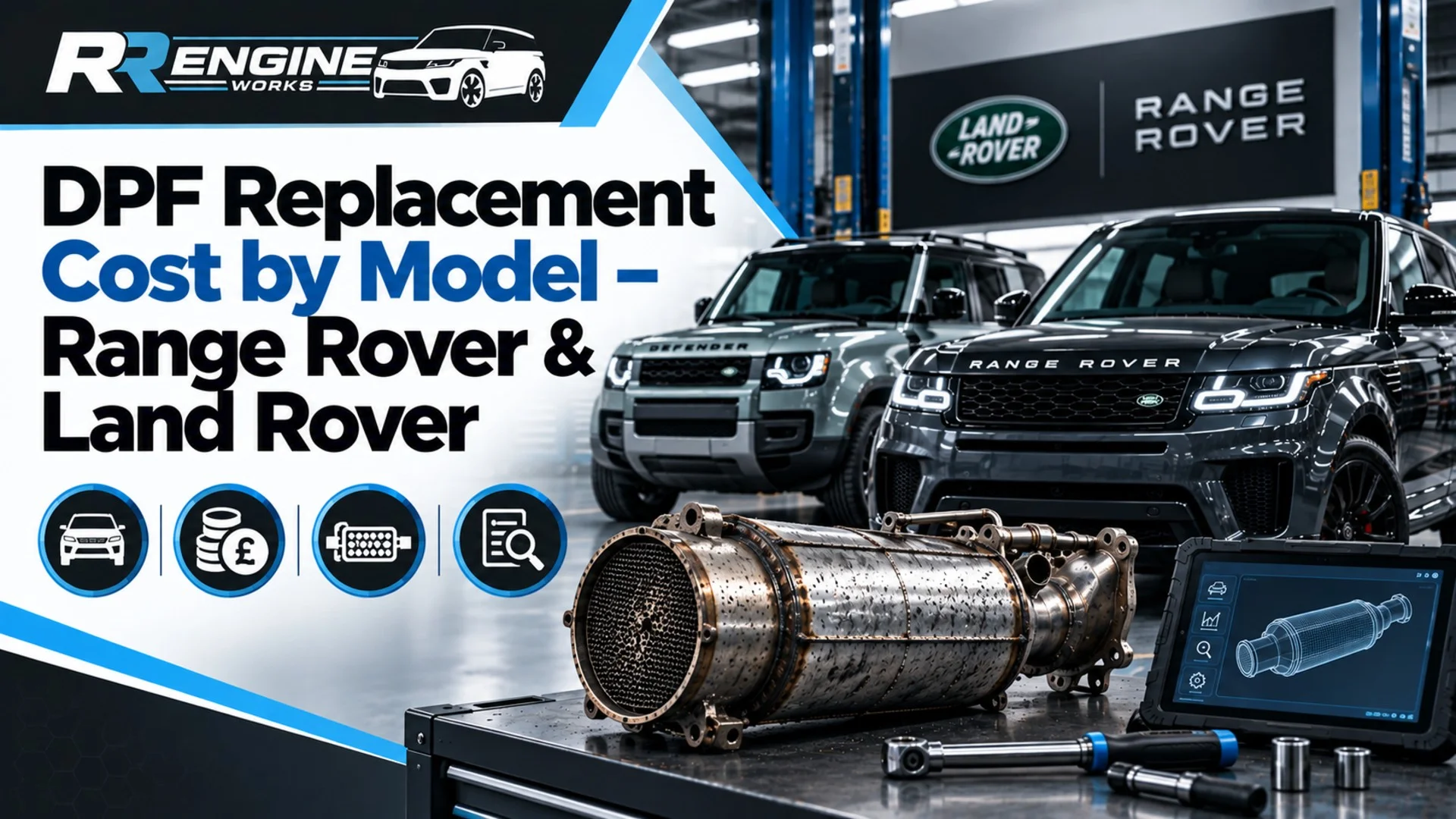
Model-specific detail matters here because engine size, DPF positioning, and typical mileage patterns all shift the cost equation. Below is how the major models compare.
Model | Common Engine | Typical DPF Access | Cost-Driving Factors |
| Range Rover Evoque | 2.0 Ingenium diesel | Moderate | Sensor faults common; regeneration issues from short journeys |
| Range Rover Sport | 3.0 SDV6 | More involved | Larger filter, higher parts cost, more labour-intensive access |
| Range Rover Vogue | 4.4 SDV8 | Complex | Premium OEM part pricing, extensive underbody work |
| Range Rover Velar | Diesel variants | Moderate | Newer platform, generally good part availability |
| Discovery / Discovery Sport | 3.0 TDV6/SDV6 | Varies by generation | Older units more prone to seized fixings |
Range Rover Evoque (2.0 Ingenium) DPF Replacement
The Evoque's Ingenium diesel is particularly sensitive to short, stop-start journeys that never let the exhaust reach regeneration temperature. Over time, this leads to persistent soot loading. We see a high proportion of Evoque DPF issues where the sensor, not the filter, turns out to be the actual culprit — which is exactly why diagnosis before replacement matters so much on this model.
Range Rover Sport (3.0 SDV6) DPF Replacement
The SDV6's DPF sits in a position that generally requires more disassembly to reach. Combine that with a larger, more expensive filter unit, and Sport models tend to carry higher overall replacement costs than the Evoque. The upside is that when the job is done properly with correct ECU adaptation, these units tend to run reliably afterward.
Range Rover Vogue (4.4 SDV8) DPF Replacement
The V8 diesel Vogue sits at the top end of the cost range, largely because of premium genuine part pricing and the amount of underbody work involved in accessing the filter. This is a model where the OEM vs aftermarket decision genuinely matters — the price gap between the two options is often more significant than on smaller-engined models.
Range Rover Velar DPF Replacement
As a newer platform, the Velar generally benefits from better part availability and fewer seized-fixing issues compared to older Range Rover models. That said, its diesel variants are still subject to the same regeneration-related soot buildup as the rest of the range.
Land Rover Discovery & Discovery Sport DPF Replacement
Discovery models — particularly older Discovery 3 and 4 units with the 3.0 TDV6 — are more prone to seized exhaust fixings simply due to age and mileage. Discovery Sport, sharing more components with the Evoque/Velar platform, tends to follow similar patterns to those models.
Why prices vary so widely between models The short answer: engine size dictates filter size and cost, exhaust layout dictates labour time, and vehicle age dictates how much of a fight the fixings put up. A ten-year-old Discovery and a newer Velar can have an identical fault code but a very different bill, purely because of these three factors.
DPF Cleaning vs Regeneration vs Full Replacement – Which Do You Actually Need?
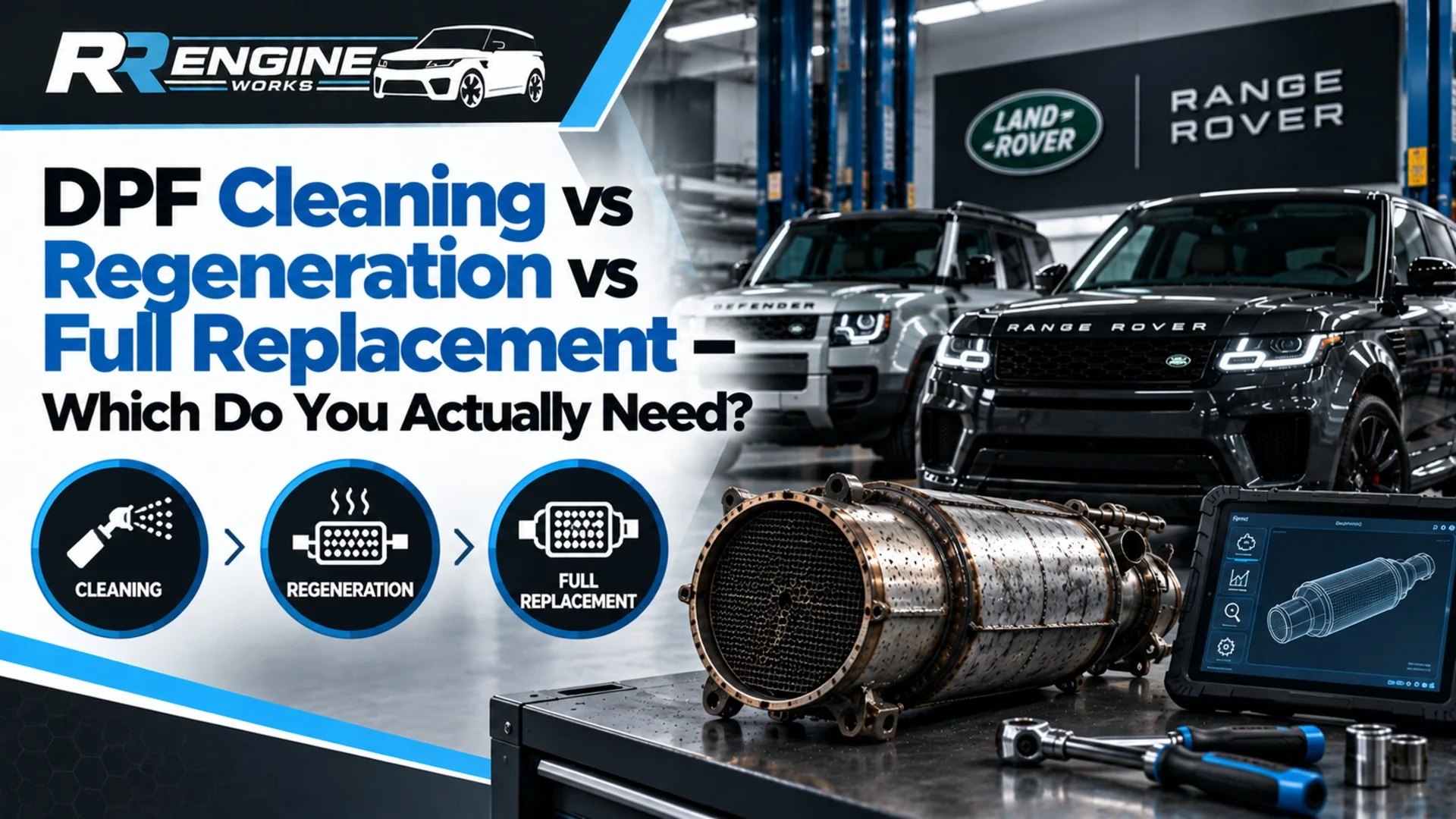
This is the section most DPF guides skip, and it's arguably the most important one for your wallet. A DPF warning light doesn't automatically mean the filter needs replacing.
Symptoms of a Blocked or Failing DPF
DPF warning light & limp mode The most obvious sign is the dashboard warning light itself, sometimes accompanied by a message urging you to keep driving at higher speed to allow regeneration. If ignored long enough, the vehicle may enter limp mode, restricting power to protect the engine and exhaust system.
Poor fuel economy & repeated failed regeneration A DPF working harder than it should — because it's partially blocked — pushes fuel consumption up. If you've noticed the regeneration cycle kicking in repeatedly without successfully completing (often signalled by unusually high idle revs for several minutes), that's a strong indicator of a blockage that passive driving alone won't clear.
How We Diagnose Your DPF Before Recommending Any Repair
Differential pressure test This measures the pressure difference across the filter to assess how restricted the exhaust flow actually is. A high reading points to a genuine blockage rather than a sensor or software issue.
Fault code scan (P2002, P2463, P242F & more) A full diagnostic scan checks for specific DPF-related codes, each pointing to a different underlying issue:
- P2002 — DPF efficiency below threshold, often indicating filter damage or excessive wear
- P2463 — Soot accumulation, typically pointing to a blockage rather than filter failure
- P242F — Ash accumulation, common on higher-mileage vehicles
- P2452 / P2453 — Pressure sensor circuit or performance faults, which can mimic a DPF problem entirely
- P244A / P244B — Differential pressure readings too low or too high, pointing toward either a sensor fault or a genuine restriction
Reading these codes correctly is the difference between replacing a £[part] DPF unnecessarily and fixing a £[sensor] pressure sensor that was the actual cause all along.
When Cleaning or Regeneration Is Enough (And You Don't Need Full Replacement)
If the diagnostic scan and pressure test show a soot-loaded but structurally sound filter, professional cleaning or a forced regeneration cycle can often restore normal function — no replacement necessary. This is typically the case for vehicles that have done a lot of short-journey, stop-start driving without ever getting the exhaust hot enough to self-clean.
Cracked or melted substrate – when replacement is unavoidable If the physical inspection reveals a cracked or melted ceramic substrate inside the filter, no amount of cleaning or regeneration will fix it. At that point, replacement is the only option — and it's exactly the outcome our diagnostic process is designed to confirm before, not after, you've paid for unnecessary work.
Frequently Asked Questions About Land Rover & Range Rover DPF Replacement
How long does a Land Rover DPF replacement take?
Most replacements are completed within a working day, though this depends heavily on how accessible the DPF is on your specific model and whether any fixings have seized. Vehicles requiring extensive underbody disassembly, like some Vogue and Discovery models, can take longer.
Does replacing the DPF clear the warning light?
Not automatically. The warning light typically needs to be cleared through ECU/PCM programming after the physical replacement is complete. If a garage replaces the part but skips this step, the light — or a related fault — can return.
How can I extend the life of my DPF after replacement?
Regular motorway or sustained higher-speed driving gives the exhaust the chance to reach the temperature needed for passive regeneration. Using the correct low-SAPS engine oil also matters significantly, since the wrong oil type contributes to faster ash accumulation inside the filter. Avoiding constant short journeys is the single biggest thing you can do to protect a new DPF.
Do you offer a warranty on DPF replacement work?
We back our DPF replacement and diagnostic work with a warranty covering both parts and labour, giving you confidence that the fix is done right the first time, not something you'll be paying to redo in a few months.
Book a DPF diagnostic or replacement at RR Engine Works, Grays
If your Land Rover or Range Rover has a DPF warning, don't jump straight to a replacement quote without knowing what's actually wrong. At RR Engine Works, based at Unit 1 Hedley Ave, Grays RM20 4EL, we run a full diagnostic scan and differential pressure test before recommending any repair, whether that's cleaning, regeneration, sensor replacement, or a full DPF swap.
We work across the full Range Rover and Land Rover lineup, from Evoque and Sport to Discovery and Vogue, using genuine and quality-matched aftermarket parts depending on what suits your vehicle and budget.
Get in touch to book a diagnostic check, and we'll tell you exactly what your vehicle needs — not just what's easiest to sell you.